
From 1 January 2026, UK “crypto-asset service providers” in other words crypto exchanges, will be required to collect all user and transaction data for 2026 and then report that data to HMRC by 31 May 2027.
This will be an ongoing requirement and is part of the Crypto-Asset Reporting Framework (CARF) being adopted by 47 countries such as the United Kingdom, South Africa, Brazil, Indonesia and many more.
The United States is set to join this requirement by 2029, so will likely collect all user data on exchanges from 2028 onwards, and then report it to their local tax authority (the IRS).
Summary
What Information Will Exchanges Report?
Exchanges will collect and report:
- Name
- Date of birth
- Home address
For every transaction, exchanges will collect and report:
- Value
- Type of crypto asset
- Number of units
What this means is that the tax authority in each of these countries adopting CARF will know exactly how much crypto you have on exchanges, the value, your age, your name and your address. This data will be sent to them by crypto exchanges registered in those countries adopting CARF.
Some countries have delayed the adoption of CARF for one year, such as Switzerland, Thailand, Australia and Canada. So they would not collect data until 2027.
Some notable countries that have not committed to adopting CARF include El Salvador and Vietnam.
The collecting of data by crypto exchanges such as Coinbase, Kraken and Binance comes into effect from 1 January 2026.
Privacy and Security Concerns
This is a lot of private customer information being transmitted between crypto exchanges and state tax authorities. Furthermore, the information can be shared between tax authorities internationally with those countries taking part.
This raises some security concerns given that we have seen hacks and security breaches in the past. If this information was to be hacked it would give sensitive information such as where you live, your age and how much crypto you potentially have.
We already know that exchanges are a prime target for hackers, information such as this would essentially tell them who to target, and sending it all to tax authorities around the world would give hackers another target to aim at.
How to Buy and Store Crypto Without KYC
As exchanges across the world prepare to collect and report user data to tax authorities, users have 30 days from today to review their options to keep their information private if they do not wish it to be collected and reported.
Countries like Vietnam and El Salvador have not committed to sharing data with tax authorities automatically. Another option is that self-custody wallets are not required to collect or report data.
Unlike exchanges, self-custody wallets give you access to your own private keys and therefore ownership of your assets. Several self-custody wallets require nothing more than an email, no address details, just simply an email at most to buy and store your crypto.
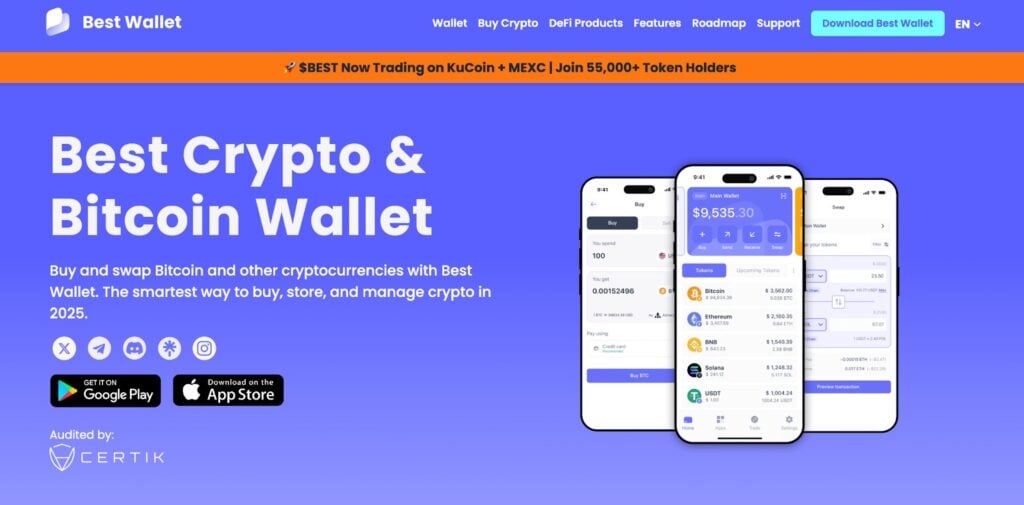
One self-custody wallet which is easy- to-use and comes without KYC is Best Wallet. This absence of identity verification appeals to users who prioritize financial privacy, especially in regions like the United Kingdom where authorities continue to enforce external oversight.
It effortlessly protects users’ personal and financial data without compromising access to essential trading and storage tools. Unlike a traditional wallet, Best Wallet prides itself as a complete Web3 ecosystem that allows users to buy, trade, and manage thousands of crypto assets freely.
Another key advantage is the ease of purchasing cryptocurrencies, thanks to its easy-to-navigate interface. Built with user convenience in mind, Best Wallet features a clean and well-organized layout that’s easy for anyone, including newbies to navigate.
The home screen is tailored to ensure quick access to all the features embedded in the wallet. Icons are very responsive, and with just simple tabs, users can explore the opportunities in the market effectively.
At the same time, Best Wallet supports tools that enable seamless portfolio management, cross-chain swaps, staking, on-chain trading, and fiat payments, all without relying on intermediaries. In terms of its multichain capacity, it currently supports six blockchains, including Ethereum, Bitcoin, Solana, Base, Binance Smart Chain, and Polygon, with plans to add more in the future.
There’s even the allure of discovering and investing in promising early-stage cryptocurrencies through its “Upcoming Tokens” feature. Many crypto-focused publications and channels, including 99Bitcoins have praised Best Wallet’s extensive features, dubbing it the best wallet for 2025.
This article has been provided by one of our commercial partners and does not reflect Cryptonomist’s opinion. Please be aware our commercial partners may use affiliate programs to generate revenues through the links on this article.