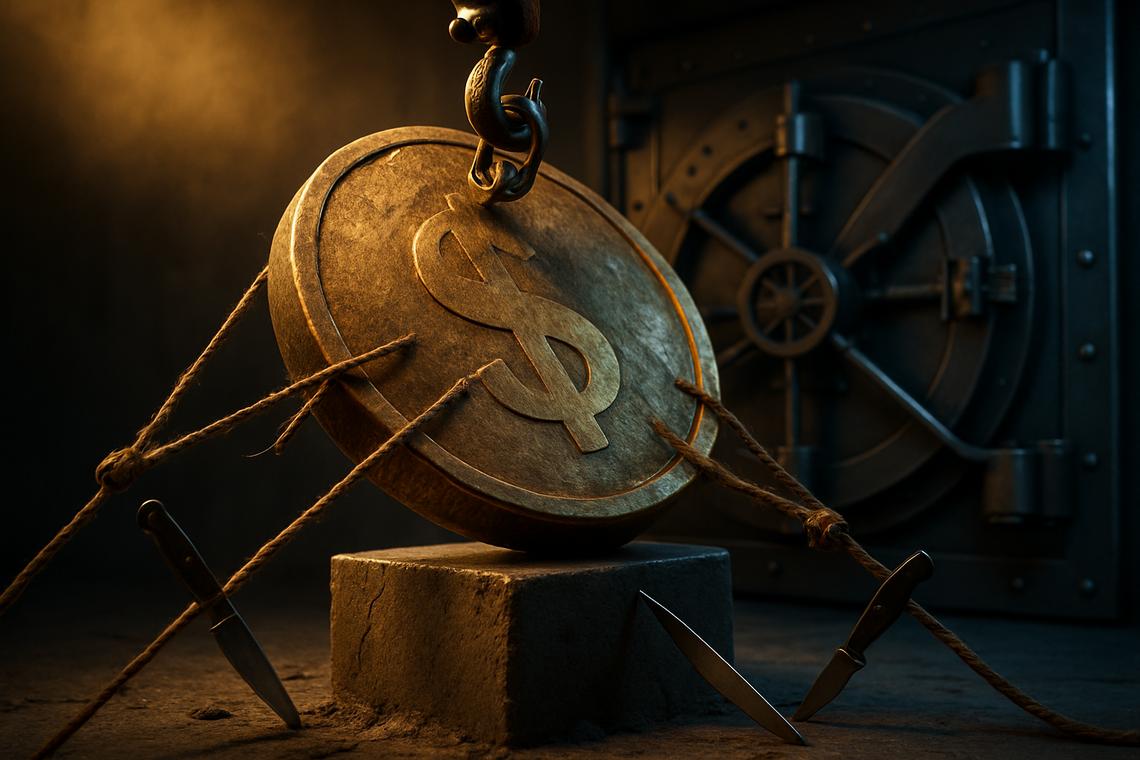
Following a sudden market disruption, the usd1 stablecoin briefly lost its peg on Monday before recovering, drawing renewed scrutiny to World Liberty Financial and its deep crypto ties.
Summary
Attack briefly knocks USD1 off its dollar peg
World Liberty Financial (WLFI), the crypto project backed by President Donald Trump and his sons, said it suffered a coordinated attack on Monday that temporarily pushed the USD1 token below its $1 target.
According to CoinGecko data, USD1 slipped to $0.994 at its lowest point, around 0.6% under its intended peg, before recovering to trade in the $0.998 to $0.999 range later in the day.
WLFI‘s native asset, the WLFI token, also came under pressure during the turmoil. Its price dropped about 7% at the height of the incident, though it later clawed back some of those losses.
World Liberty claimed on X that attackers compromised several co-founder accounts as part of the operation. Moreover, the project said the assault combined social engineering, aggressive trading strategies, and third-party promotion to amplify damage.
Hacked accounts, short sellers, and paid influencers
The company alleged that hackers took control of multiple senior team accounts, which were then used to spread misleading information and sow doubt among token holders. That said, WLFI has not yet disclosed detailed forensic findings.
At the same time, short sellers reportedly opened large positions against the WLFI token, betting that negative sentiment would trigger a sharper price decline. This alignment of hacked accounts and market bets raised concerns about deliberate market manipulation.
World Liberty also accused unnamed parties of funding paid influencer campaigns designed to amplify fear, uncertainty, and doubt, or FUD, across social media. According to the firm, those efforts sought to push retail traders into panic selling both WLFI and USD1.
The stated goal of the campaign, World Liberty said, was to “manufacture chaos” around the project and profit from rapid price swings in its assets.
How USD1’s design limited the damage
The team argued that the token’s underlying structure helped contain the impact of the attack. In particular, World Liberty highlighted its stablecoin mint and redeem model, which lets users exchange each USD1 directly for one US dollar.
In its X post, the company said: “Thanks to USD1’s sound mint-and-redeem mechanism and full 1:1 backing, we are trading steadily at par.” However, market data still showed trading slightly below the ideal $1 level during the aftermath.
USD1 is fully backed 1:1 by a mix of short-term US government treasuries, dollar deposits, and cash equivalents. Crypto custodian BitGo oversees the reserve portfolio, while consulting firm Crowe provides monthly attestation reports to confirm those holdings.
The usd1 stablecoin currently has a market capitalization of about $5 billion, placing it well behind larger rivals such as Tether’s USDT and Circle’s USDC in overall supply. Nevertheless, its rapid growth has made it a central player in certain trading venues.
Binance’s dominant role raises questions
The timing of the attack drew attention because it occurred just days after WLFI organized a high-profile crypto forum at Trump’s Mar-a-Lago resort in Florida. The event featured government officials, banking executives, and former Binance CEO Changpeng Zhao as speakers.
Trump pardoned Zhao in October 2025. Previously, Zhao had served four months in prison under a 2023 settlement with US authorities that also barred him from returning as chief executive of Binance.
According to Forbes, Binance currently custodies roughly 87% of all USD1 in circulation, holdings valued at around $4.7 billion. Moreover, both Bloomberg and The Wall Street Journal have reported that Binance played a key role in helping create USD1.
The stablecoin was used in March 2025 to settle a $2 billion investment from UAE-based firm MGX into Binance, those reports said. This deep integration has focused attention on binance usd1 holdings and the exchange’s broader influence over the asset.
Political scrutiny over Trump and Zhao ties
Against this backdrop, some US lawmakers are now questioning whether Trump’s pardon of Zhao, combined with WLFI’s links to Binance, represents a potential conflict of interest. However, no formal enforcement actions have been announced to date.
For his part, Zhao said in January that there were “no business relationships whatsoever” between himself and the Trump family. He also stressed that he did not intend to return as head of Binance, despite ongoing speculation in crypto circles.
At the time of writing, USD1 was trading at approximately $0.998 to $0.999, still fractionally below its $1 target but well above the intraday low. That said, the episode has renewed debate over transparency, concentration risk, and political exposure surrounding emerging dollar-pegged assets.
In summary, World Liberty Financial’s handling of the brief usd1 peg loss, the resilience of its redeem mechanism, and Binance’s outsized role will remain central factors as regulators, traders, and policymakers assess the stablecoin’s long-term credibility.