
Summary
How Bitcoin Cycles Work
Bitcoin cycles are often interpreted through a rather simple lens: that of the repetitiveness linked to the Bitcoin halving. Historically, the periodic reduction of the new BTC supply has coincided with a fairly recognizable sequence of market phases. After the halving, an accumulation phase tends to give way to a bull market that culminates in a peak about a year or a year and a half later, followed by a period of correction and consolidation.
This apparent regularity has led many investors to view the Bitcoin cycle as an almost predictable mechanism. However, over the years, it has become increasingly evident that the halving is just one of the elements influencing market trends. Macroeconomic factors such as global liquidity, central bank monetary policies, and the evolution of the crypto market structure play an increasingly important role.
Moreover, the growing maturity of the sector, marked by the entry of institutional investors, the spread of regulated financial instruments such as ETFs, and greater integration with traditional markets, is gradually altering Bitcoin’s cyclical behavior. For this reason, even though the reference to the halving remains central in the debate among analysts and investors, each new cycle tends to develop differently from the previous ones.
One of the most debated comparisons today concerns the potential contrast between 2022 and 2026. At first glance, both years appear to represent market cooling periods. In reality, upon closer examination of the data and macroeconomic context, profound differences emerge.
Understanding these differences is crucial for correctly interpreting the current Bitcoin cycle.
2022: The Great Crypto Market Crisis
The year 2022 was one of the most challenging in the history of the crypto sector. After reaching an all-time high in November 2021 near $69,000, the market began a long and painful decline. The downturn was not solely due to cyclical dynamics. It was a true systemic crisis in the sector. Within a few months, some of the pillars of the crypto ecosystem collapsed (see Terra Luna, Celsius, and the FTX exchange).
These events triggered a domino effect that led to forced liquidations, loss of confidence, and capital flight. The price of Bitcoin fell to around $15,500, recording a drawdown of approximately 77% from its all-time high. The sentiment was extremely negative, and many analysts were openly discussing the end of the sector.
This context makes 2022 a unique case in the history of Bitcoin cycles. It was not just a bear market, but a phase in which the sector eliminated many of its structural weaknesses. The collapse of unsustainable projects, business models based on excessive leverage, and opaque platforms led to a sort of market reset, reducing the excesses accumulated during the previous expansion phase.
The Bitcoin Cycle After the 2024 Halving
The cycle initiated with the April 2024 halving is unfolding in a very different environment compared to the past. Three factors have transformed the market:
- The approval of spot Bitcoin ETFs in the United States
- The entry of institutional investors
- Greater integration with the traditional financial system
Spot ETFs have made Bitcoin accessible to a much wider audience of investors. Pension funds, asset managers, and large financial institutions can now gain exposure to the asset without having to directly manage the custody of cryptocurrencies.
This has increased structural demand and has reduced, at least in part, the extreme volatility that characterized previous cycles. In other words, today’s market is larger, more liquid, and more integrated with the global financial system.
The Role of Halving in Bitcoin Cycles
Historically, Bitcoin has shown a certain regularity linked to the halving, the event that halves the reward for miners. The typical cycle pattern has often been described as follows:
- Halving year: accumulation phase
- Following year: strong bull market
- Following year: formation of the top
- Last year of the cycle: bear market and consolidation
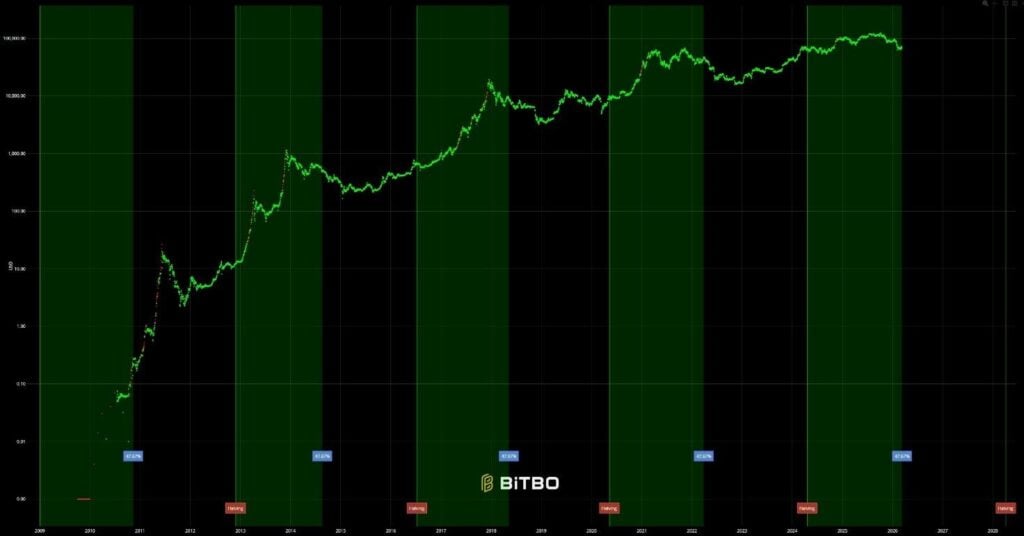
Figure 1 – Bitcoin Price and Halving Cycles (source BiTBO)
Following this logic, the 2024 halving should have led to a phase of strong growth in 2025 and a possible peak between the end of 2025 and 2026, confirming that the top of this cycle might have already been marked last October.
However, in recent cycles, an interesting phenomenon has been observed: the time between the halving and the market peak is progressively lengthening.
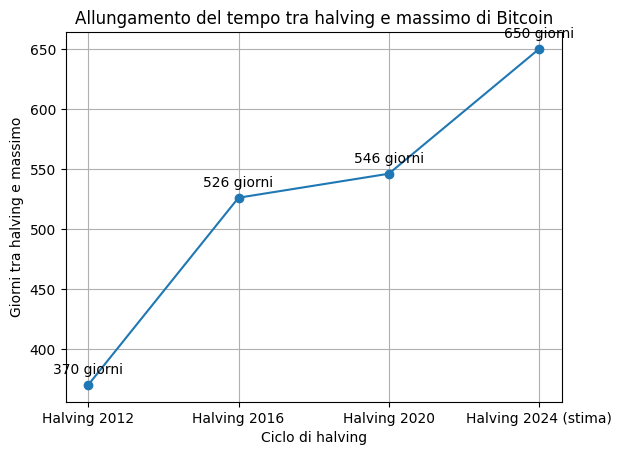
Figure 2 – Days between halving and cycle peak
In the 2012 cycle, the peak occurred approximately 370 days after the halving.
In the 2016 cycle, the peak arrived approximately 526 days later.
In the 2020 cycle, the peak occurred approximately 546 days later.
If the trend continues, the current cycle could see its peak around 650 days after the 2024 halving or perhaps more. This would place the timeframe for the top between the end of 2025 (where a peak was indeed made) and the first half of 2026, where there might still be room for a new bullish impulse.
Crash or Simple Correction? The Role of Global Liquidity
One of the central elements in the comparison between 2022 and the potential scenario of 2026 concerns the nature of the downturn. In 2022, the market experienced a systemic collapse. The downfall of major crypto platforms triggered a crisis of confidence that led to indiscriminate selling. The drawdown was among the deepest in Bitcoin’s history, a true crash.
In the current cycle, however, many analysts believe that the phase following the bull market could be much less volatile. Several factors support this hypothesis: The presence of institutional investors with longer time horizons, increased market liquidity, and a more robust financial infrastructure.
For this reason, some models suggest that the next bear market might resemble more of a cyclical correction, with a drawdown ranging between 50% and 60%, lower than the over 75% of previous cycles, with the 50% from last October’s highs already reached at the beginning of 2026.
In recent years, many analysts have begun to pay closer attention to the relationship between Bitcoin and the global liquidity of financial markets. The growth of the global money supply, often referred to as the M2 aggregate, appears to have a significant correlation with Bitcoin’s movements.
When global liquidity increases, investors tend to shift towards more risky and volatile assets. Bitcoin, being one of the most speculative assets in the financial markets, often benefits from this dynamic. Conversely, when central banks tighten liquidity and raise interest rates, capital tends to exit risky assets. This pattern was evident in the transition between 2021 and 2022, when the monetary tightening by central banks coincided with the onset of the crypto bear market.
The behavior of global liquidity could therefore be one of the decisive factors in determining whether the current cycle concluded with the peak in October 2025 or will extend into 2026 with a new rally.
Bitcoin in 2026: Possible Market Scenarios
In light of these dynamics, 2026 could represent a very different phase compared to 2022. Instead of a systemic crisis, it might simply be a distribution phase following the bull market. In this scenario (assuming October 2025 was not the new peak), the market could experience one last rally or phase of euphoria, with the formation of the cycle’s peak, followed by a correction and consolidation phase between the end of 2026 and 2027.
Clearly, we don’t have a crystal ball to say for certain, but this type of evolution would be consistent with the market’s growing maturity. Looking at the evolution over the past ten years, a clear trend emerges: Bitcoin is progressively becoming a more mature financial asset. The cycles haven’t disappeared, but they are changing shape.
The fluctuations remain wide compared to traditional assets, but the extreme volatility seems to be slowly decreasing with the increase in capitalization and institutional participation. The comparison between 2022 and the possible scenario of 2026 precisely reflects this transformation: The former represents the trauma of a still young and fragile sector. The latter could be the signal of a market entering a more mature phase.
If this trend continues, Bitcoin cycles could become less volatile, longer, and increasingly tied to global macroeconomic dynamics. For this very reason, the next chapter in Bitcoin’s history could be very different from those that preceded it.
Until next time, and happy trading!
Andrea Unger