



Crowds, strong sales, and blue-chip names made Hong Kong Art Week look familiar on the surface, yet beneath the gloss the hong kong art market is clearly shifting.
Summary
A cooler sales tempo behind busy aisles
This year’s Hong Kong Art Week functioned as a live test of the global art market’s emerging “new normal.” At first glance, Art Basel Hong Kong appeared robust: aisles were busy, deals closed, and social events drew tech founders and celebrities. However, dealers privately described a slower, more cautious rhythm in how transactions actually unfolded.
After three years of downturn, there are signs of recovery, but collectors show little urgency to buy. Moreover, many galleries came prepared to play the long game when placing works at Art Basel Hong Kong, accepting that negotiations might stretch well beyond the fair’s opening hours.
Sales were still meaningful. Bastian reported a $4 million Pablo Picasso. At David Zwirner, paintings by Liu Ye and Marlene Dumas sold for $3.8 million and $3.5 million. Hauser & Wirth placed a $2.95 million Louise Bourgeois. However, Hauser’s president noted that closing another Bourgeois, brought in the previous edition, took nine months, underscoring slower collector buying behavior.
That said, first-day sales—often pre-sold before doors open—still set the tone. Yet the wider market is shifting to a more extended tempo, where considered decision-making replaces the rapid-fire deals that characterized earlier boom years.
War, oil and rising art shipping costs
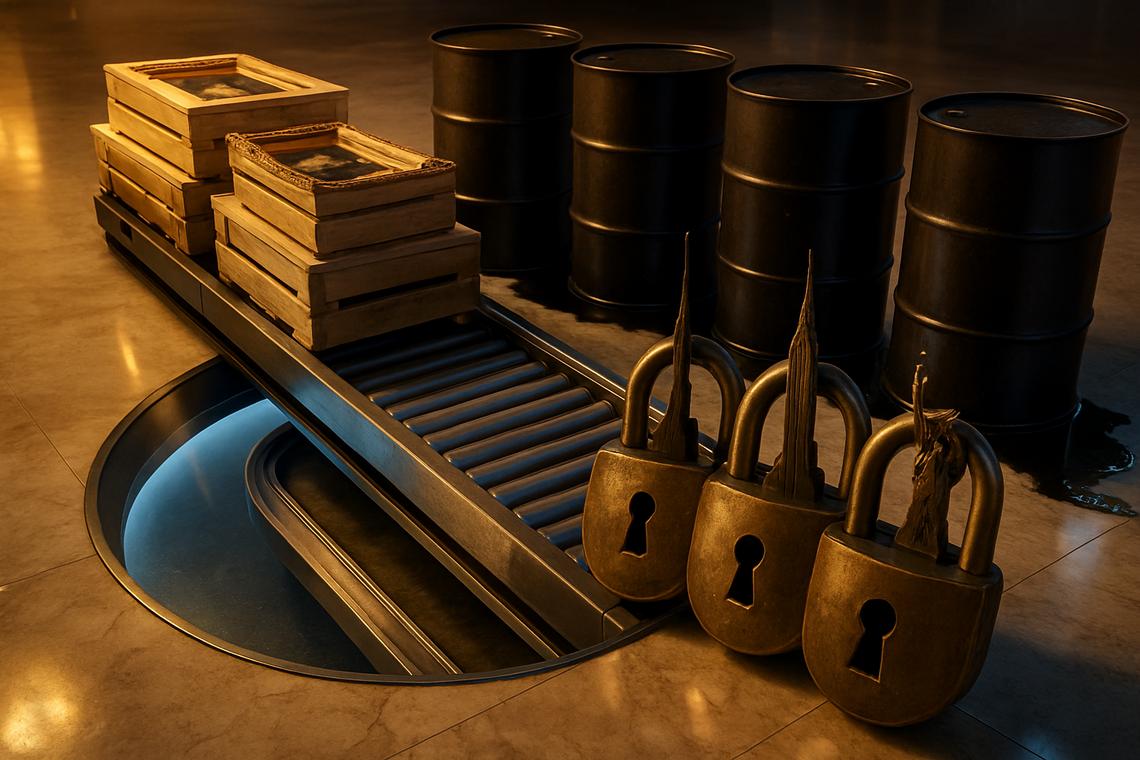
The ongoing conflict in the Middle East has not yet derailed global financial markets, but it has pushed up oil prices. Consequently, fuel-driven expenses are rippling through the art trade’s logistics chain. Rising art shipping costs are expected to sharply increase return transport from Hong Kong once the fair closes.
According to Dietl International Services, return shipping prices to the U.S. from the fair are projected to climb by about 50 percent. Moreover, those hikes could prompt hesitant buyers to delay closing deals, even when they have already expressed interest in pieces shown in the city’s fairs and galleries.
Some collectors may instead opt to place purchases into storage, waiting for conditions to improve before shipping. Activity at freeports often mirrors global geopolitical stress. In this context, Singapore’s Le Freeport, founded by dealer Yves Bouvier, has reportedly been “extremely busy” as clients move to secure and warehouse their assets.
However, the increased reliance on freeport art storage also highlights how risk management is becoming central to art ownership. Storage decisions are no longer purely about discretion or tax efficiency; they now reflect concerns about volatility in trade routes, energy prices, and regional security.
Regionalization reshapes the global art market
The global scene is becoming more fragmented into distinct art regional markets, and this shift was visible in Hong Kong. While auction sales rose in the U.S., U.K., and France in 2025, they continued to decline in China. According to Artnet’s latest Intelligence Report, Chinese auction sales fell by 10.8 percent year over year.
Economist Clare McAndrew, writing in the Art Basel and UBS Art Market Report, noted that the combined share of dealer and auction sales in the U.S., U.K., and China remained the bulk of global trade. However, that combined share is now at its lowest level in a decade, pressured by China’s retreat and the rise of other Asian and emerging hubs.
Moreover, observers pointed to the absence of several major Indian and Thai galleries that had been regulars at Art Basel Hong Kong in previous years. That said, their pullback does not signal an end to regional engagement. Instead, it suggests that galleries are weighing costs, political risk, and proximity to core clients more carefully when choosing where to show.
These patterns imply that the phrase hong kong art now carries more regional nuance. The city remains a crucial gateway, but power is diffusing to neighboring centers, altering how collectors and dealers allocate time, inventory, and capital across Asia.
Hong Kong’s policy push to defend its role
Despite the headwinds, Hong Kong is far from “falling off the map.” Like other financial hubs, it is being forced to compete harder for business. The city’s government has introduced rule changes allowing a broad range of asset managers to earn performance fees tax-free, aiming to put itself on more equal footing with Dubai and Abu Dhabi.
The city’s chief executive has also argued that the current conflict in Iran could bring both “opportunities” and risks for Hong Kong. Moreover, as capital re-routes around sanctions, energy shocks, and geopolitical tension, policymakers see a chance to reassert the city’s role as a bridge between Asia and global investors.
For the art trade, these fiscal reforms matter. Tax treatment, regulatory clarity, and banking access all shape where high-net-worth collectors base their operations. However, even favorable rules cannot fully offset higher logistics costs or the more cautious stance many buyers now take.
That said, the broader global art market is undergoing a structural realignment that plays to Hong Kong’s traditional strengths in finance and cross-border deal-making, provided it can maintain confidence among galleries and collectors.
A market being rewired
Across Art Week, a clear picture emerged: the recovery after several difficult years is real but fragile. Buying is slower, expenses are climbing, and the geography of the business is fragmenting as new regional centers contest dominance. Moreover, shipping, tax, and political factors weigh more heavily on decisions once driven mainly by taste and trend.
In this context, Hong Kong’s efforts to sharpen its financial edge look less like isolated policy tweaks and more like part of a sweeping reconfiguration of capital flows. The art market is not simply bouncing back; it is being rewired around cost, risk, and regional opportunity.
For dealers, collectors, and advisors watching Hong Kong’s fairs, the lesson is clear: the “new normal” is not about a return to past exuberance. Instead, it is a more strategic, slower, and regionally complex landscape in which every major decision—from which fair to attend to where to store a work—requires deeper calculation.
