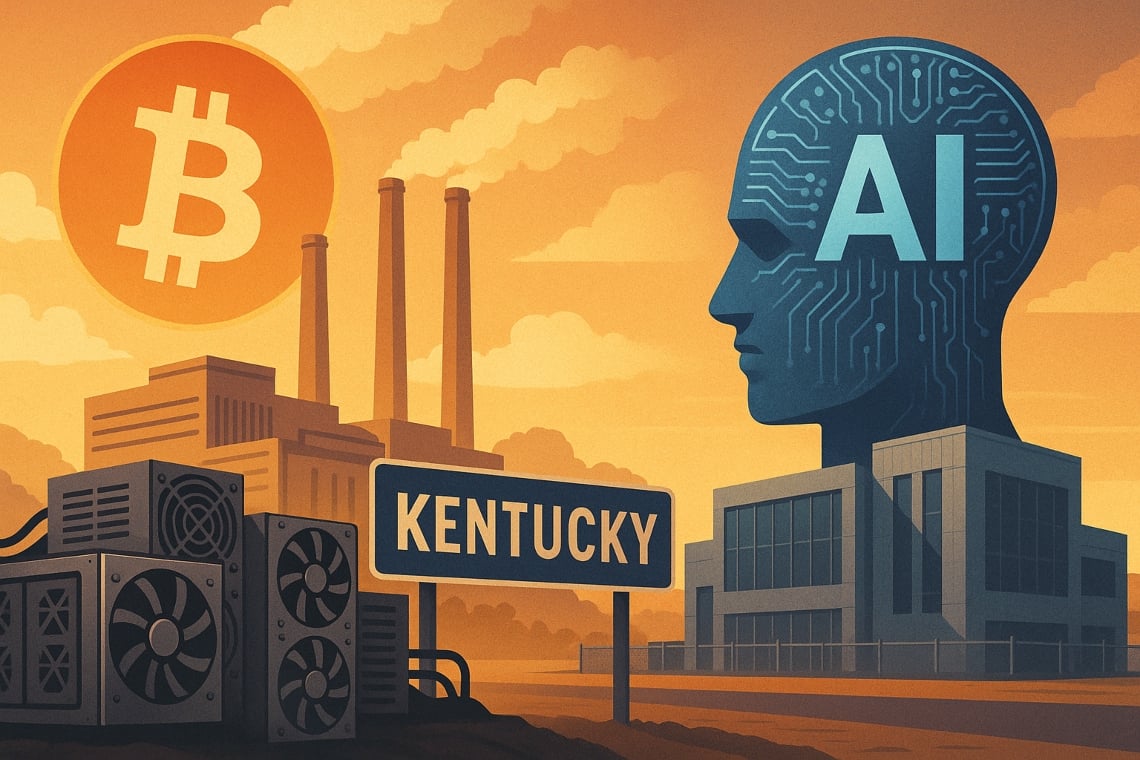
The recent experience of Bitcoin mining in Kentucky has highlighted how an emerging sector can ignite hopes of economic revival for an entire region, but also reveal itself as a bubble destined to deflate quickly.
With the shift to digital, uncertainty and opportunity intertwine, while attention moves from traditional financial assets like bitcoin towards new technological frontiers such as data centers dedicated to artificial intelligence (AI).
Summary
Kentucky and bitcoin: a fleeting mining boom
In 2021, Kentucky was at the center of attention for its growth in the field of bitcoin mining.

This activity, which consists of using computing power to validate transactions and create new coins, has found fertile ground in a state traditionally linked to coal.
Its large availability of low-cost electricity and available infrastructure attracted numerous mining operations. In that year, in fact, Kentucky contributed about 20% to the overall computing power dedicated to bitcoin mining in the United States.
However, the enthusiasm proved to be ephemeral. Despite the initial growth, local bitcoin mines began to close one after the other.
The reasons are manifold: the volatility of the asset, the high competitiveness of the sector, and the lack of clear and stringent regulations have generated a climate of instability.
The local authorities struggle to estimate the exact number of operations still active, given the opaque and poorly regulated nature of the market.
Urban legends and testimonies confirm the rapid collapse. Anna Whites, a lawyer with clients in the sector, denounces opaque schemes: many mines have been started on tertiary-owned lands, with uncertain initial funding.
After a few months of operation, the managers disappeared, leaving behind unsatisfied contracts and abandoned territories.
In particular, the story of Mohawk Energy, which began at the start of 2022 in Jenkins, Kentucky, has shown the potential and the limits of the mining project. Co-founded by Kentucky Senator Brandon Smith, Mohawk purchased a building and land with the aim of creating a mining and digital training hub.
The collaboration with a Chinese mining company had ambitious social intentions: employing former miners and disabled veterans, providing skills for jobs in the digital economy.
Despite a promising start with concrete job opportunities, the project experienced a rapid deterioration.
From bitcoin energy to artificial intelligence: a new hope?
The Chinese partner has filed a lawsuit for breach of contract. Mohawk responded with litigation, while the profit prospects have vanished. Many workers involved have lost their jobs, casting a shadow over the sector.
With the crumbling of the mining dream, attention today is turning to another type of digital infrastructure in Kentucky: data centers for AI.
These structures are essential for powering applications like Siri and ChatGPT, leveraging enormous computing capabilities for machine learning and data processing.
Wes Hamilton, local entrepreneur with experience in mining, sees AI technologies as a more solid and lasting opportunity compared to bitcoin.
This vision is echoed in the actions of local authorities as well: in March 2025, the governor signed the bill named “Bitcoin Rights,” which establishes the right to use digital assets.
The regulations facilitate, among other things, crypto operations, but aim primarily to create a favorable environment for new forms of digital economy, including data centers dedicated to artificial intelligence.
Despite the enthusiasm of certain sectors, many residents show caution and skepticism.
Nina McCoy, a citizen of Kentucky, recalls with concern the ecological problems caused in the past by the extractive industry, such as water pollution due to coal waste spills.
For her, and for others, the new data centers could replicate dynamics of environmental and social exploitation, given the enormous energy and water demand to cool these advanced technological facilities.
The digital future of Kentucky between bitcoin, AI, and sustainable development
The public debate in Kentucky thus focuses on a difficult balance. On one hand, the need to boost an economy in crisis; on the other, the protection of the environment and local communities.
Investment in infrastructure related to AI cannot be seen only as a promise of progress, but requires careful and transparent management to avoid the damages of the past.
Kentucky is therefore at a crossroads between a mining past and a technological future. The failure of bitcoin mines has taught many lessons about the volatility and pitfalls of investments in cryptocurrencies.
As a result, the possible reconversion towards AI data centers seems to offer a more stable path, but not without risks.
The current legislation and the interest of local entrepreneurs indicate a willingness to adapt to a digital world, in which financial assets like bitcoin must be accompanied by broader technological infrastructures.
However, to achieve full sustainability, it is necessary to keep the protection of communities, transparency, and effective public governance at the center.
In conclusion, bitcoin in Kentucky represents an important chapter of an unfolding story, where hopes for economic revival intertwine with environmental and social challenges.
Looking ahead means not only pursuing new technologies, but also building a responsible and inclusive digital development model, capable of transforming territories with foresight and concreteness.