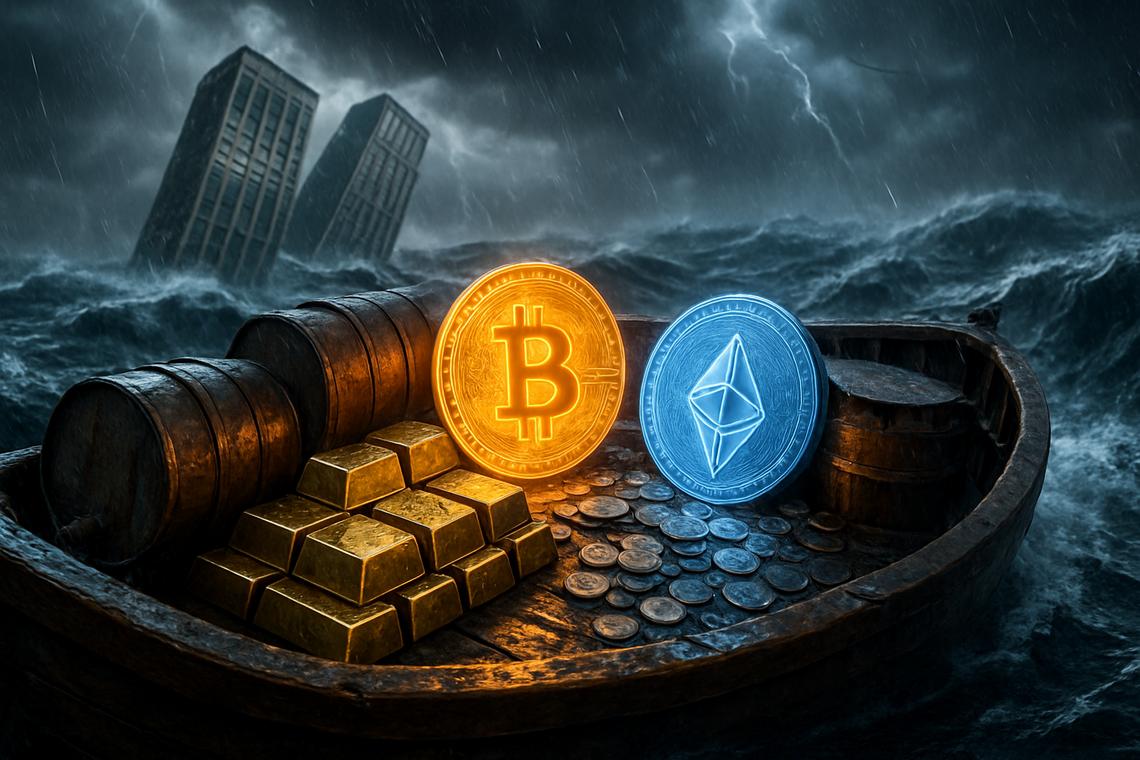
Amid rising concerns over global markets, robert kiyosaki investments are increasingly focused on hard assets he believes will outperform in a looming downturn.
Summary
Robert Kiyosaki warns of accelerating crash risk
The bestselling author of Rich Dad Poor Dad, Robert Kiyosaki, intensified his crisis warnings on March 15, flagging mounting stress in private credit and the broader banking system. According to him, financial conditions are deteriorating faster than many investors realize.
“Crash accelerates,” he wrote on X. “Private credit funds are panicked as investors withdraw their money. Major big-name banks and brand-name financial institutions are in trouble.” His comments underscored growing fears of banking sector distress and liquidity pressure across key funding channels.
Kiyosaki also cited economist Jim Rickards, highlighting Rickards’ view that the United States has already entered a “New Depression.” Moreover, this reference framed Kiyosaki’s outlook within a broader macro narrative of prolonged economic weakness rather than a short-term shock.
Deploying millions into oil, metals, and crypto
In response to what he sees as a worsening environment, Kiyosaki disclosed that he deployed millions of dollars last week into what he calls “real assets.” He said his purchases included additional oil wells, precious metals, and cryptocurrency positions, reinforcing his long-running inflation and crisis hedge thesis.
“Last week I took millions in cash and purchased more oil wells, more gold, silver, and bitcoin,” he wrote. That said, he also confirmed that he is accumulating Ethereum as part of a broader diversification effort across commodities and digital assets.
While he did not provide specific locations or structures, his move aligns with his long-standing theme of buying into oil wells and other productive assets that generate cash flow. Moreover, by shifting capital away from cash, he aims to reduce exposure to what he views as currency debasement and systemic financial risk.
Kiyosaki vs. Warren Buffett on crisis strategy
Kiyosaki contrasted his approach with that of Warren Buffett, who is widely known for maintaining large cash reserves to deploy during market downturns. He acknowledged Buffett’s strategy as rational for value investors looking to buy quality assets at discounted prices.
“Cash is not trash in a crash,” Kiyosaki wrote, conceding that liquidity can be powerful when markets seize. However, he stressed that his own philosophy diverges sharply. Instead of stockpiling cash, he prefers to convert it into oil wells, gold, silver, and bitcoin, which he views as more resilient over the long term.
“I doubt Warren Buffett would do what I do,” he added. For individuals without a clear, tested plan, he advised caution. Moreover, he suggested that simply staying on the sidelines may be the safest option during severe volatility if investors lack conviction or expertise.
Geopolitics, energy, and Kiyosaki’s oil focus
The author linked his energy investments to persistent geopolitical tensions in the Middle East. He pointed to ongoing attacks on oil tankers transiting the Strait of Hormuz as a factor supporting higher crude prices, a trend that directly benefits his Texas-based oil well holdings.
According to Kiyosaki, disruptions in a key maritime chokepoint can exacerbate supply concerns and keep energy markets tight. However, he frames this risk as an opportunity, arguing that productive oil assets can serve both as inflation hedges and as beneficiaries of regional instability in global shipping lanes.
Why Kiyosaki continues to buy Bitcoin and Ethereum
Kiyosaki has been outspoken about bitcoin for several years, repeatedly grouping it with gold and silver as a “real asset.” He bases this categorization on bitcoin’s mathematically fixed supply of 21 million coins, a feature he contrasts with central bank money creation and credit expansion.
He has also argued that bitcoin offers a better long-term upside profile than gold. Market pullbacks, in his view, are not a reason to exit but rather a chance to increase exposure. Moreover, he has consistently highlighted these drawdowns as key buying opportunities.
His messaging has not been without controversy. One social media post claimed he never bought bitcoin above $6,000, while later posts referenced purchases at far higher prices. However, despite these apparent contradictions, he continues to promote bitcoin and Ethereum as core positions, with an implicit ethereum accumulation plan embedded in his broader digital asset outlook.
Within this framework, robert kiyosaki investments are presented as a mix of oil wells, precious metals, and leading cryptocurrencies. That said, he regularly cautions that his strategies reflect personal convictions and risk tolerance rather than universal prescriptions.
Post-crash expectations and the 2026 timeline
Kiyosaki maintains that prices for gold, silver, and bitcoin are likely to surge after what he calls a “giant crash.” He believes the repricing of financial assets will favor scarce, non-sovereign stores of value and real-world productive assets such as oil wells.
He has also reiterated that his calls may prove wrong and that markets can behave unpredictably. However, his confidence remains strong, anchored in a decade-long narrative he first detailed in his 2013 book Rich Dad’s Prophecy. In that publication, he outlined a severe crash scenario that he associated with the period leading into 2026.
As that date approaches, Kiyosaki has increased the frequency and intensity of his warnings about private credit stress, bank fragility, and asset bubbles. In summary, he is positioning his portfolio around hard assets and select cryptocurrencies, betting that these holdings will outperform once the correction he anticipates finally arrives.