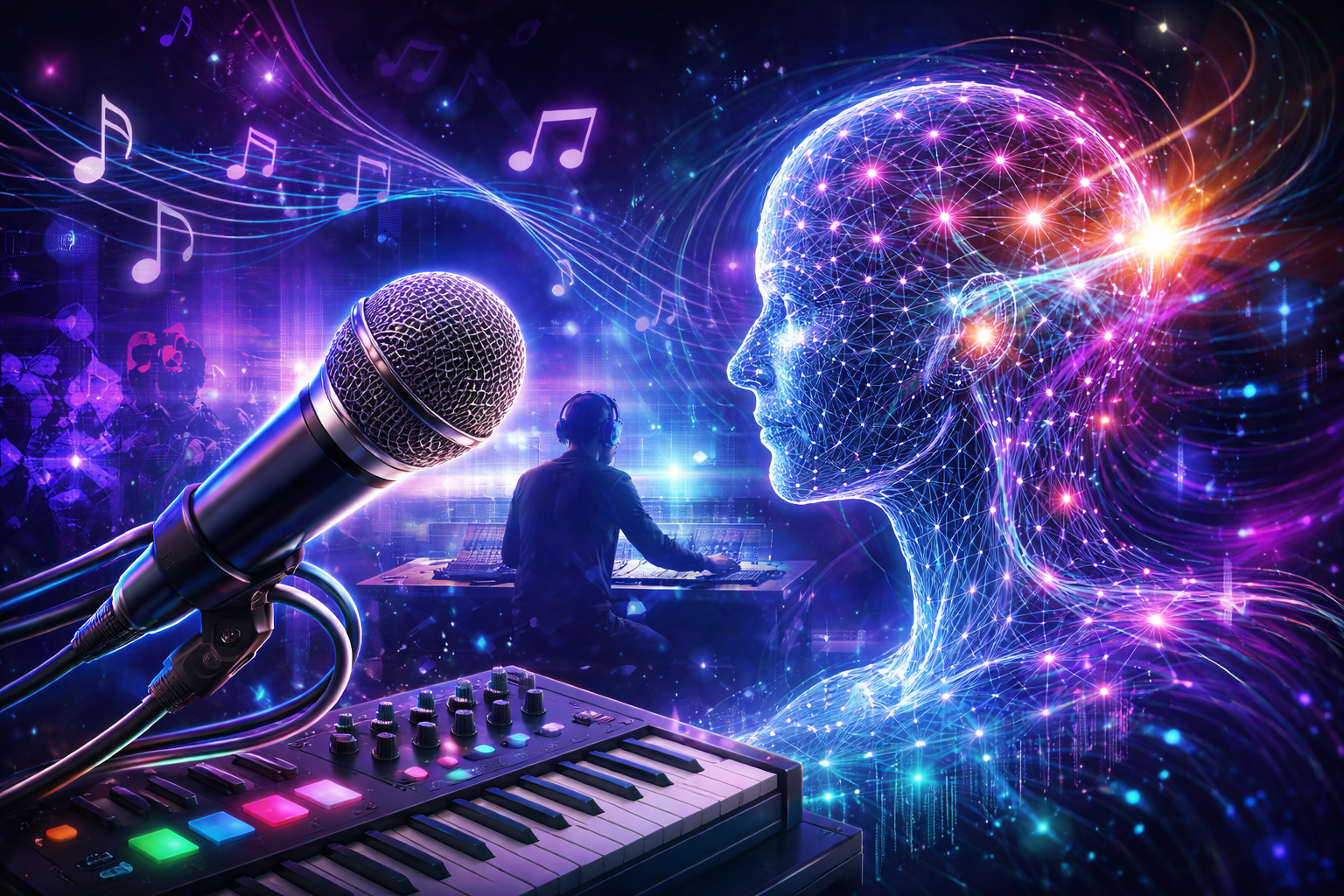
AI in music does not replace artists, but amplifies their creativity. At the HUMAN X Conference, leaders from Universal Music Group and Splice explained that the future is “artist + AI”: more powerful tools, but with creative control, protected rights, and new business models centered on creators.
Summary
The Context: HUMAN X Conference and the Key Players
During the HUMAN X Conference, a key panel took place on the intersection between music and artificial intelligence. Leading the conversation was Dan Runcie, alongside two central figures of the industry:
- Michael Nash
- Kakul Srivastava
The topic? How to truly put creators at the center in the AI era.
AI in Music: A False Narrative to Overcome
Artists vs AI: Is it really a conflict?
The short answer: no.
According to Michael Nash, the notion that there is a clash between artists and AI is a “false narrative”. The issue stems from a mistaken assumption: that AI is meant to address a scarcity of musical content.
But the reality is the opposite.
In summary:
- Even before AI, over 100,000 tracks were uploaded daily
- The music offering is already practically infinite
- AI increases volume, but does not automatically create value
This means that the real issue is not producing more music, but creating meaningful music.
AI as a Creative Multiplier
What does “AI + artist” really mean?
AI in music should be seen as a “force multiplier”, that is, an amplifier of human creativity.
Artists are already using AI tools to:
- experiment with new compositions
- accelerate music production
- create innovative experiences for fans
- explore new tools and sounds
The most important thing is:
AI does not replace creativity, but expands it.
Splice and Universal: The Collaborative Model
The partnership between Splice and Universal Music Group is a concrete example of how the industry is evolving.
The 3 Key Areas of Collaboration
- Ethical Training of AI Models
- Co-creation with Artists
- New Musical Experiences
This means that:
AI is not built “on the artists,” but together with the artists.
Rights, Copyright, and Innovation: The True Balance
How to Balance Innovation and Protection?
Question: How can the industry innovate without harming artists?
Answer: by starting with the protection of rights as a foundation for innovation.
According to Nash, the strategy is clear:
- first protect the artists
- then build new business models
Examples of this approach include:
- streaming (Spotify)
- user-generated content (YouTube)
- social music (Meta)
Now the same principle applies to AI.
In summary:
protection and innovation are not opposites, but complementary.
The True Role of AI: Reducing Creative Friction
What Do Creators Really Want?
Kakul Srivastava brings a crucial perspective:
artists do not want AI to create in their place.
They want control.
One of the most interesting feedbacks received by Splice:
“It’s too easy. I want more creative control.”
This reveals a fundamental insight:
- AI must support, not replace
- must reduce “toil” (repetitive work)
- must make room for the artist’s voice
Practical Example
An artist might say:
- “I like this part”
- “Not this one”
- “Let me integrate everything better”
AI intervenes here: optimizes, does not decide.
The Illusion of “Better Music”
Does AI produce better music?
Question: If the models improve, does the music automatically improve?
Answer: no.
Michael Nash provides a compelling example:
- Would Bob Dylan be “better” with a perfect voice?
- Kurt Cobain with impeccable production?
The implicit answer is negative.
Why?
Because music is emotion, not technical perfection.
Key Definition:
Music is “the language of emotions”.
Technology and Creativity: An Ancient Relationship
A key point that emerged from the panel:
Technology has always been a part of art.
From cave paintings to digital tools, every era has used the available technology to express itself.
This means that:
- AI is not a disruption
- it is an evolutionary continuation
The Future: When We No Longer Talk About AI
What will AI in music look like in 5 years?
The speakers’ forecasts converge on one point:
We will no longer talk about “music made with AI”.
It will simply be music.
Just as today we don’t say:
- “music made with electricity”
- “music made with software”
AI will become invisible, yet fundamental.
Future Trends to Watch
Several key trends emerge from the discussion:
1. Personalized Musical Experiences
- smart ecosystems
- adaptive content for each user
2. Growth of the Music Economy
- new monetization models
- greater fan engagement
3. Creator Empowerment
- increasingly advanced tools
- greater creative control
4. Ethical Standards for AI
- respect for rights
- industry-tech collaboration
Conclusion: artist-first is the true strategy
AI in music is not a threat, but a lever.
The most important thing is:
the future belongs to models that place artists at the center.
It’s not about choosing between man and machine, but about building a system where:
- AI amplifies
- the artist decides
- the public connects
FAQ – AI in Music
1. Will AI Replace Musicians?
No. AI is a tool that amplifies creativity, but musical value originates from human expression and emotion.
2. How are artists’ rights protected?
Through ethical training models, copyright compliance, and partnerships between tech companies and the music industry.
3. Does AI make music better?
Not necessarily. It improves the tools, but the quality of the music depends on the artistic intent, not on technical perfection.
4. What is the main advantage of AI for creators?
Reduce repetitive work and enhance creative control, allowing artists to focus on their vision.
5. Will we still distinguish between AI and non-AI music in the future?
Probably not. AI will become an invisible part of the creative process, much like many digital technologies are today.