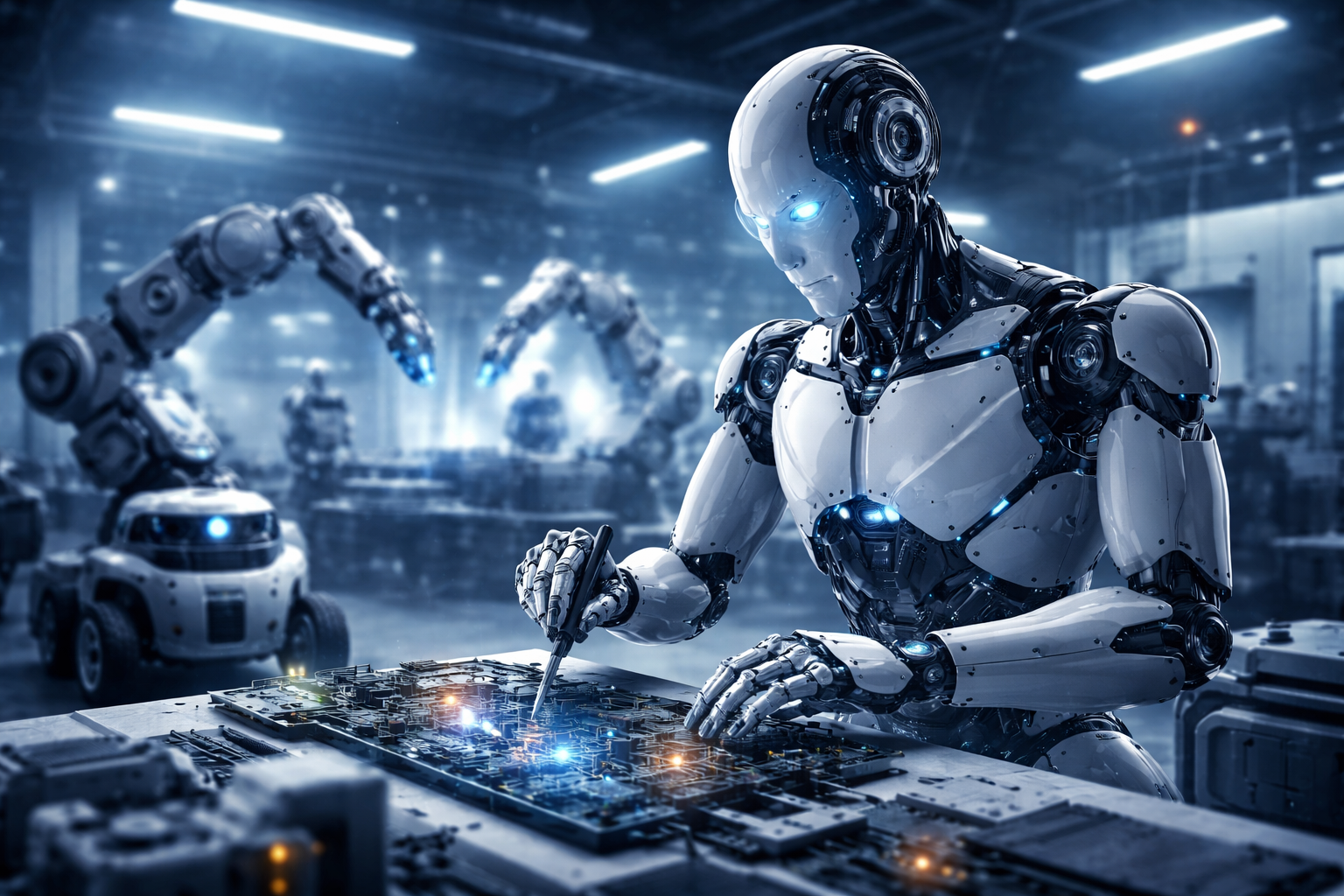
Physical artificial intelligence enables robots to perceive, decide, and act in the real world. Unlike LLMs, it requires less data but a greater understanding of physics, new architectures, and multimodal systems. The future will not be solely humanoid, but distributed among many forms of robots and intelligent environments.
Physical Artificial Intelligence: How AI Robots Work
Physical artificial intelligence represents the next major leap in AI: systems capable not only of generating content but also of interacting concretely with the real world.
During the HUMAN X Conference, experts such as Daniela Rus, Deepak Pathak, and Ali Agha highlighted a key truth:
Being smart is not enough—you need to be physically reliable.
Summary
What is Physical Artificial Intelligence
Physical artificial intelligence is a type of AI designed to operate in the real world through:
- sensory perception
- autonomous decision
- physical action
This means that:
a system does not merely answer a question, but performs real tasks such as moving objects, driving, or manipulating tools.
Physical Artificial Intelligence vs LLM
Data: Quantity is Not Enough
Language models are trained on vast amounts of textual data.
Physical artificial intelligence, on the other hand:
- works with hard-to-collect data
- requires physical information (force, contact, movement)
- cannot rely solely on video
Concrete example:
seeing someone push a suitcase is not enough to understand the effort required. You need to know the force applied.
Architecture: Physics is Needed
LLMs operate through probabilities.
Physical artificial intelligence requires:
- models that integrate physical laws
- uncertainty management
- reduction of hallucinations
According to Ali Agha:
Errors tolerable in language become unacceptable in the real world.
Real-time: no cloud
Another critical point:
- LLMs can operate in the cloud
- robots must operate in real-time, on-device
The most important thing is:
latency can make the difference between safety and danger.
How Physical Artificial Intelligence is Trained
Multimodal Approach
According to MIT CSAIL, the best results come from combining:
- video
- muscle sensors (EMG)
- transaction data
- haptic inputs
- eye tracking
In summary:
the richer the data, the better the model understands the real world.
Simulation: powerful but imperfect
Simulation has become central because:
- enables scaling
- reduces costs
- generates rare scenarios (incidents)
However, there still exists a gap between simulation and reality.
Current trend:
the focus is no longer on perfectly mimicking reality, but on randomizing it to make models more robust.
Teleoperation: Quality Without Scale
Teleoperation provides high-quality data, but:
- is not scalable
- requires human intervention
Ideal use:
- fine-tuning
- adaptation to specific tasks
Question → Answer: is video enough to train robots?
Question: Is video sufficient to train robots?
Answer: No.
The video does not capture:
- forces
- frictions
- internal dynamics
Conclusion: integration with physical data is needed.
Question → Answer: is the real limit the lack of data?
Question: Is the main issue the scarcity of data?
Answer: No, not only.
According to FieldAI:
- even with more data, the current models would fail
- the real leap is architectural
This means that:
the future of physical AI depends on new models, not just more data.
The Debate on Humanoids
Humanoids are often considered the future, but the panel highlighted clear limitations.
Why They Attract
- environments designed for humans
- ease of integration
- strong media impact
Real Issues
- mechanical complexity
- energy consumption
- control difficulty
Key Insights
The future will be multi-form factor, not humanoid-only.
We will see:
- wheeled robot
- intelligent industrial arms
- distributed systems
According to Daniela Rus:
even everyday objects like chairs or tables could become robots.
The Future of Physical Artificial Intelligence
1. Nature-Inspired Models
- differential equations
- dynamic systems
- neuroscience
2. General Intelligence
A single system capable of operating on:
- humanoid robots
- industrial robots
- other devices
3. New Data Sources
Possible developments:
- smart fabrics
- sensorized environments
4. Security at the Core
- zero tolerance for errors
- operational robustness
Strategic Implications
For companies and innovators:
- do not replicate the LLM model
- invest in physical architectures
- use multimodal data
- designing for the real world
The most important thing is:
physical artificial intelligence requires a paradigm shift.
FAQ
What is physical artificial intelligence?
It is a type of AI that enables robots to interact with the real world through perception, decision-making, and action.
Why Don’t LLMs Work for Robots?
Because they do not understand physics and can generate dangerous errors in the real world.
What is the role of data?
Data is fundamental, but it must be physical and multimodal. However, without new architectures, it is not enough.
Are Humanoids Really the Future?
They will only be a part of the future, alongside many other forms of robots more efficient for specific tasks.
Conclusion
Physical artificial intelligence marks the transition from AI that “speaks” to AI that acts.
It is not a mere evolution of LLMs, but a new paradigm based on:
- physical
- security
- multimodality
- new architectures
In summary: the future of AI will be real, embodied, and distributed.