In the landscape of modern trading, Forex and cryptocurrencies often represent the first entry point for those approaching this world. This is no coincidence: both markets offer high accessibility and, above all, strong operational scalability.
This means that it is possible to start trading even with very small amounts of capital, progressively increasing exposure over time.
The possibility of operating with small amounts, combined with the spread of intuitive platforms and educational content, has made crypto and Forex among the most popular markets for beginner traders.
However, behind this apparent similarity lie deep differences, which are essential to understand in order to avoid strategic mistakes and ineffective approaches. For this reason, understanding what really distinguishes the crypto market from Forex is a fundamental step for every trader who wants to operate consciously.
Summary
Differences between crypto and Forex: market structure
Forex is historically the largest and most liquid market in the world, based on the exchange of national currencies and dominated by central banks, financial institutions and large operators. Even though there is no real centralized exchange, the system is nonetheless structured and regulated, with dynamics that are relatively stable and predictable.
The world of cryptocurrencies, on the other hand, was born with a completely different philosophy. Bitcoin and other digital assets are based on decentralized technologies and are traded on a multitude of exchanges, often with very different characteristics from one another. This fragmentation creates a less uniform environment, in which the price can vary from one platform to another and where market inefficiencies are more frequent.
Another crucial difference concerns time. Forex operates twenty-four hours a day during the working week, but stops on weekends. This creates a clear temporal structure, with breaks that allow traders to recalibrate their strategies.
The cryptocurrency market, by contrast, never stops. It is active twenty-four hours a day, seven days a week, without any interruption. This aspect may seem like an advantage, but it also entails greater difficulty in operational and psychological management. Market movements can occur at any time, even during the night or on holidays, making risk control more complex.
Volatility and leverage: the main differences
Volatility is perhaps the most evident element of distinction between the two worlds. In Forex, especially on the major currency pairs, daily movements are generally limited. The great liquidity helps keep prices relatively stable. Cryptocurrencies, on the other hand, are characterized by much wider swings. It is not uncommon to see double-digit daily changes, especially on less capitalized assets. This volatility is fueled by a combination of factors, including the strong presence of retail investors, speculation, and the immediate impact of news and market sentiment. Consequently, while on the one hand profit opportunities can be high, on the other the risk of rapid and substantial losses is decidedly higher.

Figure 1 – Different volatility between BTC and EURUSD
The use of leverage also presents important differences. In Forex, leverage is a consolidated and regulated tool, with well-defined limits for retail traders, especially in Europe. This allows for a certain level of control over systemic risk. In the crypto market, on the other hand, leverage is often offered directly by exchanges and can reach much higher levels. However, it is associated with extremely fast automatic liquidation mechanisms. This means that a position can be forcibly closed in a matter of moments if the market moves against the trader, making even more rigorous risk management indispensable.
What moves prices: macroeconomics vs sentiment
Another fundamental aspect concerns the factors that drive prices. In Forex, market dynamics are closely linked to macroeconomics. Interest rates, inflation, monetary policies and economic data are the main drivers of currency movements. Central bank decisions have a direct and often predictable impact in the medium term.
In the world of cryptocurrencies, however, the fundamental factors are much more heterogeneous and less structured. Technological adoption, regulations, innovations in the blockchain sector and investor sentiment play a central role. Often, dominant narratives significantly influence the market, making movements less tied to objective data and more to collective perception.
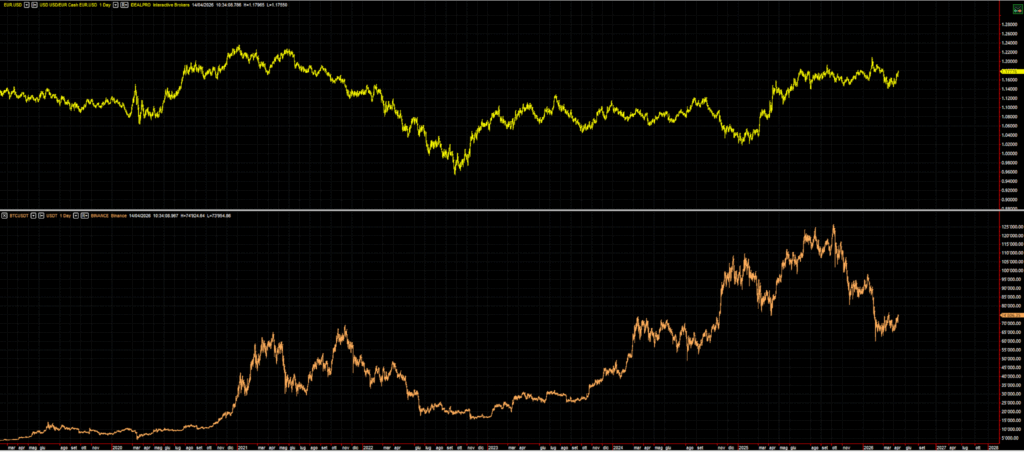
Figure 2 – Price trends of BTC and EURUSD
It is true that, in some market phases, cryptocurrencies also seem to react to macroeconomic variables such as global liquidity or central bank monetary policies. However, unlike Forex, where the link is direct and structural, in the crypto world this correlation is often less stable and sometimes only apparent. It is more a temporary overlap of dynamics than a solid and predictable causal relationship, which is why interpreting crypto exclusively with traditional macro logic can lead to misleading conclusions.
Liquidity in Forex and cryptocurrencies
The issue of liquidity is equally relevant. Forex, being the most liquid market in the world, guarantees tight spreads and generally efficient order execution. This minimizes the phenomenon of slippage, that is, the difference between the expected price and the actual execution price. In the crypto market, on the other hand, liquidity varies greatly from asset to asset. While major cryptocurrencies such as Bitcoin and Ethereum show high volumes, many altcoins suffer from limited liquidity. This can lead to significant slippage, especially in turbulent market conditions, directly affecting trade outcomes.
Regulation and decentralization
From a regulatory point of view, the differences are even more pronounced. Forex, although not a single centralized market, is subject to precise regulations and brokers must comply with strict standards, in many cases offering protections for clients.
The cryptocurrency sector, on the other hand, is still in a phase of regulatory evolution. Regulation varies greatly from country to country and many exchanges operate in legally unclear contexts. This introduces an additional level of risk, linked not only to the market but also to the security of the platforms used.
Figure 3 – Regulation and Decentralization
Trader psychology: different impact between crypto and Forex
Finally, one cannot ignore the psychological impact that these two markets have on the trader. Forex, thanks to its greater stability, tends to favor a more disciplined and systematic approach. Cryptocurrencies, on the contrary, amplify emotions.
The fear of missing out on opportunities, euphoria during growth phases and panic in moments of collapse are much more intense. Without a solid method and strong discipline, it is easy to fall into impulsive mistakes.
Connected to this are also the direct effects of the combination between the high volatility typical of the crypto market and the continuous operation of instruments active 24 hours a day, 7 days a week. This context can lead the trader to constantly monitor positions, increasing stress and mental fatigue and encouraging behaviors such as overtrading, late entries on moves and premature exits dictated by fear. In Forex, although these dynamics are not absent, they are generally more contained.
For this reason, when talking about psychology in crypto vs Forex trading, it is clear how the context directly influences the trader’s behavior and the quality of decisions.
Final considerations: crypto vs Forex, two different markets
In conclusion, considering crypto and Forex as equivalent markets is a mistake that can seriously compromise a trader’s results.
Although both offer interesting opportunities, they require different approaches, tools and mindsets. Forex represents a more structured and predictable environment, while cryptocurrencies offer a more dynamic and uncertain context, but also potentially more profitable.
The key to operating successfully is not to choose which market is absolutely better, but to understand their characteristics and adapt one’s strategy accordingly. Only in this way is it possible to turn complexity into a competitive advantage.
Until next time and happy trading!
Andrea Unger