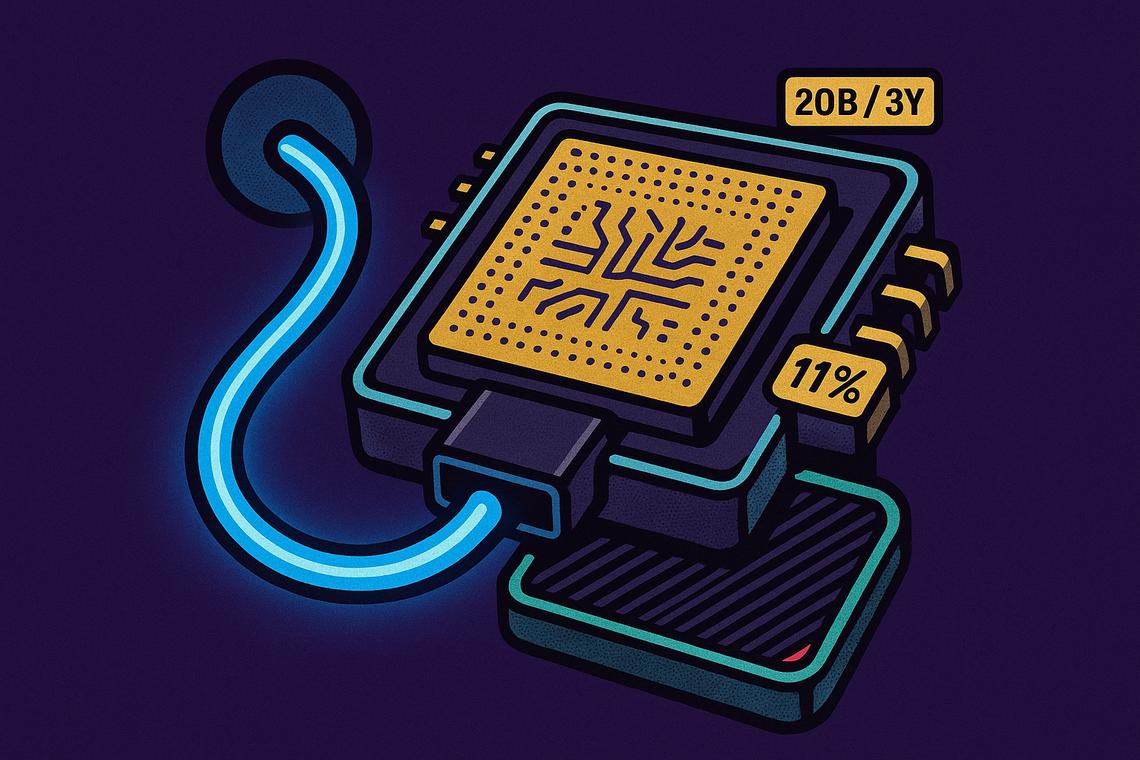
OpenAI’s OpenAI Cerebras deal is drawing attention for more than its size. The new agreement commits over $20 billion across three years, and it could also give OpenAI roughly an 11% equity stake in the AI chipmaker, turning a major supply arrangement into something much closer to a strategic investment.
That shift matters because it lands just as Cerebras is planning to go public in May 2026. For a company heading toward a Cerebras IPO, having one of the world’s biggest AI buyers deepen both its spending and potential ownership changes the story investors will be asked to price.
It also shows how the AI race is evolving. Access to compute is no longer just an operating need. Instead, for companies building large-scale models, it is increasingly a strategic asset, and the OpenAI Cerebras deal points to a future where the biggest AI players do not just buy capacity from suppliers — they tie themselves to them.
Summary
OpenAI expands its Cerebras commitment
The new commitment builds on an earlier January 2026 agreement between the two companies that was valued at over $10 billion. That earlier deal secured 750 megawatts of compute capacity from Cerebras, giving OpenAI a large block of infrastructure for model training.
Now the relationship is expanding sharply. With more than $20 billion committed over three years, the financial scale has moved well beyond a standard customer contract.
That is the first big reason this matters: it underlines how central AI chips and compute capacity have become to the economics of the industry. Cerebras makes chips designed for large-scale AI model training, and OpenAI is effectively increasing its dependence on that supply while locking in more of it.
In practical terms, this is not just about purchasing hardware. It is about securing the kind of computing power needed to stay competitive in training advanced AI systems.
The OpenAI equity stake could reshape the relationship
The most striking feature of the OpenAI Cerebras deal may be the ownership piece. The arrangement could hand OpenAI roughly an 11% equity stake in Cerebras, with the stake described in the 10% to 11% range.
That changes the balance of the relationship. Instead of remaining only a customer, OpenAI could become a meaningful shareholder in the company supplying a key part of its AI infrastructure.
This is where the strategic logic becomes clearer. OpenAI is not just buying compute; it is potentially buying into the company that provides it. As a result, that creates tighter alignment between demand and supply at a time when AI infrastructure is one of the most valuable parts of the market.
It also adds another layer to OpenAI’s positioning. The company raised $122 billion in Q1 2026 at an $852 billion post-money valuation, giving it unusual financial firepower. In the same quarter, OpenAI, Anthropic, xAI, and Waymo captured about 65% of venture capital funding, a sign of how concentrated the AI funding race has become.
Against that backdrop, an AI chip investment tied to long-term compute access looks less like a side bet and more like core strategy.
Why the Cerebras IPO now matters more
Cerebras IPO plans now carry more weight because investors have a clearer story to evaluate. The company is planning to go public in May 2026, and this expanded relationship with OpenAI gives it something public investors typically want to see before a listing: visibility.
For Cerebras, the upside is obvious. A three-year commitment worth over $20 billion offers revenue support and strategic validation from one of the most prominent buyers in AI. It suggests that Cerebras is not just a speculative hardware name, but a company with a major customer willing to deepen the relationship in a material way.
That can help shape valuation expectations.
Strategic validation comes with a tradeoff
At the same time, the same fact that makes the Cerebras IPO more compelling could also raise harder questions. If one customer accounts for such a large share of expected business, investor concern may quickly turn to revenue concentration risk.
That is the second big reason this matters. Public markets often reward growth, but they also look closely at dependency. OpenAI’s backing may strengthen confidence in Cerebras, yet it may also make investors ask how diversified the business really is beyond one giant partner.
So the OpenAI equity stake angle cuts both ways. It gives Cerebras a stronger IPO narrative, while also putting more focus on whether the chipmaker can prove demand beyond its most powerful customer.
A supplier deal is becoming a power move
At its core, the OpenAI Cerebras deal shows how the AI market is maturing into something more vertically strategic. Companies are no longer just lining up chips, cloud, and capital as separate inputs. They are beginning to connect them.
For OpenAI, that means turning a vendor relationship into something closer to an alliance. For Cerebras, it means approaching public markets with a much stronger commercial anchor than many IPO candidates can claim.
And for investors, the next question is straightforward: whether this kind of tie-up becomes the new model for AI infrastructure — where buying compute is no longer enough, and owning part of the supply chain starts to look like the smarter bet.