



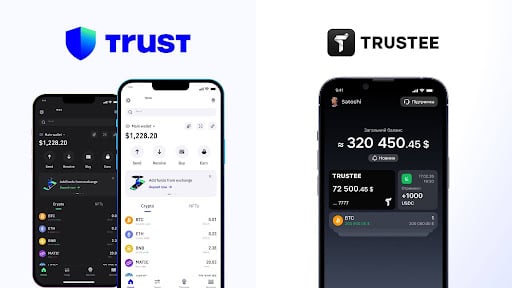
At first glance, Trustee Plus and Trust Wallet look like competitors in the same category. Both are mobile, both handle crypto, and both can serve as a first entry into the market. The similarity ends there. Inside, they’re built on two different logics.
Trust Wallet is a mobile self-custody wallet. Its strength is asset control, broad support for networks and tokens, NFTs, and Web3 access. Trustee Plus is a crypto-financial application. Its strength isn’t just storage, but making digital assets usable in daily life — paying, swapping, transferring, and moving money in and out of the dollar.
For a beginner, this matters. One product answers, “How do I own crypto on my own?” The other answers, “How do I actually use crypto?”
Summary
Two Mobile Wallets, Two Different Problems
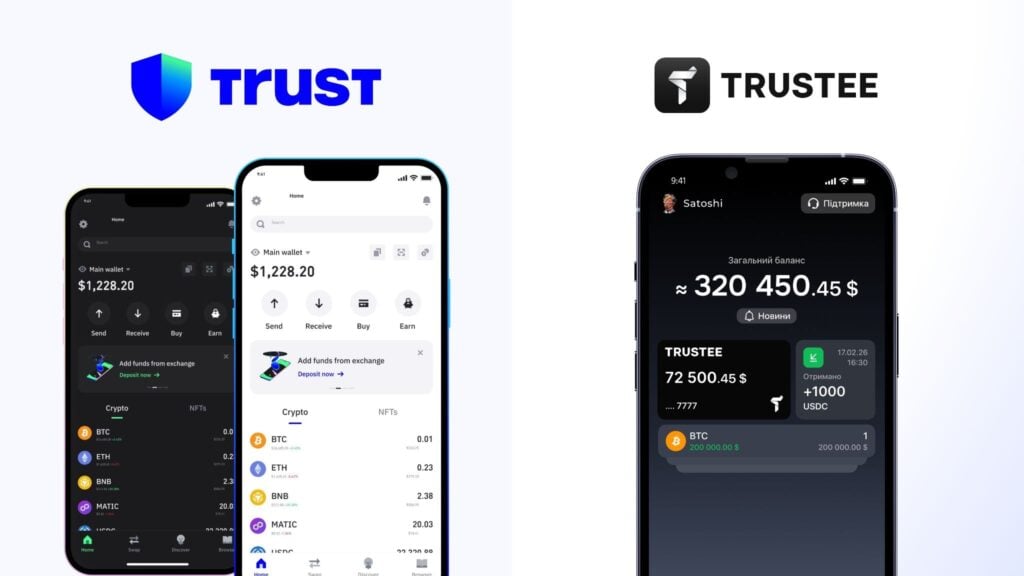
Trust Wallet is one of the most recognized non-custodial wallets on the market. It supports a wide range of assets and blockchains, works with NFTs, DeFi, and dApps, and positions itself as a self-custody multi-chain platform. The company reports over 200 million users.
For someone who wants to hold their own on-chain wallet and control their private keys, this is a strong fit. The trade-off is operational responsibility: networks, addresses, fees, recovery phrases, dApp permissions, and the constant risk of irreversible mistakes.
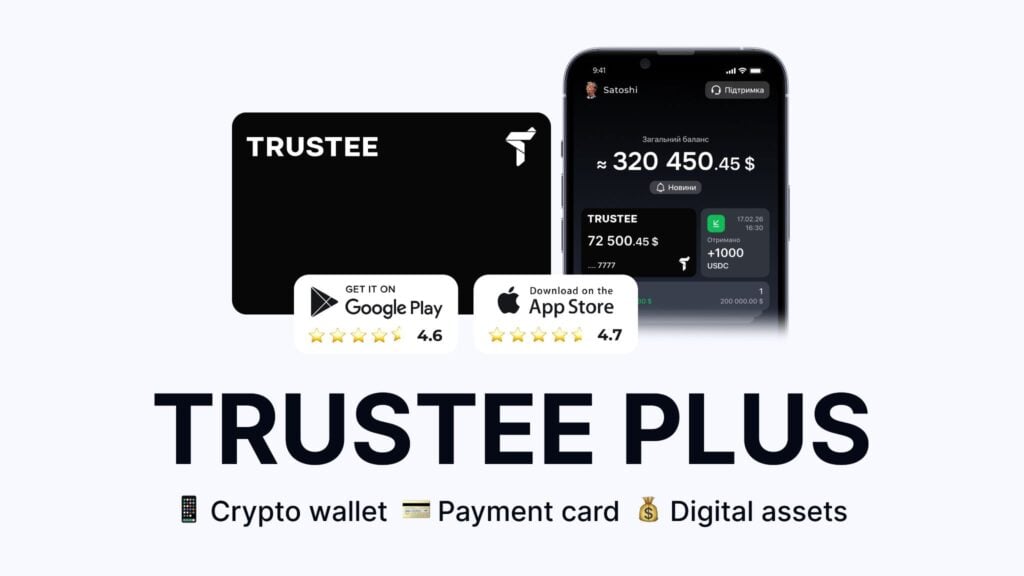
Trustee Plus comes at crypto from a different angle. It doesn’t try to cover every Web3 scenario. Its focus is financial utility: a personal IBAN with SEPA transfers, a crypto card, fiat purchases via Visa and Mastercard, in-app swaps, and support for 30+ coins and networks including TRC-20, ERC-20, Solana, and NEAR.
The goal isn’t breadth for its own sake — it’s making digital assets liquid in everyday life.
The Card Changes Everything
The biggest practical difference between the two isn’t the number of coins. It’s that one company issues its own card.
That sounds small, but the card is what turns a crypto wallet into a real financial tool. A user holds USDT or other assets on the balance, adds the card to a mobile wallet, and pays with their phone at any standard terminal. The same principle runs throughout: contactless integration, instant conversion at the point of sale, and top-ups in stablecoins.
In practice, this removes the whole “sell-asset-and-withdraw” loop. No manual swap, no exchange detour, and no waiting on a bank. The user taps; conversion happens at checkout. For the person, it looks like a normal payment. For crypto, it’s a way into the everyday economy.
Trust Wallet doesn’t compete here, and that isn’t a flaw — it’s the product’s nature. It is excellent for holding assets and operating on-chain. It did add Apple Pay and Google Pay in late 2025, but on the buy side: as an on-ramp for purchasing crypto, not as a way to spend a balance at checkout.
There is no Trust Wallet card, and no European banking rails. For someone who wants not just to hold tokens but actually pay for coffee, rent, or a subscription with them, Trustee Plus is the more practical product.
Built for People Living Between Countries
Crypto often becomes genuinely useful not when someone buys their first token, but when life goes global. A freelancer gets paid by a client abroad. An expat keeps part of their savings in digital assets. A digital nomad changes countries and currencies and doesn’t want to depend on a single local bank.
In these scenarios, a wallet without a payment layer feels incomplete. It can show a balance and support dozens of networks, but the final question is always the same: how do I use this money today?
SEPA rails connect the app to European banking. The card opens up offline and online spending. Mobile wallet integration strips out extra steps. In-app swaps let the user move between assets without juggling services. Trust Wallet offers a different kind of freedom — independent ownership. That matters too. But for a person entering crypto who wants to feel its practical value, “freedom of use” lands faster than “freedom of custody.”
How Simple Is It to Send Money?
Crypto talks a lot about decentralization and rarely about something as mundane as sending money to a friend.
This is a classic on-chain action: pick the address, pick the network, pick the asset, and factor in the fee. It works — but a mistake can be expensive, especially with tokens that exist on multiple chains.
Trustee Plus brings the same task closer to fintech: transfers by phone number with a 0% fee. It is less flashy than hundreds of supported blockchains, but much closer to how people normally send money. For a first wallet, that detail matters — it cuts the fear of error and turns a technical operation into a familiar action.
Security: Independent Control vs. Recoverable Access
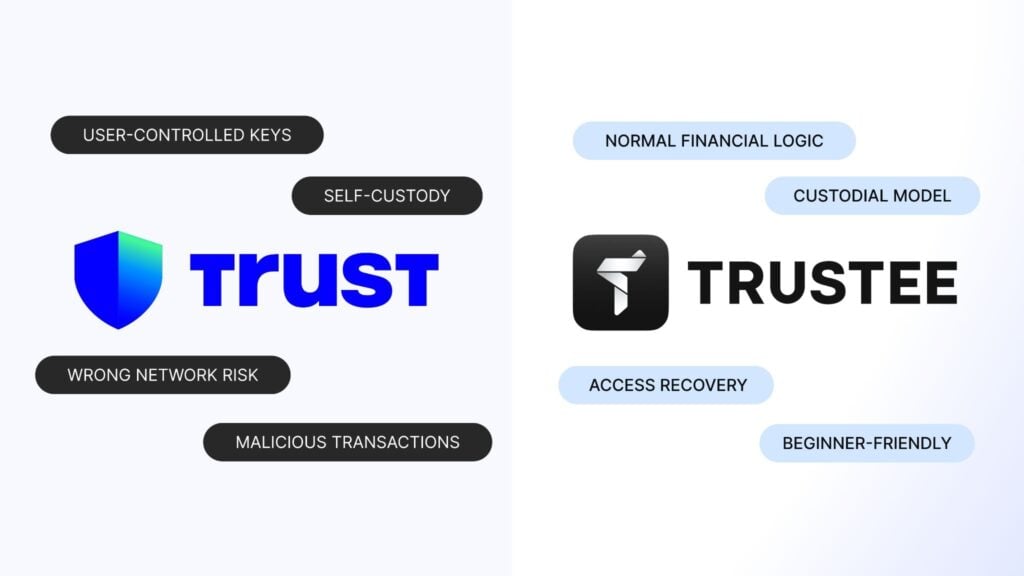
Trust Wallet is built on self-custody. The user controls the keys and doesn’t rely on anyone. For the crypto community, this is the entire point.
But independent custody doesn’t remove risks — it moves them onto the user. Lose the recovery phrase, sign a malicious transaction, or send to the wrong network, and support can’t put things back together the way a banking app would.
Trustee Plus uses a custodial model. To purists, this is a compromise; to the mass market, it’s just normal financial logic. There is an account, support, access recovery, and a clear interface for handling money. It isn’t “better or worse” — it’s a question of how much technical responsibility the user wants on day one. Trustee Plus minimizes the number of decisions a beginner has to get right.
Where Trust Wallet Genuinely Shines
For someone who wants to hold assets independently, keep a wide variety of tokens, work with NFTs, connect to dApps, and move between blockchains, it is a serious tool.
Its advantage is breadth: many networks, many assets, Web3 access, and full key ownership. For a user who already knows the territory, those are compelling arguments. But for a first wallet, breadth doesn’t always equal convenience. A beginner usually cares more about doing the basics quickly — receive, swap, transfer, and pay — without getting lost in the details.
Why Trustee Plus Is the More Useful Starting Point
Trustee Plus isn’t trying to out-Trust Trust Wallet. It isn’t selling “maximum multi-chain.” It sells a different idea, one that’s more mature for a broad audience: crypto should be more than an asset sitting in an app — it should be a tool for moving money.
That matters especially in Europe, where bank transfers, contactless payments, and card-based spending are baseline infrastructure. A wallet that doesn’t plug into those rails eventually pushes the user toward extra services.
Trustee Plus shortens the path: assets can be bought, swapped, transferred, and spent inside one app. It still supports a real range of coins and networks — but it doesn’t make every action into an on-chain quest.
Conclusion
Trust Wallet is a strong mobile self-custody wallet. It’s the logical pick for users who want to control their keys, hold many assets, and work with NFTs, dApps, and multiple chains.
But a beginner’s first wallet should do more than store tokens. It should show why crypto is useful outside of exchanges and on-chain environments. On that test, Trustee Plus is the more practical start: a card tied to a mobile wallet, European payment rails, a broad set of coins and networks, phone-number transfers, in-app swaps, and access recovery — not just a wallet, but a financial interface for daily crypto use.
Different products reflect different priorities in the evolution of crypto usability and self-custody.
