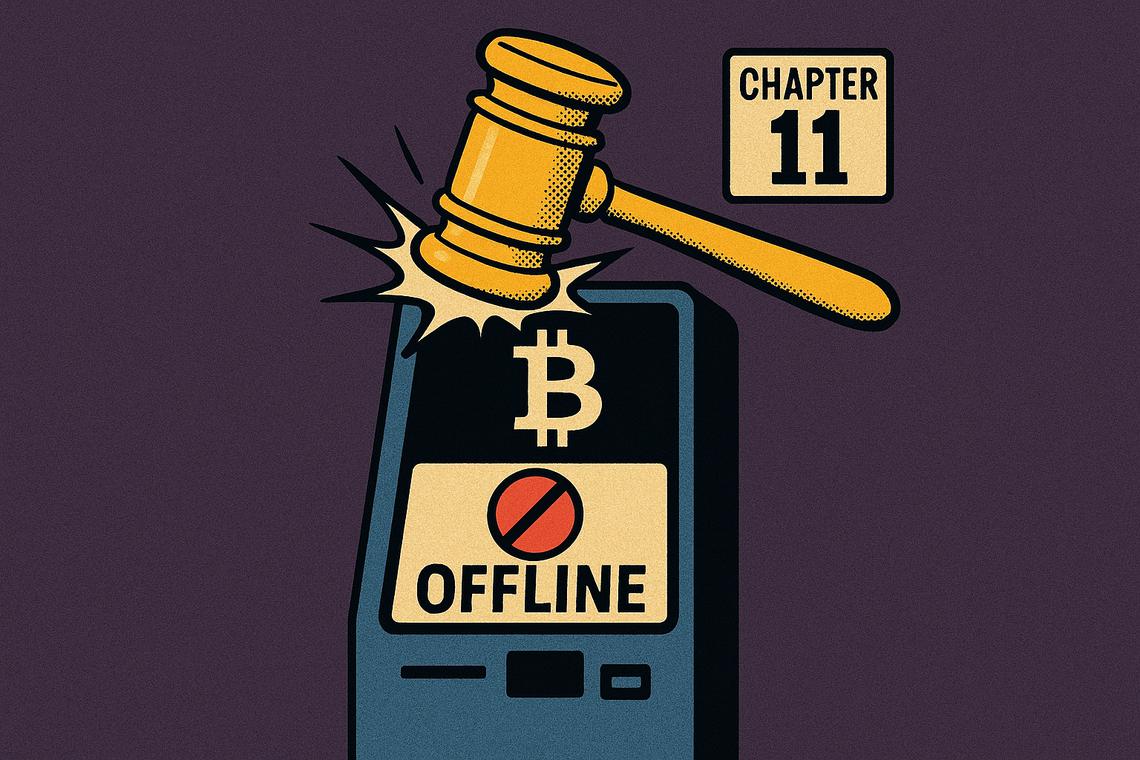
Bitcoin Depot Chapter 11 bankruptcy marks a sharp break for a business built around one of crypto’s most visible real-world touchpoints: the Bitcoin ATM. The company has entered voluntary Chapter 11 bankruptcy proceedings, plans to wind down operations and sell assets, and has already taken its entire ATM network offline.
That collapse did not come out of nowhere. Bitcoin Depot said mounting regulatory pressure battered its business model, with stricter state compliance rules, transaction limits, lawsuits, and enforcement actions pushing its Bitcoin ATM operations into unsustainable territory.
For a sector that promised simple cash access to Bitcoin, the shutdown lands as more than a single-company failure. It highlights how hard it has become for crypto cash-access services to keep operating when legal costs, compliance demands, and fraud controls keep rising at the same time.
Summary
Bitcoin Depot Chapter 11 bankruptcy and the planned wind-down
Bitcoin Depot entered voluntary Chapter 11 bankruptcy proceedings as it moves to wind down operations and sell assets.
The filing is tied directly to a business retreat, not a turnaround story built around expansion. The company’s stated plan is to unwind the operation and dispose of assets, underscoring how severe the pressure on its business had become.
That makes the Bitcoin Depot Chapter 11 bankruptcy notable beyond the company itself. Bitcoin ATMs have long served as a bridge between digital assets and everyday cash users. When a major operator shuts down completely, it raises fresh questions about whether that model still works under tougher rules.
Why the Bitcoin ATM business became unsustainable
Bitcoin Depot tied its decline to a stack of overlapping pressures. The company said stricter state compliance rules were a major factor, and that transaction limits, lawsuits, and enforcement actions added to the strain.
Those forces hit at the core of the business. Bitcoin ATM operations depend on making cash-based crypto access easy enough for users while still meeting regulatory standards. Once compliance gets heavier and limits tighten, the economics can shift quickly.
In this case, the company said that mounting regulatory pressure hurt its business model to the point that the operation no longer made sense.
Why this matters is fairly straightforward: the crypto cash-access sector often lives or dies on operational margin and regulatory tolerance. If those narrow further, services built around physical access points can become much harder to sustain, even when demand for Bitcoin access remains.
What happened to the ATM network
Bitcoin Depot’s entire ATM network has already been shut offline.
That detail matters because it shows the company is not simply restructuring around a smaller footprint. The network is down in full, ending its direct role in Bitcoin ATM access as the bankruptcy process unfolds.
The Bitcoin ATM shutdown also gives the story a broader industry meaning. Physical crypto infrastructure tends to be one of the most public-facing parts of the market. When it disappears, users feel the change immediately, and the sector loses one of its clearest on-ramps between cash and Bitcoin.
What CEO Alex Holmes said about restructuring
CEO Alex Holmes said the company had expanded fraud prevention measures, but those steps were not enough to overcome worsening legal and financial conditions.
Instead, Holmes said restructuring was the only viable path forward.
That statement points to an important tension inside the business. Even after tightening fraud prevention, the company still faced a mix of regulatory pressure and operating strain that it could not absorb. In other words, the problem was not framed as a single fixable issue, but as a broader breakdown in the model.
For readers watching the sector, the Bitcoin Depot Chapter 11 bankruptcy is a sign that compliance-heavy crypto businesses may face a very different future from the one many expected during earlier growth years. Cash access to Bitcoin still carries appeal, but the companies providing it now appear to face a much tougher test: proving they can survive the rules designed to govern them.