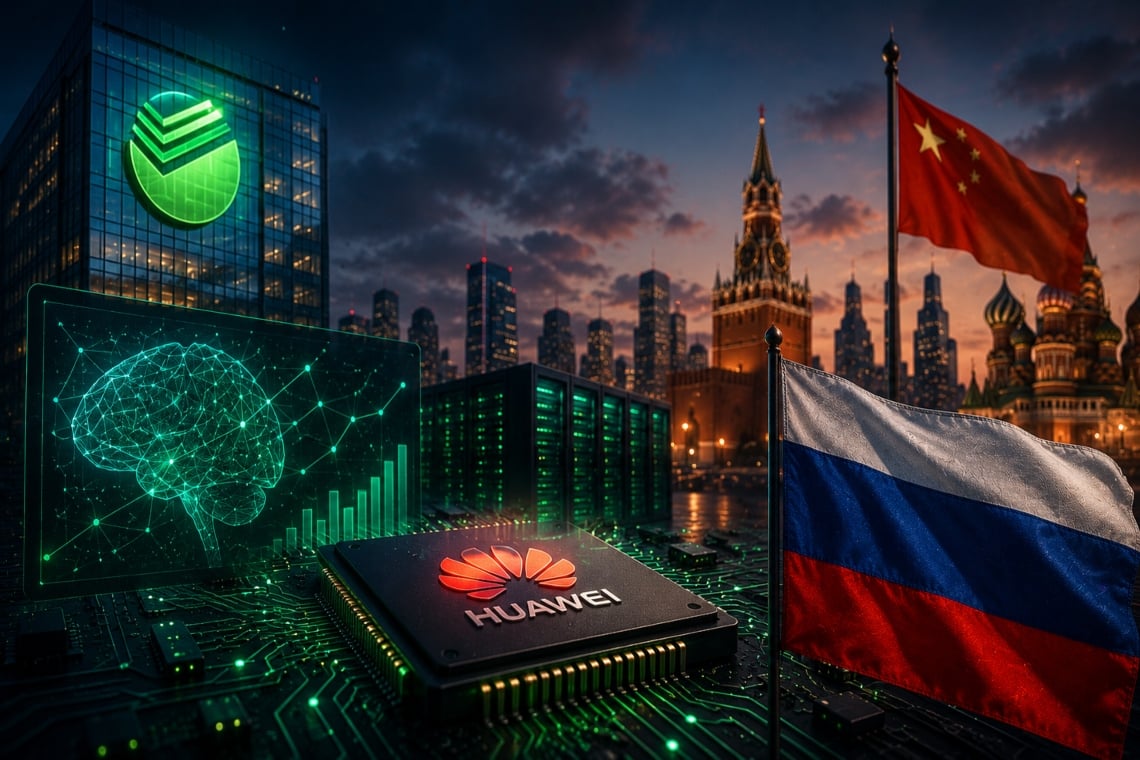
Russia is accelerating the development of artificial intelligence (AI) and is looking increasingly to China to circumvent Western restrictions.
At the center of this strategy is Sberbank, Russia’s main financial institution, which wants to strengthen the GigaChat model using Chinese AI chips in an increasingly competitive global context.
Summary
GigaChat and Russia’s challenge to global artificial intelligence
As we know, the global race for artificial intelligence is redefining technological and geopolitical balances, and Russia does not want to be excluded from this transformation.
During Russian President Vladimir Putin’s visit to China, the CEO of Sberbank, German Gref, confirmed that the group hopes to use Chinese microchips to support the development of GigaChat.
That is, the AI model considered one of the country’s most important technological projects.
The statements come at a particularly delicate time for Moscow. The Western sanctions introduced in recent years have in fact severely limited Russia’s access to advanced semiconductors produced by U.S. companies or U.S. allies.
This has forced many Russian entities to seek technological alternatives in Asia, especially in China, which has now become Russia’s main strategic partner also on the hardware front.
GigaChat represents one of the symbols of this ambition. The model was developed by Sberbank, Russia’s largest bank, which in recent years has heavily invested in the technology sector, progressively transforming itself into a digital giant as well.
The group’s goal is to create a national AI ecosystem capable of competing, at least domestically, with the most advanced Western and Chinese models.
However, the main problem remains the hardware infrastructure. Generative artificial intelligence requires enormous computational capacity and therefore access to highly performant chips.
Without advanced semiconductors, the development of complex language models inevitably risks slowing down.
For this reason, Sberbank is reportedly looking at Huawei’s Ascend 950 chips, currently considered among the most advanced AI products available in China.
Even though these processors still lag behind the American Nvidia H200 accelerators, they nonetheless represent one of the few realistic options for countries affected by Western restrictions.
AI chips, sanctions and global competition: Russia seeks room between China and the United States
Russia’s strategy, however, runs into another major obstacle: Chinese competition itself.
The country’s main internet companies, such as ByteDance, Tencent and Alibaba, are increasing their orders of Huawei AI chips to support their own artificial intelligence systems.
This means that even for Moscow, obtaining advanced hardware could become increasingly difficult.
Behind this dynamic lies a broader issue concerning global technological fragmentation.
Until a few years ago, the AI market was in fact dominated almost exclusively by American companies, with Nvidia becoming the absolute benchmark for chips intended for training language models.
Today, however, China is trying to build an independent supply chain, while Russia is attempting to position itself within this new Eurasian technological axis.
The problem is that Moscow starts from a position of significant delay. Russia continues to depend almost entirely on electronic imports in the most sensitive sectors, including defense.
Sanctions have made this structural vulnerability even more evident, pushing the Kremlin to invest more heavily in technological cooperation with Beijing.
Not by chance, in recent months several analysts have pointed out how AI has also become a central element in national security strategies.
The discussion is no longer only about chatbots or commercial applications, but about technologies that can be used in cybersecurity, military analysis, surveillance and industrial automation.
In this scenario, having access to the most advanced chips is equivalent to possessing a strategic advantage.
China itself, although growing rapidly, is still chasing the United States in the field of the most sophisticated semiconductors.
Huawei has made important progress with the Ascend line, but the technological gap compared to Nvidia processors remains significant. This indirectly limits Russian ambitions as well, since they depend on China’s ability to close the gap.