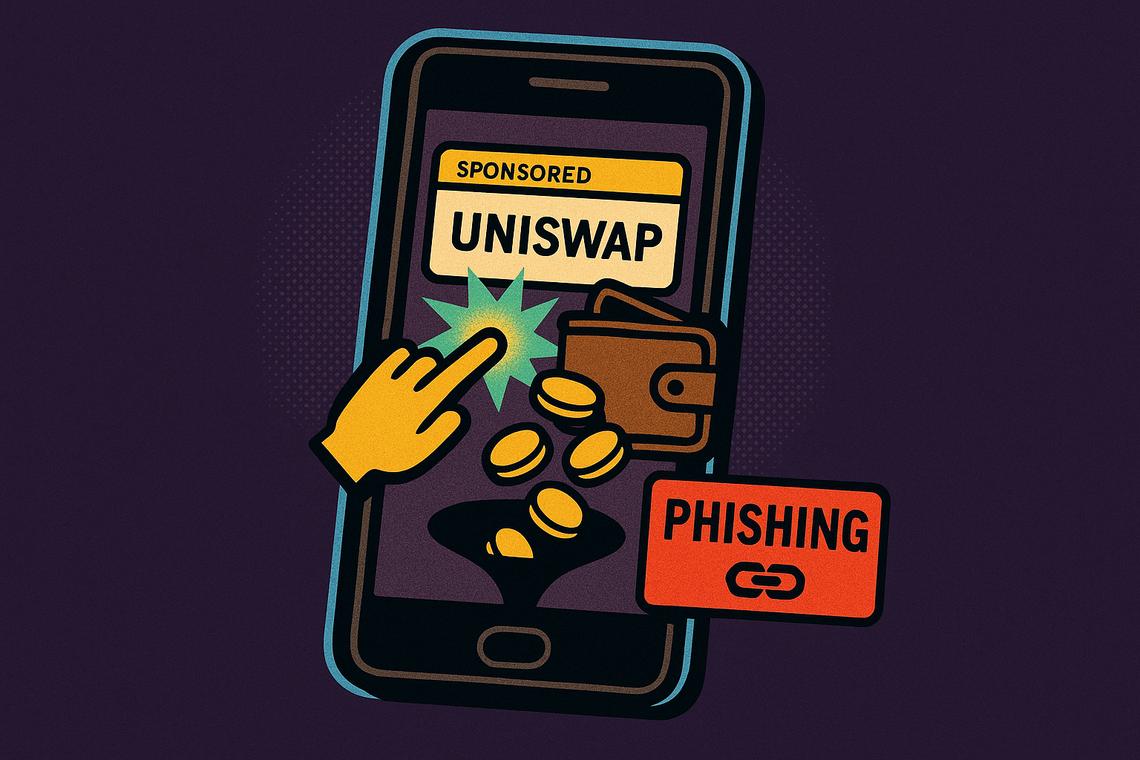
Crypto users searching for Uniswap on Google are once again running into a familiar trap. In the latest Uniswap phishing Google Ads case, fake sponsored links reportedly helped scammers steal at least $400,000 by pushing users toward a cloned site that looked real enough to win their trust.
What makes this case stand out is how ordinary the setup appears. A user searches for a major DeFi brand, sees a paid result above the legitimate link, clicks, connects a wallet, and approves a transaction. Moments later, assets are gone.
That pattern has become alarmingly common across crypto. Meanwhile, security researchers say this Uniswap-themed campaign is part of a broader wave of fake crypto ads and Google search phishing sites spreading through search results.
Summary
Fake Uniswap ads on Google reportedly drained at least $400,000
The reported losses tied to the fake Uniswap campaign have reached at least $400,000, according to on-chain reporting cited by security observers.
On-chain analyst b-block linked the operation to two wallet addresses holding 146 ETH. The article says those wallets together held roughly $306,000 at the time, based on Etherscan data.
Stacy Muur, founder of Green Dots, said the phishing ads were placed above legitimate Uniswap links in Google search. She also shared a screenshot showing the fake sponsored result, underscoring the core problem in this kind of Google search phishing setup: the malicious link can appear before the real one.
That matters because search placement changes user behavior fast. In crypto, where users often act quickly to connect wallets, swap tokens, or chase market moves, a single misplaced click can turn a routine visit into a full wallet compromise.
How the phishing campaign worked
The mechanics were simple, but effective. Security reporting tied the campaign to sponsored Google search ads that mimicked the official Uniswap listing. After users clicked through, they landed on a phishing page that closely copied Uniswap’s interface.
From there, the trap moved on-chain.
Attackers used a malicious smart contract to trick victims into approving unlimited asset transfers. Once that approval was granted, the scammers did not need private keys to move funds. The approval itself opened the door.
In practical terms, the wallet draining scam followed a familiar sequence:
- A fake sponsored ad appears above the legitimate Uniswap result
- The victim connects a wallet on a cloned interface and signs an approval
- The malicious contract gains transfer permissions and drains assets
This is one reason the Uniswap phishing Google Ads threat is so effective. It does not depend on breaking into a wallet in the traditional sense. Instead, it abuses user trust and the normal approval flow built into decentralized apps.
Why security groups say the threat is growing
Security groups have been warning for months that fake crypto ads are not isolated incidents. They are recurring attack channels.
SEAL previously said phishing tied to Google Search ads stole more than $1.27 million between March 13 and March 30 alone. The organization also said it blocked more than 356 malicious advertisement links over the past year.
That scale suggests the issue is no longer just a brand-impersonation problem for one protocol. It is becoming an infrastructure problem for crypto discovery itself. If major DeFi services are being impersonated where users first find them on search engines, then the attack surface begins before anyone even reaches an app.
SEAL said attackers either buy Google advertisements directly or compromise legitimate advertiser accounts to distribute fake links impersonating major protocols and exchanges. The group also said malicious actors often outbid legitimate companies, helping phishing pages rise to the top of sponsored search results.
Why the Google Ads model is so useful to scammers
The Google Ads model works for attackers because it borrows trust from the search engine itself. As a result, users may assume a sponsored result is safe, especially when it uses a familiar name like Uniswap.
In crypto, that trust gap is especially dangerous. Users often move quickly, and even one approval can give a malicious contract permission to drain funds.
A pattern stretching beyond Uniswap
The latest incident fits a wider trend.
Scam Sniffer previously reported that a user lost more than $1.23 million in Uniswap NFTs through a fake site. In that case too, the phishing page reportedly copied the real interface and used a malicious transaction flow to drain funds after approval.
PeckShield Alert has also warned about fake Aave advertisements appearing in Google search results. That means the problem is not limited to one token, one exchange, or one campaign. It is affecting multiple recognizable DeFi brands.
Security researchers have also pointed to cloned interfaces and Punycode domains as recurring tactics. These fake sites can look nearly identical to the real thing, especially when paired with a paid ad and a familiar brand name. For users moving quickly, the difference can be hard to spot.
Why this matters for crypto users and DeFi platforms
This story is about more than one phishing ring.
The bigger issue is that search advertising remains a direct funnel into wallet-draining scams. For crypto platforms, that creates a brand and trust problem even when their own systems are not breached. For users, it means basic actions like searching for a protocol homepage can carry hidden risk.
It also helps explain why security teams keep focusing on approvals rather than just passwords or seed phrases. In many of these attacks, victims are not handing over private keys. They are authorizing malicious transfers through interfaces designed to look legitimate.
That distinction matters because it changes how crypto theft happens. The weak point is often not the wallet software itself, but the path users take to reach an application.
The search battle is becoming part of crypto security
The latest Uniswap phishing Google Ads campaign shows how closely crypto security now overlaps with search visibility, ad placement, and brand impersonation.
b-block’s linkage to two wallets holding 146 ETH gives the case an on-chain anchor, while the wider figures from SEAL point to a larger trend that is still hitting users across the sector. Add in warnings involving Aave and earlier Uniswap-related losses, and the message is hard to miss: for many attackers, the hunt for victims starts long before a wallet is connected.