



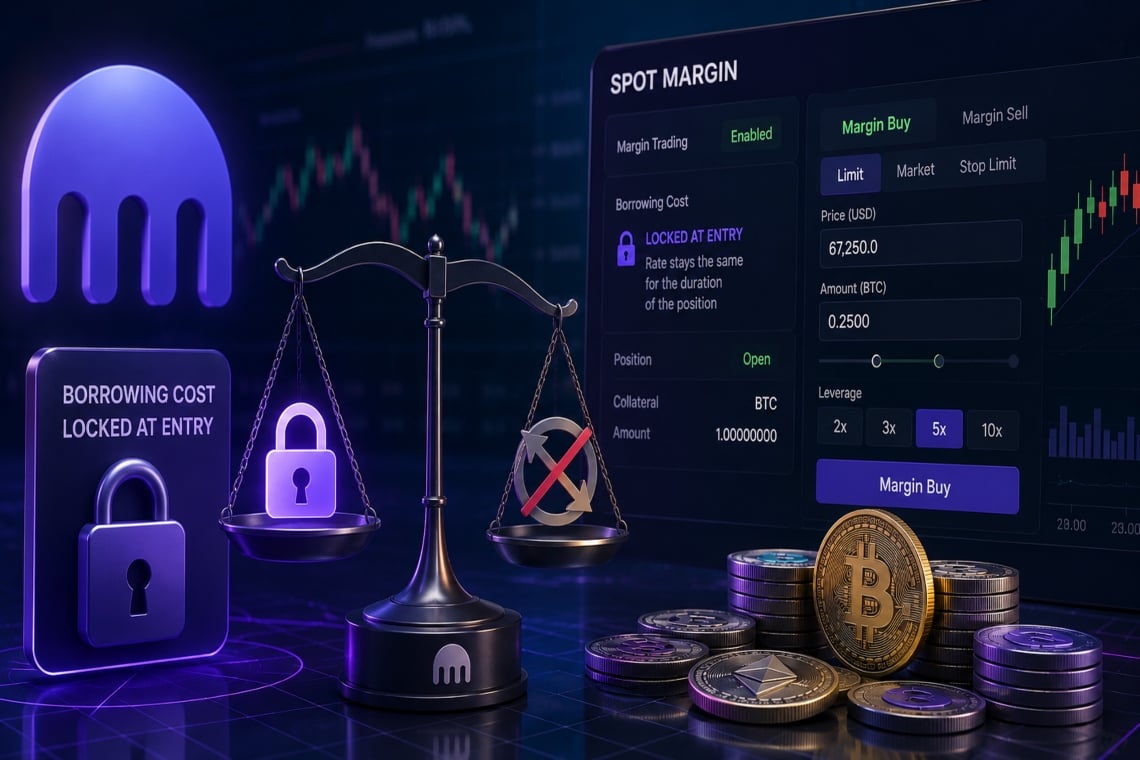
As Kraken expands its regulated trading offerings in the United States, one feature of its newly launched spot margin product is drawing attention among experienced crypto traders: borrowing costs are fixed when a position is opened and do not adjust afterward, even if market conditions change.
The distinction may appear technical, but it represents a significant departure from the way many cryptocurrency traders have become accustomed to managing leveraged positions through perpetual futures contracts.
Summary
How Kraken’s US Spot Margin Product Works
Kraken recently launched regulated spot margin trading for US retail customers following Payward’s acquisition of Bitnomial, a move that expanded the company’s ability to offer CFTC-regulated derivatives and leveraged trading products in the United States.
According to Kraken’s margin fee documentation, borrowing rates are determined at the moment a position is executed and remain fixed for the duration of that trade.
Current published rates include:
- BTC/USD long positions: 0.025% every four hours
- BTC/USD short positions: 0.010% every four hours
Unlike perpetual futures funding rates, these borrowing costs do not rebalance as market sentiment changes.
For traders accustomed to perpetual contracts, this difference can materially impact the economics of a position over time.
Why Perpetual Traders May Misunderstand the Cost Structure
Perpetual futures dominate leveraged crypto trading globally. On most exchanges, funding payments are exchanged between longs and shorts at regular intervals, typically every eight hours.
These funding rates fluctuate continuously based on market conditions. In some bearish environments, funding can even turn negative, allowing long traders to receive payments rather than incur costs.
As a result, many traders develop an expectation that holding costs will naturally adjust over time.
Kraken’s regulated spot margin product operates under a different framework. The borrowing rate established at trade entry remains unchanged regardless of subsequent shifts in volatility, liquidity, or market sentiment.
Timing Matters More Than Many Traders Realize
The fixed-rate structure means that two traders taking identical directional positions may face very different long-term borrowing costs.
Consider a trader opening a BTC long position during a period of elevated volatility. The borrowing rate applicable at that moment becomes the rate attached to the position for its entire lifespan.
Another trader entering a similar position after market conditions stabilize could potentially secure more favorable borrowing economics.
The directional exposure may be identical, but the cost of maintaining the trade can differ significantly depending on when the position was initiated.
The Regulatory Context Behind the Product
Kraken became the first CFTC-regulated venue to offer spot margin trading to US retail customers, according to reporting from The Block.
The launch follows Payward’s reported $550 million acquisition of Bitnomial, a transaction that closed in May 2026 and was confirmed by both Kraken and industry media reports.
While much of the industry’s attention focused on the regulatory significance of the deal, the mechanics of the margin product itself have received less scrutiny.
With Kraken’s US perpetual futures offering still expected later in 2026, regulated spot margin currently represents one of the primary leveraged trading options available to US crypto traders seeking a compliant alternative to offshore venues.
Different Products, Different Risks
According to Anton Palovaara, founder of Leverage.Trading, traders migrating from offshore perpetual exchanges may underestimate how differently borrowing costs behave within a fixed-rate margin framework.
“Kraken’s own fee documentation states that the rollover rate locks at execution. On perpetual contracts, funding resets every eight hours and can flip negative in bearish conditions. On Kraken’s spot margin product, neither of those things happens. A trader who entered during a volatility spike is carrying 0.025% per four hours, about 54% annualized, for the entire life of the position.”
The observation highlights a broader distinction detailed in the Leverage.Trading Futures vs Margin Trading educational analysis. While both products provide leveraged exposure, the underlying cost structures can produce dramatically different outcomes over extended holding periods.
For traders evaluating Kraken’s regulated margin offering, the timing of entry may therefore influence more than just price performance. It can also determine the borrowing costs attached to the position from the moment the trade is opened until it is closed.
What Traders Should Watch
As regulated crypto trading products continue to expand in the United States, understanding the mechanics behind leverage may become increasingly important.
For traders transitioning from perpetual futures to regulated spot margin, borrowing costs should be evaluated separately from directional market views.
In Kraken’s case, the execution price is not the only factor locked in at trade entry. The borrowing rate may be as well.
