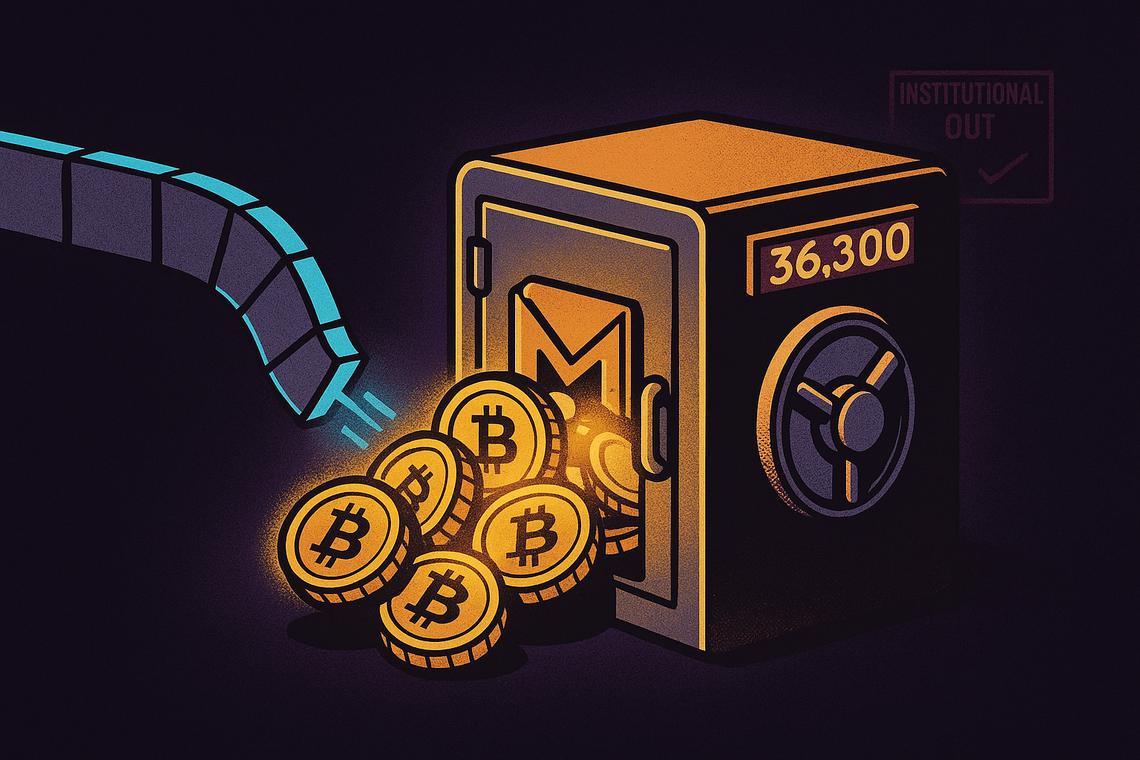
Marathon Digital Holdings just made a move that tells you a lot about where its thinking has shifted. The company — better known by its ticker MARA — quietly acquired 1,000 BTC through crypto brokerage FalconX, spending roughly $66.7 million at a time when Bitcoin was trading near $66,700 after a failed attempt to break above $70,000. For a company that spent much of early 2026 offloading Bitcoin at scale, this purchase is a meaningful signal about its evolving Marathon Bitcoin strategy.
Summary
Key takeaways
- Marathon Digital Holdings bought 1,000 BTC via FalconX for approximately $66.7 million, split into five equal transfers of 200 BTC each.
- The purchase brings MARA’s total Bitcoin holdings to roughly 36,300 BTC, valued at over $2.4 billion.
- In Q1 2026, MARA sold 20,880 BTC worth around $1.5 billion — far more than the 2,247 BTC it mined — making this accumulation a clear strategic reversal.
- Darkfost data shows net Bitcoin market outflows have reached approximately 66,000 BTC, pointing to weakening structural demand from institutional buyers and ETFs.
- MARA is now among the largest publicly listed Bitcoin holders globally.
Marathon Digital Holdings Executes Major Bitcoin Purchase
The acquisition is straightforward in its mechanics but revealing in its timing. On-chain data aggregator Lookonchain tracked the transaction, confirming it was executed in five equal transfers of 200 BTC each — a structured approach that avoids large single-block market impact. The total cost came to approximately $66.7 million, with Bitcoin hovering near $66,700 at the time after a recent rejection from the $70,000 level.
Details of the 1,000 BTC Acquisition via FalconX
FalconX, the institutional crypto prime brokerage handling the transaction, processed the full order in systematic batches. The five-part execution structure is a common institutional tactic to minimize slippage and avoid tipping the market. At the current price level, MARA was effectively buying into a brief pullback — not chasing highs.
That kind of disciplined entry matters when you’re deploying $66.7 million in a single transaction. It also signals that the company isn’t operating on impulse. This looks more like a planned allocation than an opportunistic dip buy.
Context of Bitcoin Price During Purchase
Bitcoin’s inability to sustain a move above $70,000 before this transaction adds important context. The rejection left the asset trading roughly 5% below that level, creating what some institutional buyers view as a cleaner entry point. Whether that thesis plays out remains to be seen, but the timing suggests MARA viewed the pullback as favorable rather than alarming.
Shift from Selling to Accumulation Reflects Strategic Reorientation
To understand why this purchase matters, you need to look at what MARA was doing just a few months earlier — and the contrast is striking.
Q1 2026 Mining and Selling Activity
During the first quarter of 2026, Marathon mined 2,247 BTC through its mining operations. But it sold 20,880 BTC during the same period — nearly nine times what it produced — generating approximately $1.5 billion in proceeds. Those funds went toward debt reduction, note repurchases, and expansion into AI data center infrastructure.
That was a deliberate liquidation phase. MARA was converting Bitcoin holdings into operational and financial flexibility. It ended Q1 2026 with 35,303 BTC on its books — down significantly from prior levels after that heavy distribution period.
Current Bitcoin Holdings and Balance Sheet Focus
The latest 1,000 BTC purchase pushes total holdings back up to approximately 36,300 BTC, now valued at more than $2.4 billion. That repositions MARA firmly among the largest publicly listed Bitcoin holders in the world — a ranking that carries weight with institutional investors and analysts tracking corporate Bitcoin exposure.
The shift from aggressive selling to deliberate accumulation tells a clear story: MARA appears to have completed its debt restructuring and diversification phase, and is now pivoting toward long-term balance sheet reinforcement through Bitcoin. Rather than treating its BTC as a source of liquidity, the company is once again treating it as a core strategic asset.
This kind of strategic reversal doesn’t happen by accident. It reflects an internal conviction that holding Bitcoin on the balance sheet — rather than converting it to cash — is the better long-term bet. Given where MARA is positioning itself in the mining and AI infrastructure space, locking in Bitcoin at current levels may be seen internally as building reserves before the next significant price move.
Declining Institutional Demand and Market Outflows Underpin Purchase Timing
MARA’s accumulation is happening against a backdrop that makes it somewhat contrarian. Broader institutional demand for Bitcoin has actually been cooling, according to market data — which makes the company’s timing either very well-calculated or notably bold.
Weakening Institutional Spot Demand and ETF Activity
Data from analyst platform Darkfost shows weakening spot demand across key institutional channels. The two primary demand drivers — direct institutional accumulation and Bitcoin ETF inflows — have both lost momentum in recent weeks. Exchange-traded funds have recorded consistent outflows, reducing net demand growth. Meanwhile, Strategy, one of the best-known corporate Bitcoin accumulators, has slowed its buying activity and recorded limited selling.
These aren’t isolated signals. When ETF flows turn negative and the market’s most prominent corporate buyer steps back, it creates a demand vacuum. That vacuum directly influences price behavior, which is part of why Bitcoin struggled to hold above $70,000 ahead of MARA’s purchase.
Net Bitcoin Market Outflows and Structural Demand Trends
Darkfost data puts the scale of this demand contraction in sharper relief: net outflows in the Bitcoin market have reached approximately 66,000 BTC. That’s one of the more significant demand contractions measured in recent cycles, and it points to reduced absorption capacity among institutional participants broadly.
For MARA, buying into this environment is a two-sided proposition. On one hand, softer institutional demand means less competition for blocks and potentially more favorable pricing. On the other hand, the same demand weakness that made the purchase cheaper also reflects genuine uncertainty about near-term price direction. The MARA BTC accumulation move is a long-term bet, not a short-term trade — and the company appears to be making it with full awareness of the current market environment.
What’s analytically interesting here is the divergence: as broader Bitcoin institutional demand softens and ETF buying slows, MARA is moving in the opposite direction. That counter-cyclical positioning could prove prescient if structural demand recovers, or it could reflect a company building reserves ahead of its next operational expansion. Either way, it puts MARA in a meaningfully different position than peers who are sitting on the sidelines.
With Bitcoin market outflows running near 66,000 BTC and ETF momentum stalled, the market is at a point where the next catalyst — whether institutional re-entry, a macro shift, or regulatory clarity — could reset the demand picture quickly. MARA’s 36,300 BTC reserve means it would benefit disproportionately from any such recovery, making this accumulation phase one worth watching closely as Q2 2026 unfolds.
FAQ
Why did Marathon Digital Holdings switch back to buying Bitcoin?
MARA’s latest purchase reflects a strategic reversal from selling to accumulation, aiming to reinforce its balance sheet long-term. After spending Q1 2026 selling over 20,000 BTC to fund debt reduction and infrastructure expansion, the company appears to have completed that phase and is now rebuilding its Bitcoin reserves.
How significant is Marathon’s Bitcoin holding compared to other public companies?
With approximately 36,300 BTC valued at over $2.4 billion, MARA is among the largest publicly listed Bitcoin holders in the world, placing it in a select group of corporations that treat Bitcoin as a primary balance sheet asset.
What market conditions coincided with MARA’s recent Bitcoin purchase?
The purchase occurred amid weakening institutional spot demand and reduced ETF buying activity, with Bitcoin price near $66,700 following a rejection from $70,000. Darkfost data indicated broader softening in structural demand across key institutional channels at the time of the acquisition.
What do the Bitcoin market outflows indicate about demand?
Net outflows of about 66,000 BTC, as tracked by Darkfost, point to weakening structural demand and reduced absorption capacity among institutional buyers. Both ETF flows and corporate accumulation activity slowed in the period leading up to MARA’s purchase, marking one of the more notable demand contractions in recent market cycles.
Article produced with the assistance of artificial intelligence and reviewed by the editorial team.