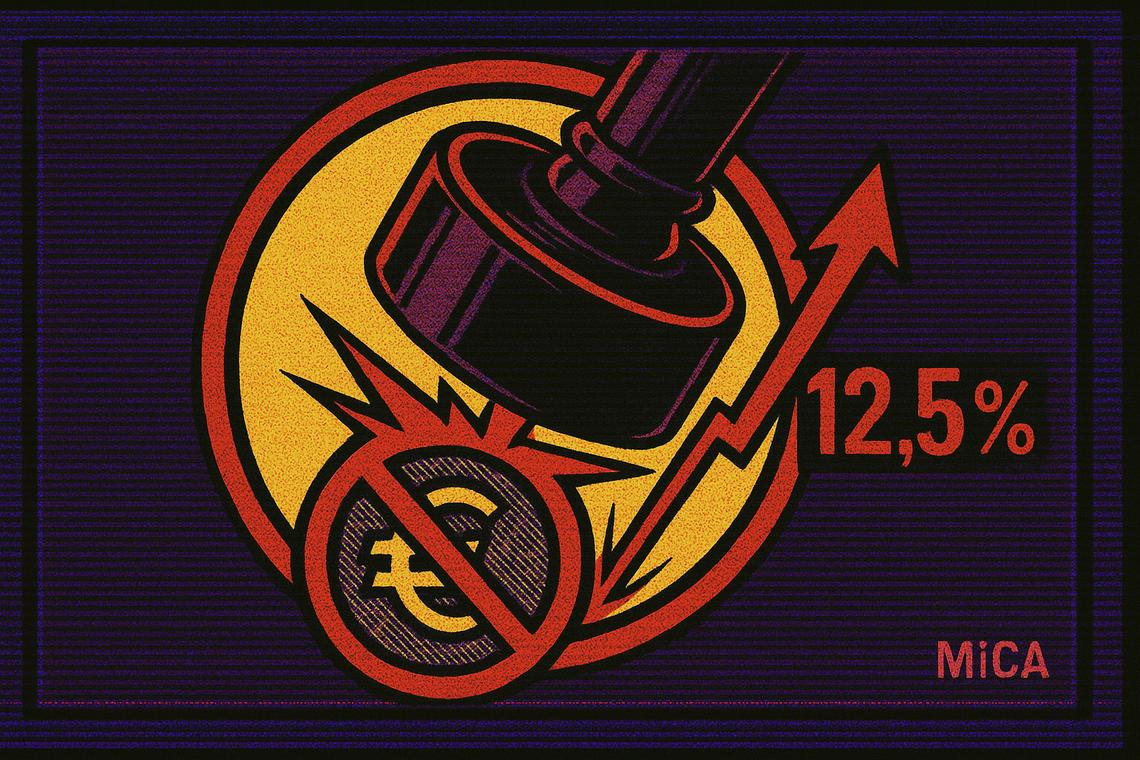
The European Banking Authority has put crypto token issuers on notice. The EU regulator published a consultation paper on June 26 outlining a sweeping MiCA penalty framework that could expose issuers of significant digital assets to fines of up to 12.5% of annual turnover — or twice the profits generated by a violation, whichever is greater. For an industry still adjusting to the world’s most comprehensive crypto rulebook, the message is unambiguous: the grace period is over.
Summary
Key takeaways
- The EBA proposes fines of up to 12.5% of annual turnover for issuers of significant asset-referenced tokens and up to 10% for significant e-money token issuers that breach MiCA rules.
- Penalties can alternatively reach twice the profits earned from a violation, whichever amount is higher.
- Crypto firms must hold a valid MiCA license by July 1, 2026, or face enforcement action and restrictions on operating across the EU.
- Binance withdrew its MiCA application in Greece and is limiting EU services, while Coinbase and OKX are actively courting the displaced user base.
- The consultation window closes September 28, 2026, giving the industry a narrow window to shape the final methodology.
EBA Proposes a Standardized, Two-Step Penalty Calculation
The proposed framework is deliberately systematic. Under the EBA’s methodology, regulators would first assess the baseline seriousness of an infringement — its scope, duration, and market impact — before adjusting the final fine upward or downward depending on aggravating or mitigating circumstances. Think of it as a sentencing grid for crypto violations, designed to remove inconsistency from national enforcement.
The statutory ceilings are significant. Issuers of significant asset-referenced tokens face fines up to 12.5% of annual turnover. Issuers of significant e-money tokens face a slightly lower ceiling of 10% of annual turnover. Where authorities can quantify the profits generated by a violation, fines can reach twice that figure — a provision clearly aimed at cases where a percentage of turnover might understate actual harm.
The Paris-based watchdog is explicit about the goal: uniform application of financial sanctions across all 27 EU member states. Without standardization, enforcement would inevitably fragment along national lines, with stricter jurisdictions driving firms toward more lenient ones. The EBA’s framework is designed to close that arbitrage gap before it opens.
Why This Matters Beyond the Numbers
The scale of the proposed penalties puts crypto issuers in the same enforcement territory as traditional banks under European financial law. For global stablecoin operators and token platforms with hundreds of millions in annual revenue, a 12.5% turnover fine is not a rounding error — it is an existential threat. The EBA is engineering deterrence, not just compliance.
The July 1 Licensing Cliff and What Follows
The consultation paper landed just days before the July 1, 2026 MiCA licensing deadline, when all crypto asset service providers and token issuers must hold formal authorization from a national EU regulator to legally operate across the bloc. The transitional period that allowed many firms to function under looser local arrangements has ended.
Firms that missed the deadline face a hard choice: halt operations, accept operational restrictions, or risk triggering exactly the kinds of violations the new penalty framework is built to prosecute. Unauthorized public disclosures, organizational compliance failures, and operating without authorization are all explicitly covered.
The industry now has until September 28, 2026 to submit feedback on the penalty methodology before it is finalized. That three-month consultation window matters — it is the last formal opportunity to influence how fines are calculated. But with the licensing deadline already in effect, firms are navigating an unforgiving compliance environment well before the final rules are locked in.
Market Impact: Binance Pulls Back, Coinbase and OKX Move In
The most visible casualty of the July 1 deadline is Binance, the world’s largest crypto exchange by volume. The exchange withdrew its MiCA license application in Greece and notified European users that it would stop onboarding new EU customers and restrict selected services from July 1. According to exchange notices shared by users on social media, existing customers retain access to withdrawals — digital assets remain available for withdrawal in line with applicable regulatory requirements — but the growth engine for EU users has been switched off.
The financial fallout was immediate. According to DefiLlama data, Binance recorded $1.96 billion in daily net outflows following its withdrawal announcement, followed by a further $2.52 billion and $1.46 billion in net outflows over the next two days. Binance has indicated it intends to seek MiCA authorization through another EU member state, though no timeline or specific jurisdiction has been confirmed.
Coinbase and OKX Capitalize on the Gap
Where Binance retreats, rivals advance. Coinbase and OKX — both operating with MiCA-compliant authorizations — have launched targeted campaigns across European markets to attract users displaced by Binance’s restrictions. Coinbase rolled out incentive campaigns in several European markets for users migrating assets ahead of key deadlines. OKX introduced welcome rewards and deposit-matching offers for qualifying users in the European Economic Area.
The competitive dynamic here is worth watching. MiCA compliance, once viewed primarily as a cost center, is rapidly becoming a marketing asset. Exchanges that invested early in licensing can now position themselves as the safe, regulated option for EU retail investors who suddenly find their primary platform restricted.
Europe Sets the Global Tone on Crypto Enforcement
The timing of the EBA’s announcement is not incidental. By publishing the MiCA penalty framework details simultaneously with the licensing deadline, European authorities are signaling that enforcement will begin immediately — not after a further transition period. The contrast with the United States, where crypto regulation has historically moved through enforcement actions rather than proactive rulemaking, is stark and intentional.
The EU is positioning MiCA as the global benchmark for digital asset regulation, and the penalty framework is the enforcement architecture that makes that benchmark credible. For crypto firms with international operations, the practical implication is clear: the EU market now requires the same compliance infrastructure as traditional financial services, and the cost of non-compliance has been priced in at a level large enough to hurt even the biggest operators.
Whether the consultation process reshapes the final methodology — and how aggressively national regulators choose to deploy it once formalized — will determine just how much teeth these rules ultimately have.
FAQ
What penalties does the European Banking Authority propose for MiCA violations?
The EBA proposes fines of up to 12.5% of annual turnover for issuers of significant asset-referenced tokens and up to 10% for significant e-money token issuers. Penalties can also reach twice the profits earned from a violation where applicable.
When must crypto firms obtain MiCA licenses to operate in the EU?
Crypto firms must secure MiCA licenses by July 1, 2026. Firms that missed this deadline face enforcement actions and operational restrictions across the European Union.
How is the penalty amount determined under the EBA framework?
Penalties are calculated using a two-step methodology: regulators first assess the seriousness of the infringement, then adjust the final amount upward or downward based on aggravating or mitigating circumstances.
What is Binance’s response to the MiCA licensing deadline?
Binance withdrew its MiCA application in Greece and began limiting EU services from July 1, including halting new EU customer onboarding. The exchange has indicated it intends to seek authorization through another EU member state, though details have not been confirmed.
Article produced with the assistance of artificial intelligence and reviewed by the editorial team.