



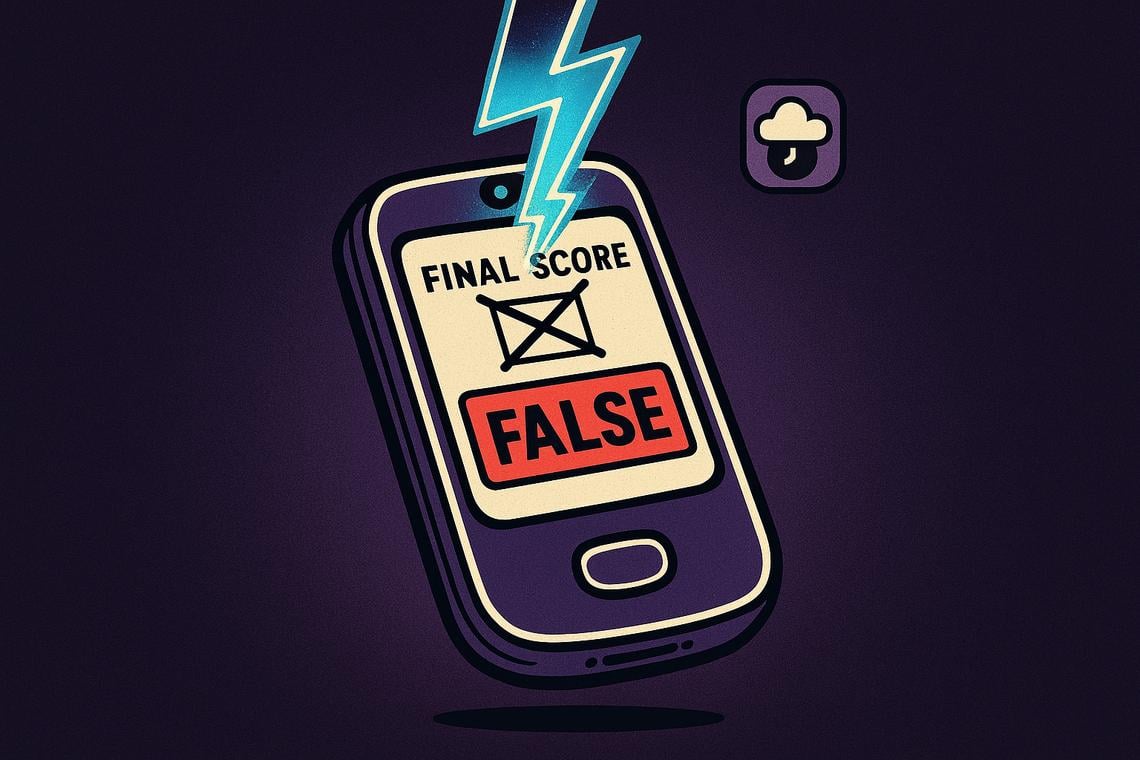
A push notification sent to Coinbase users during a FIFA World Cup match set off an uncomfortable question for one of crypto’s biggest exchanges: what happens when AI gets a live sporting result completely wrong — before the game has even been played?
Summary
Key takeaways
- Coinbase sent a false AI-generated alert claiming Norway defeated Brazil 3-2 in a World Cup match that had not yet started.
- At the time of the notification, the match was under a weather delay — Coinbase’s own prediction market page showed this correctly.
- CEO Brian Armstrong confirmed an internal investigation is underway, but the cause of the error has not been disclosed.
- Coinbase operates prediction markets through a partnership with Kalshi and has been actively integrating AI across its products.
- No material impact on Coinbase’s business or share price has been reported so far.
A False Result, a Delayed Match, and a Notification That Shouldn’t Have Existed
The erroneous alert told users that Norway had defeated Brazil 3-2, with striker Erling Haaland scoring twice. There was just one problem: the match hadn’t started. It was sitting under a weather delay, and Coinbase’s own prediction market page reflected that reality accurately — showing the game as postponed while the push notification simultaneously declared a final score.
That contradiction is what makes the incident particularly jarring. The platform’s own data systems correctly identified the match as delayed. Yet something in the notification pipeline generated and delivered a fabricated result to users as though it were official. The two signals went out at the same time, pointing in completely opposite directions.
For users relying on those alerts to make decisions on Coinbase’s prediction markets, the gap between what was true and what was sent out wasn’t just a technical glitch — it was the kind of error that could have directly influenced behavior in a live financial product.
Brian Armstrong Steps In, but Answers Remain Scarce
After users flagged the false notification online, Coinbase CEO Brian Armstrong acknowledged the problem publicly. “Taking a look with the team – thanks for reporting it,” Armstrong said in response to user complaints, confirming that an internal investigation had begun.
What that investigation has not yet produced is an explanation. The exact cause of the incorrect alert remains unknown — Coinbase has not confirmed whether it originated from an AI model, an automated data feed, or some other internal system. The company also hasn’t indicated whether similar notifications will be paused while the review is ongoing.
That silence matters. Knowing what went wrong is the prerequisite to knowing how often it could happen again. Without a disclosed root cause, users are left to trust that the platform is handling it — which is a harder ask when the error involved a prediction market tied to real money.
Why This Incident Cuts Deeper Than a Sports Mix-Up
Strip away the football context and what remains is a broader stress test for AI-powered financial notifications. Coinbase has been building aggressively in this space, weaving artificial intelligence into its products and expanding its prediction market offering through a partnership with Kalshi. That partnership gives users access to event-based markets alongside traditional crypto services — a product category that depends entirely on accurate, real-time information.
This is where the false alert does its most lasting damage. Prediction markets are supposed to aggregate information and surface reliable outcomes. When the notification layer feeding those markets produces a fabricated result — and delivers it with the same authority as a real one — it undermines the core premise of the product itself. Critics made exactly this point after the incident surfaced: an AI-generated alert that declares a winner before a ball has been kicked doesn’t just embarrass the platform, it erodes the trust architecture that makes prediction markets function.
Armstrong has previously noted that Coinbase generally prefers resolving technical issues without cutting off customer access to services. That philosophy makes sense for most bugs. But notification errors in prediction markets sit in a different risk category — one where speed and accuracy aren’t just features, they’re the product.
The Harder Question About AI Oversight in Financial Technology
The Coinbase AI false alert episode arrives at a moment when financial technology firms are moving fast to deploy AI across customer-facing systems, often without the safety infrastructure that the deployment scale demands. In most cases, errors surface internally before reaching users. Here, the error reached users first — and in a form designed to look authoritative.
What the incident exposes isn’t just a software problem. It highlights a governance gap: who is responsible for verifying AI-generated content before it goes out to users in a financial context? The distinction between a harmless chatbot hallucination and a false result delivered to users of a regulated prediction market product is significant. One is annoying; the other has real stakes.
So far, the fallout has been reputational rather than financial — no material impact on Coinbase’s business or share price has been reported. But the more Coinbase integrates AI into live market products, the narrower the margin for this kind of error becomes. An investigation is the right first step. What the industry will be watching for is what comes after it.
FAQ
What was the false AI alert issued by Coinbase?
Coinbase sent a false AI-generated push notification claiming Norway had defeated Brazil 3-2 in a FIFA World Cup match, with Erling Haaland scoring twice — before the match had even started.
Why was the alert false?
The match was under a weather delay when the alert was sent, meaning no official result existed at the time. Coinbase’s own prediction market page correctly showed the game as delayed, making the notification directly contradictory to the platform’s own data.
How has Coinbase responded to the false alert?
CEO Brian Armstrong confirmed publicly that an internal investigation is underway. However, the company has not yet disclosed the cause of the error or whether AI notification systems will be paused during the review.
What impact did the false AI alert have?
The incident undermined confidence in AI-powered prediction market notifications and raised broader concerns about the accuracy and oversight of AI-generated content on financial platforms. No material impact on Coinbase’s business or share price has been reported.
Article produced with the assistance of artificial intelligence and reviewed by the editorial team.
