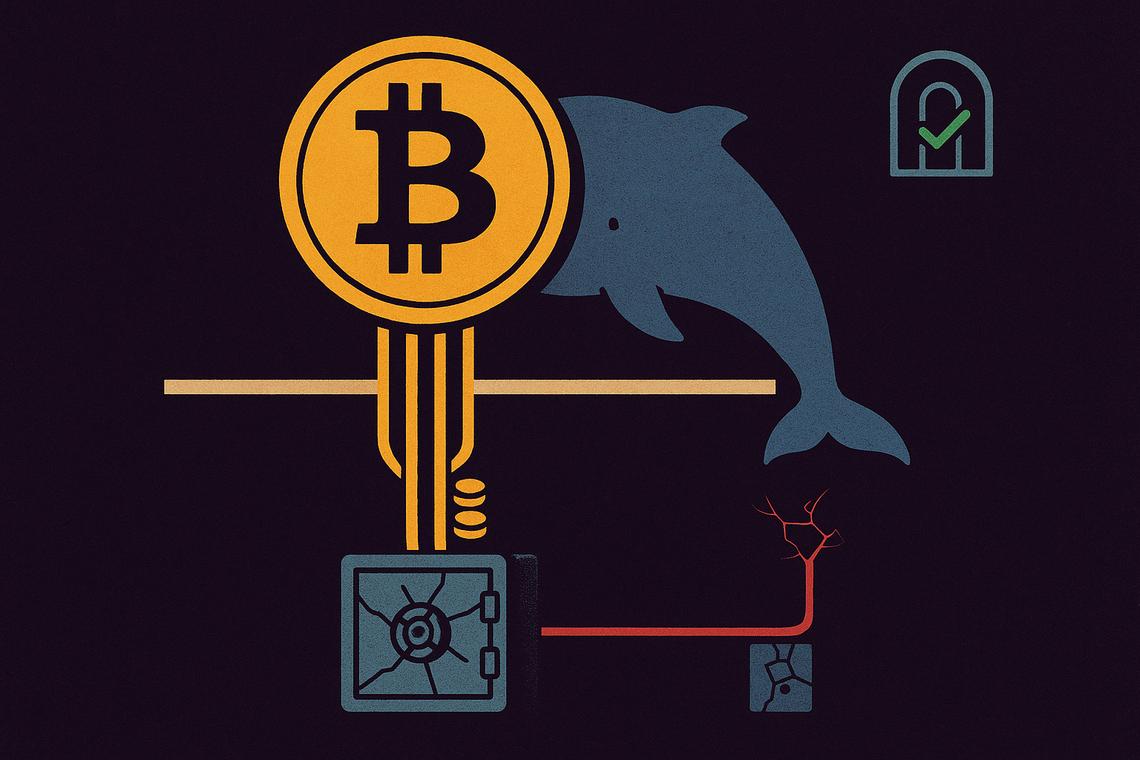
Something quiet is happening at the top of the Bitcoin market — and the numbers are hard to ignore. Bitcoin whale accumulation has surged to one of its highest levels of the year, with wallets holding between 1,000 and 10,000 BTC scooping up approximately 66,700 BTC over the past 60 days as of July 19. At prices hovering around $64,500 to $64,700, that represents billions of dollars in fresh exposure — absorbed steadily, without chasing price.
Summary
Key takeaways
- Whale wallets (1,000–10,000 BTC) accumulated approximately 66,700 BTC in the 60 days ending July 19, one of the strongest buying waves of the year.
- Mid-sized holders (100–1,000 BTC) distributed around 77,800 BTC during the same period, providing liquidity for whale buying.
- Bitcoin price held stable between $64,500 and $64,700 throughout the accumulation window.
- Exchange reserves continued declining as more BTC moved to self-custody, reducing available sell-side supply.
- US spot Bitcoin ETFs returned to net inflows after an extended outflow streak, though the recovery remains modest relative to prior redemptions.
Bitcoin Whales Are Buying Into a Flat Market
The most striking detail about this accumulation wave is not just the size — it is the context. Large holders are not buying into a rally. They are loading up while the market stands still.
Bitcoin’s price barely moved during the entire accumulation window, settling into a narrow band around $64,500 to $64,700 in mid-July. That kind of price stability during heavy buying is unusual. It suggests that whale-level demand is being absorbed by roughly equivalent selling from elsewhere — which raises an important question about who is on the other side of the trade.
A Buying Wave That Rivals Mid-June’s High-Water Mark
The 66,700 BTC accumulated by large wallets in this 60-day stretch places the current wave just below the strongest accumulation event of the year. In mid-June, those same whale-tier wallets recorded a net gain of 68,000 BTC — previously the single highest accumulation episode of 2026. Two massive accumulation events back to back represent a notable pattern of sustained buying by the market’s largest participants.
When entities managing thousands of Bitcoin commit capital at this scale during flat price conditions, the implied message is straightforward: they believe current prices are attractive relative to where they expect things to go.
Mid-Tier Holders Are Moving in the Opposite Direction
While whales accumulate, a different cohort is heading for the exits. Mid-sized holders with 100 to 1,000 BTC distributed around 77,800 BTC during the same 60-day window — slightly more than what whales absorbed.
Who Is Actually Selling
This group typically includes miners managing cash flow, early investors taking partial profits, and funds rebalancing allocations. Their selling is less a signal of bearishness and more a reflection of structural portfolio mechanics. Miners must sell to cover operational costs. Funds that have held Bitcoin since lower prices face pressure to realize gains or reduce crypto exposure as broader market conditions shift.
Critically, mid-tier distribution provides the liquidity that whale buyers require. Without a willing seller, accumulation at this scale would push prices sharply higher. The fact that prices stayed flat suggests the two forces are currently in near-balance — a dynamic that rarely persists indefinitely.
Exchange Outflows and the Shrinking Supply Pool
Declining exchange reserves are reinforcing the supply-side picture. More Bitcoin is moving off centralized platforms and into self-custody, a trend that has been running steadily for months. When coins leave exchanges, they remove immediately sellable supply from the market. The effect is cumulative — each withdrawal narrows the pool available to meet future sell orders.
This matters because supply squeezes do not always produce immediate price reactions. The compression builds slowly, and the catalyst that triggers the eventual repricing often comes from the demand side rather than the supply side. That brings the focus back to institutional flows.
Renewed Institutional Demand via US Spot Bitcoin ETFs
US spot Bitcoin ETFs have returned to net inflows after a prolonged stretch of mixed and negative flows earlier in the year. According to The Block, citing SoSoValue data, US spot bitcoin ETFs recorded total net inflows of $79.15 million on July 16, with BlackRock’s IBIT leading with $33.44 million. The recovery follows an extended period of outflows earlier in the year.
The recovery is real, but it requires perspective. The ETF wrapper — which gave traditional investors clean access to Bitcoin — also functions as a source of mechanical supply when sentiment reverses. The flow regime has stabilized, but it has not yet recovered the intensity that characterized the product’s strongest inflow periods.
What the Divergence Actually Signals
The split between whale accumulation and mid-tier distribution is one of the sharper on-chain signals currently visible in the Bitcoin market. It describes a transfer of supply from holders more likely to sell — funds rebalancing, miners covering costs, early investors reducing exposure — to holders with longer time horizons and higher conviction in future price appreciation.
Historically, sustained accumulation by large wallets during price consolidation has preceded significant upward moves. But the timing is genuinely uncertain. Supply squeezes can take weeks or months to translate into price action, and the current on-chain setup does not guarantee any specific outcome. External conditions carry real weight.
Macro Pressures Remain a Countervailing Force
The broader market environment adds complexity. According to The Block, Coinbase’s Bitcoin Premium Index remained negative for a record 60 consecutive days as of July 17, historically a signal of weaker US institutional demand. Semiconductor stock selloffs have periodically dragged Bitcoin lower within broader risk-off moves. Geopolitical energy risk keeps rate expectations elevated, with the CME FedWatch Tool placing a 30% chance of a 50-basis-point Fed rate hike before year-end, according to XS.com’s Simon-Peter Massabni.
Diana Pires, chief business officer at sFOX, noted in comments cited by The Block that Bitcoin’s core fundamentals remain intact, but a high-inflation environment pushes large investors to weigh a broader set of opportunities — creating short-term headwinds even for assets with strong long-term conviction. The on-chain picture and the macro picture are currently pulling in different directions, and neither has resolved the tension yet.
What makes the current setup worth watching is precisely that unresolved tension. Whales are accumulating at near-peak annual levels, exchange supply is shrinking, and institutional products are beginning to attract fresh capital again. Whether those forces compound into a breakout — or whether macro headwinds and regulatory uncertainty reset the equation — is the question the market has not yet answered.
FAQ
How much Bitcoin have whale wallets accumulated recently?
Whale wallets holding between 1,000 and 10,000 BTC accumulated approximately 66,700 BTC over the 60 days ending July 19, making it one of the strongest buying waves of 2026.
What is the recent behavior of mid-tier Bitcoin holders?
Mid-sized holders with 100 to 1,000 BTC distributed around 77,800 BTC during the same 60-day period, a group that typically includes miners, early investors, and funds rebalancing their portfolios.
What does stable Bitcoin price during whale accumulation indicate?
Price stability alongside aggressive large-wallet buying suggests that whale demand is being offset by mid-tier selling, creating a near-balance. It also signals that large holders find current price levels attractive and are positioning for future appreciation rather than chasing an existing rally.
How are exchange reserves and US spot Bitcoin ETFs affecting the market?
Exchange reserves are declining as Bitcoin moves into self-custody, gradually reducing available sell-side supply. US spot Bitcoin ETFs returned to net inflows, with BlackRock’s IBIT recording $33.44 million on July 16 alone, though the overall recovery remains modest compared to the extended outflow period earlier in the year.
Article produced with the assistance of artificial intelligence and reviewed by the editorial team.