
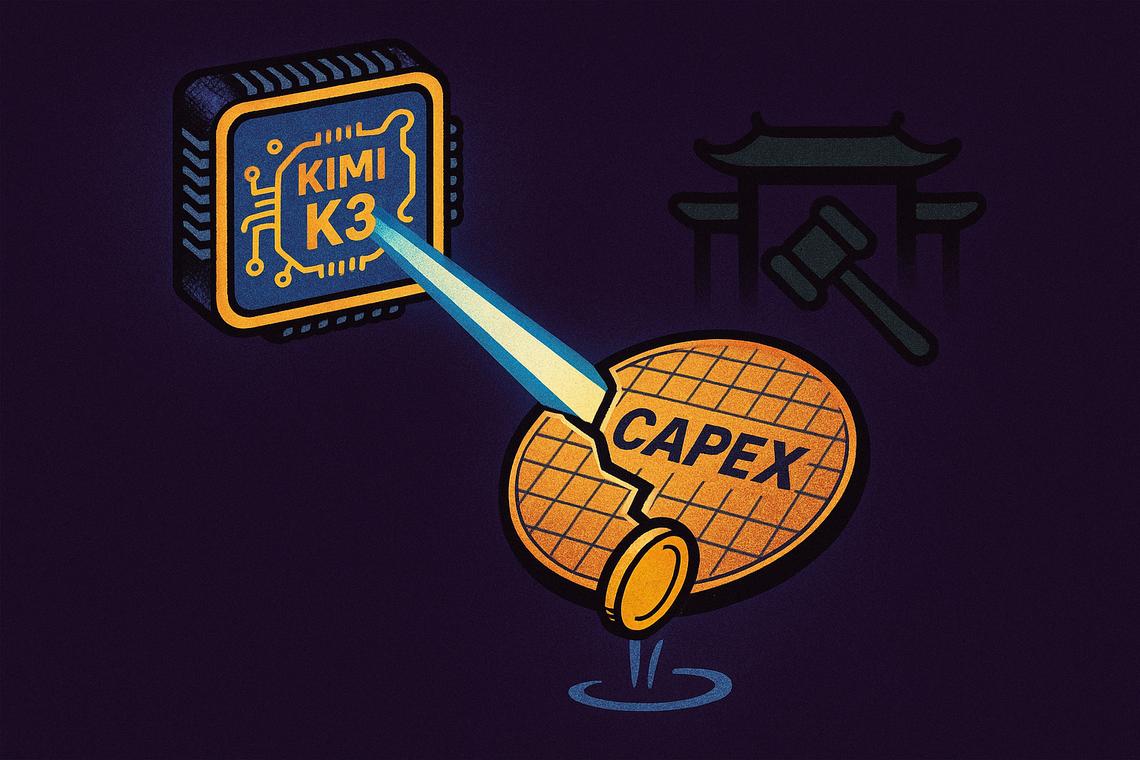
A Beijing startup that few people outside AI circles had heard of a year ago is now moving toward a Hong Kong stock exchange listing, armed with a model that just rattled Wall Street, spooked semiconductor investors, and dragged bitcoin down with it. Moonshot AI’s IPO push isn’t just a capital markets story — it’s a signal that the global AI race has entered a new and more disruptive phase.
Summary
Key takeaways
- Moonshot AI has distributed a shareholder resolution seeking approval for a Hong Kong IPO within six months, according to Bloomberg.
- A new funding round is expected to value the three-year-old company at above $30 billion, up from $20 billion in a Meituan-led round in May.
- Annual recurring revenue hit $300 million in June, jumping from $200 million in April, fueled by surging demand for the Kimi K3 model.
- Kimi K3, an open-weight model, outscored nearly every rival except Anthropic’s Claude Fable 5 and OpenAI’s GPT-5.6 on key benchmarks.
- The model’s release triggered a semiconductor selloff that pulled bitcoin and related stocks lower, reflecting AI’s growing grip on broader market dynamics.
Moonshot AI’s IPO Plans and Valuation Surge
The Moonshot AI IPO process formally began when the company distributed a shareholder resolution seeking its backers’ blessing for a Hong Kong listing, Bloomberg reported. If the timeline holds, a public offering could arrive within the next half a year — an aggressive pace for a startup that was valued at roughly $4 billion at the end of 2025.
Funding Round Lifts Valuation Above $30 Billion
The company is wrapping a financing round that may push its valuation beyond $30 billion. That figure represents an extraordinary leap from the $20 billion it commanded earlier in a Meituan-led round. Cumulative funding since late 2025 is reported to sit somewhere between $3.9 billion and $6 billion, with backers including Alibaba, Tencent, and China Mobile, according to Crypto Briefing.
The timing of the IPO push is not incidental. Moonshot is moving to tap capital markets precisely when its numbers and its technology are moving in the right direction simultaneously — a combination that rarely lasts long in the AI sector.
Kimi K3 Model Drives Record Growth and Subscription Demand
The commercial engine behind this listing story is Kimi K3, the model Moonshot released on July 17. The reaction in the market — and among users — was immediate.
Annual Recurring Revenue Hits $300 Million
Moonshot’s annual recurring revenue reached $300 million in June, up sharply from $200 million in April. That trajectory — a 50% increase in just two months — is the kind of growth figure that makes IPO bankers move fast. It also reflects how quickly Kimi K3’s launch translated into real commercial momentum.
Temporary Pause on New Kimi K3 Subscriptions Due to Surge
Demand was so intense that Moonshot temporarily paused new subscriptions over the weekend following the model’s release, as capacity could not keep up. Daily sales were said to be up at least sixfold since launch. A subscription pause sounds like a problem, but in the context of an impending IPO, it reads as a proof point: the product works, and people want it badly enough to wait.
Global AI Competition Heightens with Alibaba’s Qwen3.8
Moonshot is not operating in a vacuum. The same weekend that Kimi K3 forced a subscription pause, Alibaba announced its own major move.
Kimi K3’s Performance Among Top Global AI Models
Kimi K3 is an open-weight model — meaning its architecture is publicly accessible to developers — and it outscored every major rival except Anthropic’s Claude Fable 5 and OpenAI’s GPT-5.6 on certain parameters. On a widely watched coding benchmark, it topped the rankings outright. For a Chinese startup to place third globally in that kind of head-to-head comparison, behind only two American frontier labs, represents a meaningful recalibration of the competitive map.
Alibaba’s 2.4 Trillion Parameter Qwen3.8 Challenges U.S. Providers
On Sunday, Alibaba disclosed that its Qwen3.8 model — a 2.4 trillion-parameter system — is going open-weight, with a preview version called Qwen3.8-Max already available across Alibaba’s developer tools. The company claims it trails only Claude Fable 5 among frontier models.
The strategic logic here matters. Open-weight models let anyone run a model locally, without paying the original developer per token. For American providers like OpenAI and Anthropic, which have built their revenue models around token-based API pricing, this is a direct structural pressure on their core business. Every capable open-weight release from a Chinese lab chips away at the pricing power that U.S. AI companies have taken for granted.
Market Reactions: Semiconductor Selloff and Bitcoin Volatility
The market did not wait for earnings calls or analyst reports to respond. The AI model releases triggered a semiconductor stock selloff on Friday that dragged crypto down alongside it.
Bitcoin as a Proxy for AI Capital Investment Cycle
Bitcoin’s role in this story is more structural than it might first appear. According to reporting by Shaurya Malwa at CoinDesk, bitcoin has traded as a proxy for the AI capital investment cycle throughout the month. Many bitcoin miners have repositioned themselves as AI data-center operators, their revenues tied to sustained demand for compute. When a model release suggests that compute needs may be lower than assumed — because a more efficient open-weight model can run on less hardware — the economics of those data-center bets come into question.
That chain of logic, from Chinese AI benchmark to semiconductor selloff to bitcoin pressure, is what makes Moonshot’s moment something broader than a startup IPO story. It is a stress test for the entire AI capital investment narrative that has driven markets for the past two years.
The next major data points arrive soon. Earnings reports from Alphabet, Tesla, and Intel will show whether AI capital spending is still accelerating or beginning to plateau — and whether the miners and data-center operators who restructured their businesses around AI compute have built on stable ground.
FAQ
When is Moonshot AI planning its IPO?
Moonshot AI plans to seek shareholder approval and potentially list on the Hong Kong stock exchange within six months, according to Bloomberg, after formally distributing the shareholder resolution to investors.
What drove the increase in Moonshot AI’s valuation?
A recent funding round that may value the company above $30 billion, combined with the successful launch of the Kimi K3 AI model that boosted annual recurring revenue from $200 million in April to $300 million in June, has underpinned the sharp rise in valuation.
How does the Kimi K3 model compare with other AI models?
Kimi K3 outscored nearly all rivals on key benchmarks except Anthropic’s Claude Fable 5 and OpenAI’s GPT-5.6, and it topped a widely watched coding benchmark outright, placing it among the top three globally ranked frontier models at launch.
How have Moonshot AI’s developments affected global markets?
The release of Kimi K3 triggered a semiconductor stock selloff that pulled bitcoin and related crypto assets lower. Bitcoin has been trading as a proxy for the AI capital investment cycle, meaning AI-related shocks now consistently ripple into digital asset markets as well.
Article produced with the assistance of artificial intelligence and reviewed by the editorial team.