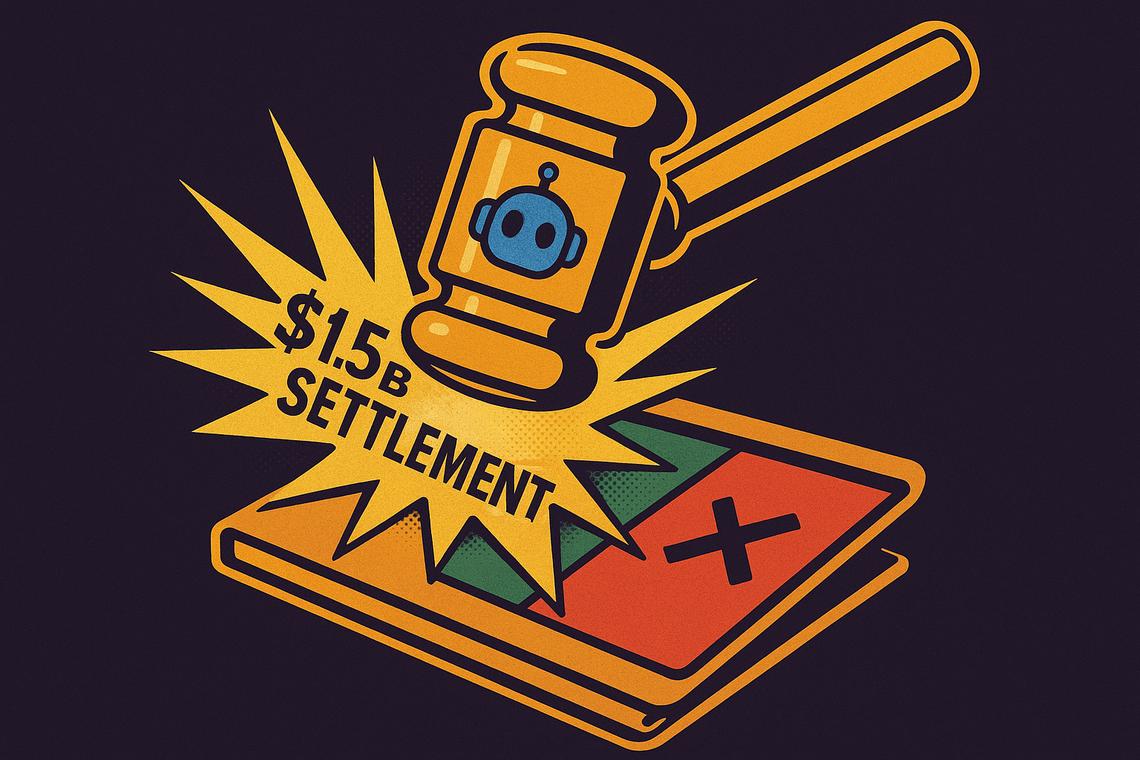
A federal judge in San Francisco has signed off on what is now the largest known copyright settlement in U.S. history — a $1.5 billion agreement that resolves the first major Anthropic AI copyright settlement to reach a conclusion in the United States. The case exposed a fault line running through the entire AI industry: the difference between using copyrighted material to train a model and simply hoarding millions of stolen books.
Summary
Key takeaways
- U.S. District Judge Araceli Martinez-Olguin approved Anthropic’s $1.5 billion settlement with a class of authors and publishers — the largest known copyright settlement in U.S. history.
- A prior ruling by Judge William Alsup found that training Claude on books constitutes fair use, but storing over 7 million pirated books in a digital library was ruled copyright infringement.
- More than 91% of eligible authors and publishers have already claimed their share of the settlement.
- Plaintiffs’ attorneys were awarded $101 million in legal fees, down from the $187.5 million they had requested.
- Some authors opted out of the class action and continue to pursue separate lawsuits against Anthropic.
Anthropic Finalizes Landmark $1.5 Billion AI Copyright Settlement
Judge Araceli Martinez-Olguin of the U.S. District Court for the Northern District of California gave final approval to the settlement on Monday. The deal, originally reached in 2025 following a key fair use ruling, closes a lawsuit first filed in 2024 by a group of authors who alleged Anthropic had illegally downloaded and stored pirated versions of their books to build the training data behind its Claude AI model.
The payout is structured to deliver $3,000 per work across an estimated 500,000 works, distributed among the authors and publishers who hold rights to them. That makes it not just the resolution of one case, but a benchmark — the largest known copyright recovery in the history of U.S. law, according to lead plaintiff attorney Justin Nelson.
The settlement came just months before a damages trial that had been scheduled for December and was widely seen as carrying extraordinary financial risk. Potential liability, based on the scale of the pirated library, had been estimated to run into the hundreds of billions of dollars. Settling before a jury ever heard the case was a calculated move.
Legal Findings Define Scope of AI Copyright Use and Infringement
The core legal question — whether training an AI on copyrighted books counts as infringement — was actually answered in Anthropic’s favor. Then-Judge William Alsup ruled that using books to train Claude constitutes fair use under U.S. copyright law, a decision widely seen as a turning point for the AI industry as a whole.
But that ruling came with a significant caveat. Alsup also found that Anthropic had built part of its training library from books downloaded from pirate sites, including Library Genesis and Pirate Library Mirror. More than 7 million pirated books were stored in a digital library that was not necessarily used for training purposes — and that storage, entirely separate from the fair use question, was ruled a copyright violation. The case went to settlement rather than trial on the damages for that finding.
That distinction matters enormously for how the rest of the industry reads this outcome. The fair use ruling offers some shelter to AI companies that obtain training data through legitimate channels. It offers none to those that relied on pirated repositories. Alsup has since retired, and because Anthropic settled before any appeal, his fair use ruling remains a single district court decision — persuasive, but not binding precedent. Other courts considering cases against Google, Meta, Midjourney, and OpenAI are free to reach different conclusions.
Settlement Participation and Legal Fee Award
The settlement drew exceptionally broad participation. According to Anthropic Deputy General Counsel Aparna Sridhar, more than 91% of eligible authors and publishers have already claimed their payments — a figure that Judge Martinez-Olguin cited when rejecting all objections to the deal. The judge found that concerns about the settlement’s size did not reflect a realistic assessment of the risks of going to trial.
On legal fees, the court awarded plaintiffs’ attorneys just over $101 million — a meaningful reduction from the $187.5 million they had requested. That gap signals judicial scrutiny of fee requests even in landmark cases, a precedent that could influence how attorneys structure fee agreements in future AI copyright litigation.
Ongoing Litigation and Next Steps for Authors
Not every author was satisfied. A number opted out of the class action entirely and have filed their own separate lawsuits against Anthropic, which remain active. Their claims fall outside the scope of Monday’s approval and represent a continuing legal exposure the settlement did not eliminate.
For those who stayed in, distributions are expected to begin as soon as possible, though no specific payment date has been publicly confirmed.
The broader implication is that while this case closes, the legal questions it raised are still being contested in courtrooms across the country. A class action lawsuit against Google — filed just last week by major publishers including Hachette and Cengage, along with authors like Scott Turow — over training data used for its Gemini platform shows the litigation wave has not crested. For the AI industry, the Anthropic settlement draws a clear line: how you get your training data is just as legally exposed as whether you use it at all.
FAQ
What was the core issue settled in the Anthropic copyright lawsuit?
Anthropic settled claims that it illegally downloaded and stored pirated books to train its Claude AI. A prior court ruling had found that AI training on books qualified as fair use, but the separate act of storing over 7 million pirated books in a digital library was ruled copyright infringement — and that infringement question was what the settlement resolved.
How much did Anthropic agree to pay in the settlement?
Anthropic agreed to a $1.5 billion settlement, approved by U.S. District Judge Araceli Martinez-Olguin in San Francisco. The payout is structured at $3,000 per work across an estimated 500,000 works.
Did all authors accept the settlement?
No. While more than 91% of eligible authors and publishers claimed their payments, some authors opted out of the class action and are pursuing separate, ongoing lawsuits against Anthropic.
When will the settlement payments be distributed to authors?
Distributions to class members are expected to begin as soon as possible following the court’s final approval, though a specific payment date has not been publicly announced.
Article produced with the assistance of artificial intelligence and reviewed by the editorial team.