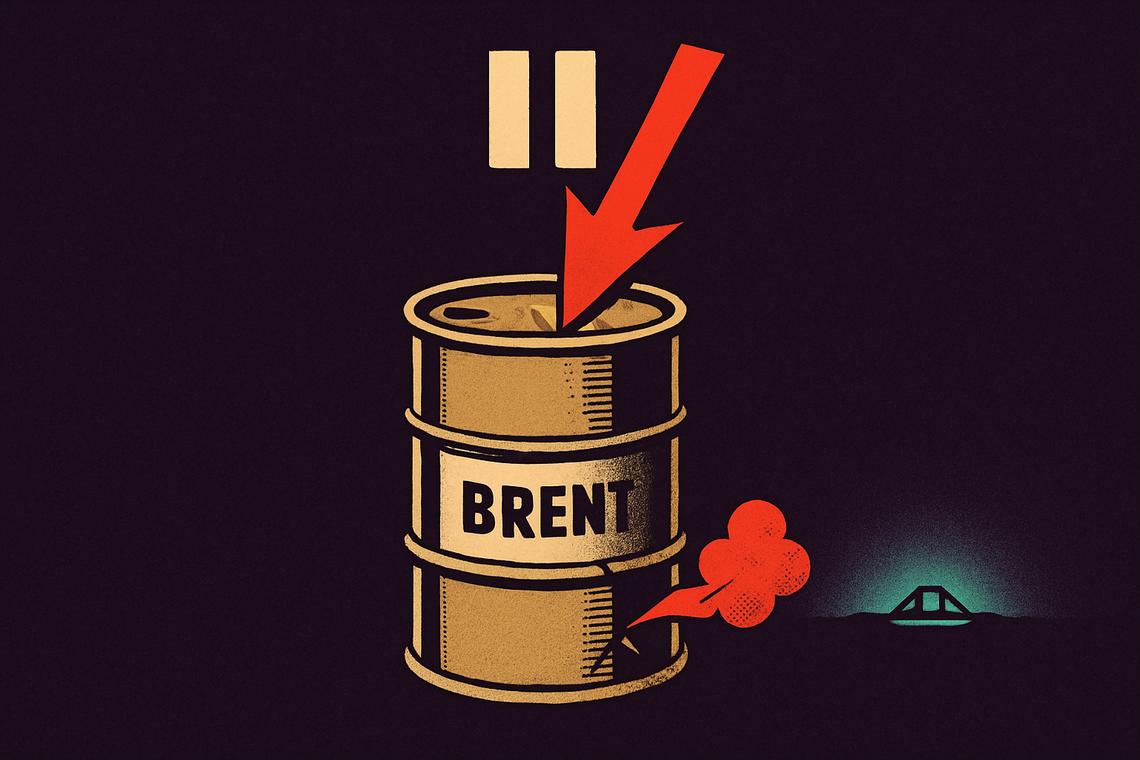
Oil markets just had one of their sharpest reversals of the year. The Brent crude oil price fell below $84 a barrel, while U.S. crude slid under $79, in seguito alla decisione del Presidente Donald Trump di sospendere gli attacchi militari programmati contro l’Iran e di avviare nuovi colloqui diplomatici per la riapertura dello Stretto di Hormuz. For a market that had spent weeks pricing in war, the sudden de-escalation represented a significant shift in sentiment.
Summary
Key takeaways
- The Brent crude oil price dropped below $84 a barrel, while U.S. crude fell under $79 per barrel.
- Brent briefly tumbled as much as 7.3% to $81.55 before recovering some losses.
- The decline followed Trump’s pause on planned military strikes against Iran and his announcement of renewed talks to reopen the Strait of Hormuz.
- Even after the drop, oil prices remain roughly 20% above pre-conflict levels.
- The pullback partially unwound July’s rally, which had been fueled by weeks of escalating tensions in the Middle East.
Brent and US Crude Oil Prices React to US-Iran Geopolitical Shift
Oil sold off following signals that the conflict might be cooling. The Brent crude oil price slipped below $84 a barrel and U.S. crude dropped under $79, marking one of the steepest single-move retreats since tensions in the region intensified earlier this year.
Sharp Price Declines Following Trump’s Military Pause
At its lowest point, Brent crude briefly slid as much as 7.3%, touching $81.55 a barrel before recovering some ground. That kind of intraday swing underscores just how sensitive energy markets have become to every signal coming out of Washington and Tehran. A single policy shift, in this case a pause rather than a resolution, was enough to erase a meaningful chunk of the risk premium baked into prices.
Partial Recovery and Context of July Rally
The drop didn’t come out of nowhere. Oil had rallied through July as tensions near the Strait of Hormuz and retaliatory strikes between the U.S. and Iran pushed traders to price in supply disruption. By July 30, Brent crude had reached $92.65 per barrel at 6:30 a.m. Eastern Time. The latest slide effectively unwinds a meaningful portion of that run-up, though it hasn’t erased it entirely.
Trump’s Pause on Iran Military Strikes and Diplomatic Initiatives
The catalyst behind the drop was political, not economic. Trump’s decision to pause planned strikes on Iran, paired with a push for renewed diplomacy, gave markets a reason to price out some of the war risk that had been driving crude higher for weeks.
Announcement of Pause in Military Strikes
The pause followed a period of intense back-and-forth between the two sides. This latest pause represents an attempt to step back from escalation, and markets treated it as a signal of de-escalation.
Renewed Diplomatic Talks on Reopening the Strait of Hormuz
Just as important as the military pause was the announcement of renewed talks aimed at reopening the Strait of Hormuz, one of the world’s most critical oil chokepoints. Any credible move toward restoring safe passage there carries outsized weight for global energy markets, since a large share of the world’s seaborne crude passes through it.
Market Implications and Investor Outlook
Even after the pullback, oil is far from cheap by recent standards. Prices remain around 20% above where they stood before the conflict began, a reminder that the geopolitical premium hasn’t fully disappeared, it has only compressed.
Price Levels Relative to Pre-Conflict Benchmarks
That 20% gap matters for anyone tracking inflation, shipping costs, or fuel prices at the pump. Crude typically makes up more than half the cost of a gallon of gasoline, so swings of this size tend to ripple through household budgets, even when the initial price spike fades faster than the corresponding drop at the pump.
Continued Monitoring of Middle East Geopolitical Developments
Why does this swing matter beyond the trading floor? Because it shows how quickly sentiment can flip when the underlying conflict is still unresolved. Investors are continuing to monitor developments in the Middle East closely, aware that a single diplomatic setback or renewed attack on shipping lanes could send prices back toward July’s highs. The pause and the talks are encouraging signs, but they are not a settlement, and oil traders know the difference.
FAQ
What caused the recent dip in Brent crude oil prices?
The dip occurred in seguito alla decisione del Presidente Donald Trump di sospendere gli attacchi militari programmati contro l’Iran e di avviare nuovi colloqui diplomatici per la riapertura dello Stretto di Hormuz.
How much did Brent crude oil prices decline at their lowest point?
Brent crude oil briefly declined as much as 7.3%, touching $81.55 a barrel, before recovering part of that loss.
Are oil prices still high despite the recent fall?
Yes. Even after the drop, oil prices remain around 20% above pre-conflict levels, showing that much of the geopolitical risk premium is still priced in.
What is the significance of reopening the Strait of Hormuz in this context?
Renewed diplomatic talks to reopen the Strait of Hormuz aim to ease tensions around one of the world’s most important oil shipping routes, a key factor behind recent volatility in the Brent crude oil price and broader energy markets.
Article produced with the assistance of artificial intelligence and reviewed by the editorial team.