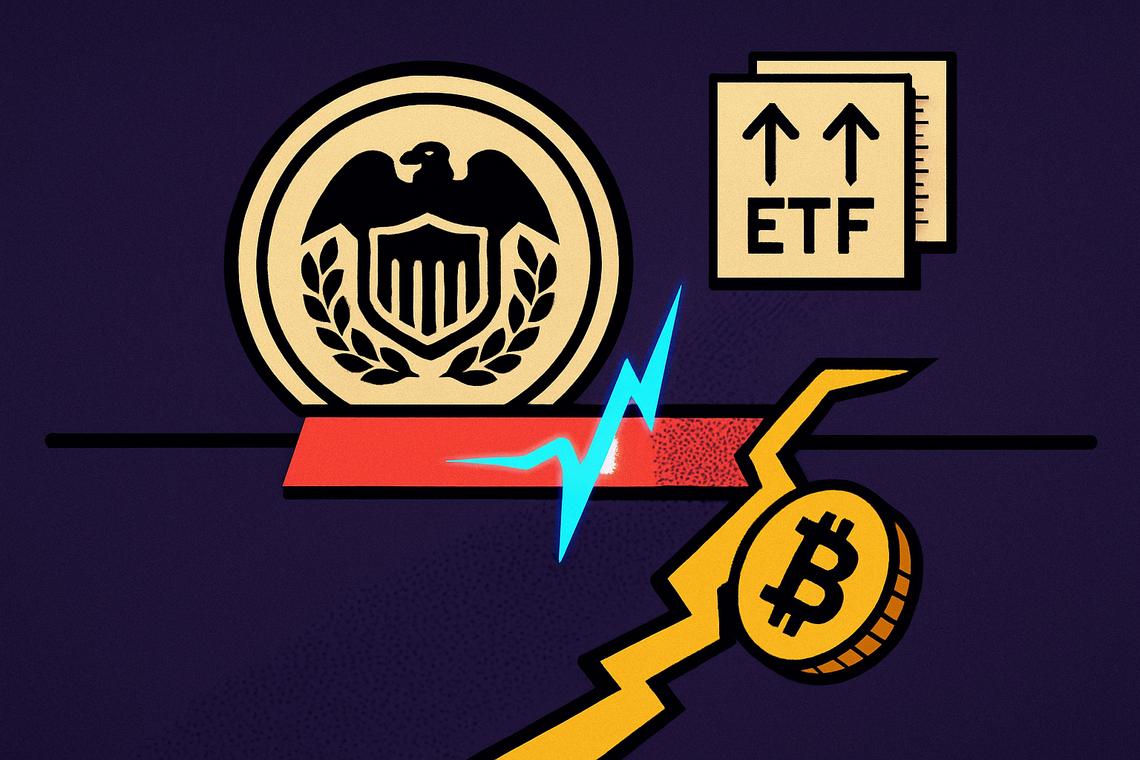
The Federal Reserve left interest rates untouched on July 29, 2026, holding its target range at 3.50% to 3.75%, yet the ripple effects moved through mortgage markets and crypto trading desks almost immediately. Understanding the Federal Reserve bitcoin impact has become a running preoccupation for traders this summer, especially as Chair Kevin Warsh signaled the central bank might soon meet less often — a shift that could stretch the gaps between rate decisions and, by extension, the windows in which Bitcoin absorbs macro shocks.
Summary
Key takeaways
- The Fed held its benchmark rate at 3.50% to 3.75% on July 29, 2026, with three FOMC members — Beth Hammack, Neel Kashkari and Lorie Logan — dissenting in favor of a quarter-point hike.
- Bitcoin traded near $64,137 on August 5, 2026, roughly 49% below its October 6, 2025 record high of $126,198.
- Chair Kevin Warsh floated cutting the Fed’s regular policy meetings from eight to six a year, a change that would likely begin in 2027 and stretch the gap between decisions from about six weeks to roughly nine.
- Bitcoin spot ETFs pulled in $170.1 million on August 3, with BlackRock’s IBIT alone contributing $111.4 million, just days after the group had bled $265.4 million.
- Prop trading desks reportedly cut position sizes in half in the 24 hours before Fed decisions, creating what one industry executive called a “liquidity hole.”
Federal Reserve Holds Rates Steady, but Cracks Show in the Vote
The Fed’s decision to stand pat on July 29 wasn’t unanimous, and that matters for how markets read what comes next. The vote landed at 9 to 3, with Hammack, Kashkari and Logan all pushing for an immediate quarter-point increase — the first time in years that three voters have broken ranks together on the hawkish side. Kraken’s internal tracking flagged it as the first unified three-member dissent since September 2016.
Warsh declined to elaborate on where exactly the disagreement centered. “I’ll let the dissenters speak for themselves,” he told reporters, adding that he sensed “overwhelming agreement on objectives and authority, and commitment” among the broader committee despite the split vote.
The hold didn’t spare borrowers from feeling squeezed. The average 30-year fixed mortgage rate climbed to 6.66% the following day, an 11-month high according to Freddie Mac’s weekly survey. Eric Bernstein, president and co-founder of Austin-based mortgage broker LendFriend, said the disconnect between the Fed’s inaction and market movement is something his clients feel in real time. “Every rate call moves my phone before it moves the market,” Bernstein said. “The thirty-year doesn’t track Fed funds directly, but expectations do, and I’ve watched borrowers lose a quarter point of buying power in the two hours after a press conference.”
At the press conference, Reuters reporter Ann Saphir pressed Warsh on the fact that markets were pricing “a near 100 percent chance of a rate hike” for September. His response set the tone for everything that followed: “We’re not going to be constrained by market prices,” he said. “We’re not going to be constrained or take verbatim from what the market’s doing.” He argued that letting prices speak for themselves, rather than layering on Fed commentary, actually preserves useful information. “If we’re trying to land the plane and deliver 2 percent inflation, and we take a very useful source of information and we get it all fogged up by giving it our own forecast, by providing rolling commentary, I can assure you that we’re going to have less information.”
Within a week, that near-certain September hike had evaporated from betting markets. Aggregated pricing from Kalshi and Polymarket on Tuesday showed a hold at 54.2%, a quarter-point hike at 44.6%, a larger increase at 4.5% and a cut at just 1.5%. Polymarket alone saw $3.7 million wagered on a hold versus $3.2 million on a hike — a sign traders are genuinely split rather than coasting on consensus.
Bitcoin’s Price Slump and the Fed Connection
Bitcoin changed hands at $64,137 early Wednesday, up less than 1% on the day but sitting roughly 49% below the $126,198 all-time high it touched on October 6, 2025. That gap frames much of the current market anxiety, and it’s a big part of why every Fed signal now gets parsed for clues about where the dollar and Treasury yields head next.
The mechanics are fairly direct. When traders price in a rate hike, the dollar tends to strengthen and Treasuries become more attractive relative to riskier assets — pulling capital away from Bitcoin. One macro account, @Cryptofocus_NL, summarized the dynamic bluntly online: “Three FOMC voters already wanted 25 basis points. A hot number grows that group and the market starts pricing a September hike. That lifts the dollar and pays you more to hold Treasuries than risk. Money leaves Bitcoin every time.” Financial commentator Walter Bloomberg (@DeItaone) had flagged the same tension hours before the decision, noting Bitcoin had climbed 0.8% to $64,344 “as the dollar weakened ahead of the Fed’s rate decision,” while warning that “any hawkish signals could lift the dollar and pressure BTC.”
By the close of trading, financial commentary account @zerohedge noted that “FED SWAPS NO LONGER FULLY PRICE IN A SEPTEMBER RATE HIKE,” and by the next day, macro trader @gdkush summed up the muted reaction: “Warsh held. Hawkish. ‘Won’t hesitate to stop inflation.’ No forward guidance. September is live. BTC ~$64.5K, barely moved… Because the market already priced the hawkish hold.”
Bitcoin Spot ETFs See Fresh Inflows
Even with prices depressed, institutional appetite hasn’t fully dried up. Spot Bitcoin ETFs collectively pulled in $170.1 million on August 3, with BlackRock’s IBIT fund alone accounting for $111.4 million of that total — a notable reversal after the group had shed $265.4 million just days earlier, on July 31. That kind of whiplash between outflows and inflows underscores how sensitive ETF demand has become to shifting Fed rate expectations. Bitcoin bull Arthur Hayes has long argued that Bitcoin needs looser Fed policy to hit his more ambitious price targets, but the current chair appears to be steering in the opposite direction — publishing less guidance and, potentially, meeting less often.
Fed Weighs Fewer Meetings Starting in 2027
Warsh isn’t just holding rates steady — he’s also questioning how often the Fed needs to gather at all. The New York Times reported on July 31 that he floated trimming the number of regularly scheduled policy meetings during the July gathering, reportedly asking colleagues to send written views rather than debating it openly at the table. Later reporting narrowed the target to six meetings a year, down from the eight that have been standard since Paul Volcker set that cadence back in 1981. Federal statute only requires a minimum of four meetings annually. A Fed spokesperson declined to comment on the proposal.
The 2026 calendar — with meetings still scheduled for September, October and December — is expected to remain intact, meaning any new rhythm would likely begin in 2027. Warsh has been consistent about wanting more flexibility here for some time. At his April confirmation hearing, he told senators: “I believe the statute requires a minimum of four meetings, but four is not enough. So having more meetings than that is appropriate. But I’ve not even begun to look at the meeting schedules for 2027 and beyond.”
Why does this matter for markets? Cutting meetings from eight to six would stretch the interval between scheduled decisions from roughly six weeks to about nine. Bitcoin, along with every other asset that reacts to Fed signaling, would trade through those longer gaps without fresh guidance to anchor expectations. Warsh himself invoked the nine-week figure on July 29, arguing that five years of above-target inflation “cannot be cured in nine weeks” — a comment that cuts both ways, since it also implies less frequent opportunities for the Fed to adjust course if conditions shift quickly.
Inside the ‘Liquidity Hole’ Around Fed Decisions
Trading desks don’t wait for the Fed to speak — they brace for it, and that bracing itself distorts markets in the hours beforehand. Noam Korbl, co-founder and chief operating officer of prop-firm comparison site PropFirms, described a consistent pattern: “We see funded traders cut size by half in the twenty-four hours before a rate decision, and the ones who don’t are usually the ones who breach a drawdown rule that afternoon. Spreads widen, slippage triples, and a stop that worked all month stops working. The decision matters far less than the liquidity hole around it.”
That thinning liquidity has real consequences for anyone trading Bitcoin or other risk assets around a Fed announcement — wider spreads and unreliable stop-losses mean price moves can overshoot in either direction before settling. Chris Hunter, CEO of Vancouver-based prop firm Maven Trading, offered some context on the nature of those funded accounts during the On The Margin podcast, noting that “a prop firm does not have regulations… it’s essentially a game. It’s a trading-based game, skill-based game. There’s no real money being played with.” He was candid about how drawdown rules function from the firm’s side: “A lot of times trying to catch the trader on mistakes so that they could not pay them in the same way that an insurance company is going to try to catch a car crash for any mistakes that they make.”
Kaledora Kiernan-Linn, CEO of onchain derivatives venue Ostium, framed the broader shift in market behavior on the same podcast: “Macro the new reality TV is sort of our quippy way of putting this.” She added that sentiment now drives price action more than fundamentals: “The returns to being good at reading the tea leaves and at sensing momentum shifts and vibe shifts are higher than they’ve ever been in a world where mimetics and sentiment drives price action much more than fundamentals.”
Warsh’s Inflation Stance: ‘There Is Only a Target’
Warsh drew a hard line on inflation policy during the same press conference, rejecting any notion that the Fed might quietly tolerate a softer target. “There is no soft inflation target, there is no soft implicit target,” he said. “There is only a target, and it is 2 percent.” That statement, paired with his refusal to let market pricing dictate Fed decisions, paints a picture of a chair prioritizing institutional discipline over responsiveness to short-term sentiment.
The households absorbing these decisions often feel the effects with a delay, according to Andrew Gosselin, a CPA and senior contributor at SaveMyCent. “Most households don’t feel a rate decision the day it happens,” he said. “They feel it six weeks later when a card APR resets or a savings rate quietly drops. That lag is why people misjudge it.” He noted that the people who navigated the last cycle best “weren’t the ones predicting the Fed, they were the ones who’d already moved their cash somewhere that pays and fixed what they could fix.”
Meanwhile, the data pipeline that will shape the Fed’s September decision keeps arriving. ADP reported private employers added just 44,000 jobs in July, short of forecasts, with official payroll numbers due Friday — Bloomberg’s survey looks for 85,000, FactSet’s for 100,000. CPI lands August 12, PPI August 13, and the Fed’s July meeting minutes follow on August 19, all ahead of the Jackson Hole symposium, where Warsh said he hasn’t decided whether to deliver “a big picture speech” or “a more traditional set up for all the action we’re going to have between September and December.” Brent crude, trading near $90 a barrel and down from the $100-plus prints seen during the spring Iran conflict, adds another variable that could sway both inflation readings and risk appetite in the weeks ahead.
FAQ
Why did the Federal Reserve keep interest rates steady in July 2026?
The Fed maintained rates at 3.50% to 3.75% on July 29, 2026, reflecting a consensus to hold amid ongoing inflation concerns and incoming economic data, even as three FOMC members dissented in favor of a quarter-point hike.
How do Federal Reserve decisions affect Bitcoin prices?
Bitcoin prices tend to react to Fed decisions through shifts in risk pricing and the strength of the US dollar, with price declines often accompanying expectations of rate hikes as capital rotates toward Treasuries.
What changes is the Federal Reserve considering for its meeting schedule?
Fed Chair Kevin Warsh proposed reducing the number of annual policy meetings from eight to six, likely starting in 2027, which would stretch the interval between decisions from about six weeks to roughly nine weeks.
What is the ‘liquidity hole’ around Federal Reserve decisions?
It refers to funded proprietary traders cutting their position sizes by half in the 24 hours before a Fed announcement, which thins out market liquidity, widens spreads, and increases slippage right when volatility tends to spike.
Article produced with the assistance of artificial intelligence and reviewed by the editorial team.