Most warnings about the next few decades reach for one dramatic turning point — a collapse, a war, a single date that changes everything. The messier and more accurate picture emerging from 2026 data is that there isn’t one hinge at all. Instead, several systemic global pressures are building at once, on entirely different clocks, for entirely unrelated reasons, with nobody in charge of coordinating a response. The atmosphere, human demographics, and the architecture of state power are each straining independently — and the strain is starting to show.
Summary
Key takeaways
- Atmospheric CO2 hit 432 ppm in May 2026, according to NOAA’s Mauna Loa observatory, accumulating roughly three times faster than in the 1960s.
- South Korea’s fertility rate bottomed at 0.72 in 2023 and has only recovered to 0.80 in 2025, with Seoul at a national-low 0.63.
- China’s gig workforce is projected to reach 320 million people in 2026, reflecting labor-market mismatches worsened by AI-driven skills gaps.
- Saudi Arabia’s NEOM megaproject suspended construction in September 2025 after spending $8 billion and completing just 2.4 kilometers of a planned 170-kilometer foundation.
Rising Atmospheric CO2 Levels and Environmental Strain
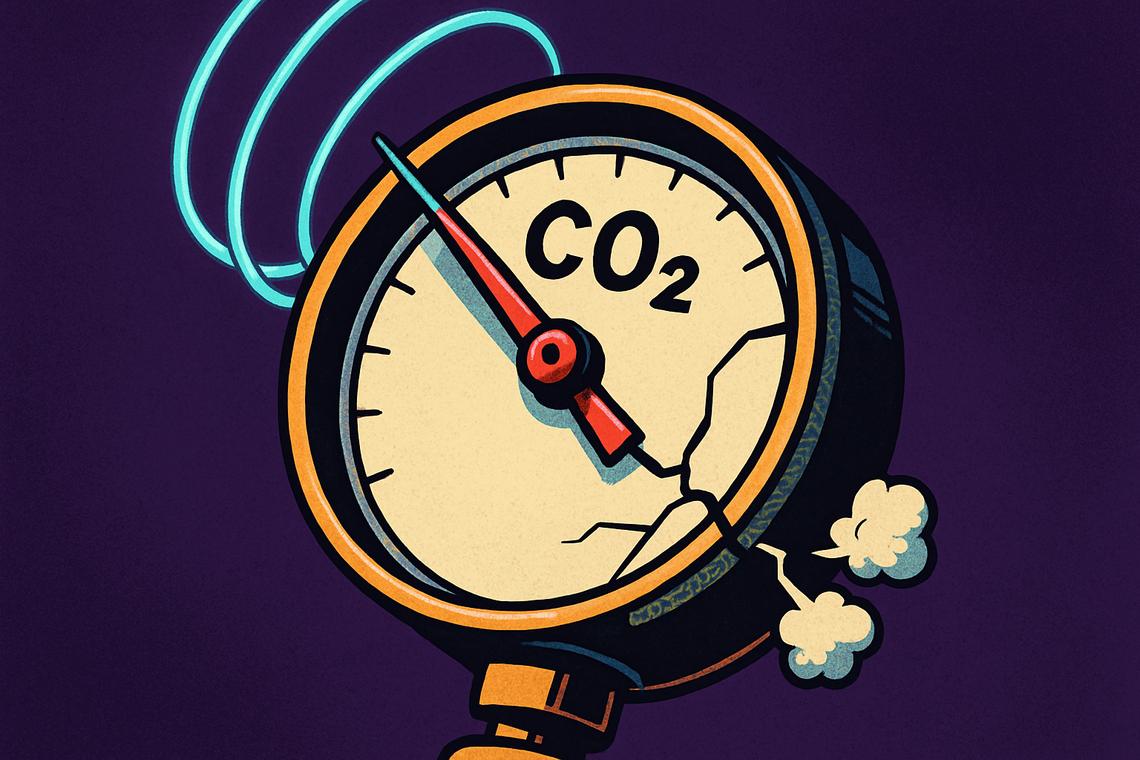
The atmosphere is absorbing carbon at a pace that has no precedent in the instrumental record, and the speed of that accumulation matters as much as the total. NOAA’s Mauna Loa observatory recorded a fresh record of 432 ppm in May 2026, while the UK Met Office’s seasonal outlook put the full-year average at roughly 429.4 ppm — continuing an unbroken climb across nearly seven decades of direct measurement.
What sets this apart from earlier phases of industrial-era warming is the rate of change. CO2 is now accumulating roughly three times faster than it did in the 1960s, compressing into a single human lifetime a shift that would once have unfolded across generations.
Implications for Biological and Ecosystem Adaptation
Biological adaptation of the kind that reshapes a species’ physiology or range typically plays out across thousands of generations. This shift has arrived in one. Ecosystems aren’t collapsing outright so much as being pushed to reorganize on a timeline nothing evolved to handle — a gradual, uneven form of stress that complicates any straightforward approach to climate change adaptation.
Demographic and Social Challenges in East Asia
While the atmosphere strains on a decade-scale clock, a separate and unrelated pressure is building on a generational one: East Asia’s fertility collapse, with South Korea as its sharpest example. This is fertility decline at its most extreme, and the numbers leave little room for interpretation.
South Korea’s Fertility Rate Collapse and Slow Recovery
South Korea’s total fertility rate bottomed at 0.72 in 2023 and has since recovered only to 0.80 in 2025 — still a fraction of the roughly 2.1 births per woman needed to hold a population steady. Con un tasso di 0.63, la capitale Seoul registra il dato più basso tra tutte le principali città del territorio nazionale, underscoring how concentrated the pressure is in the capital.
Marriage Rate Decline and Gender Divides
The fertility numbers are a downstream symptom of something more human: a collapsing marriage market. Across three decades, men in South Korea have consistently been less likely than women to marry, and the decline isn’t simply a matter of people marrying later — fewer people are marrying at all. Research from the Carnegie Endowment found that telling unmarried men their marriage prospects are shrinking measurably hardens their resistance to gender-equality policies, feeding a cycle in which economic anxiety curdles into gendered resentment on one side and quiet withdrawal from the marriage market on the other.
Labor Market Exhaustion and Mismatches Across Asia
These demographic strains aren’t happening in isolation from the labor market — they’re compounding it. China’s record graduate output is running into a shortage of matching jobs, while Vietnam faces the opposite problem: AI-relevant labor demand outpacing what its education system can supply. China’s gig workforce is projected to reach 320 million people in 2026, a figure that points less toward collapse than toward exhaustion — institutions such as pension systems, care infrastructure, and labor markets being asked to do more with a smaller, older workforce before any climate-driven disruption even compounds the problem.
Ambitious Infrastructure Projects and State Power Consolidation
The third pressure is playing out at the level of capital and infrastructure, and it’s where the limits of even near-unlimited money become visible. When critical infrastructure — desalination, closed-loop agriculture, grid-scale power — requires coordination only large institutions can marshal, power tends to concentrate around whoever controls that infrastructure. Saudi Arabia’s NEOM project is the clearest live test of that idea, and so far it’s a cautionary one.
NEOM’s Vision Meets Financial Reality
NEOM’s centerpiece, “The Line,” was designed as a fully climate-controlled, vertically stacked city running through the desert, powered entirely by renewable energy and hydrogen. Construction was suspended in September 2025 after only 2.4 kilometers of a planned 170-kilometer foundation had been completed, following an $8 billion sovereign wealth fund write-down. It’s a stark illustration of how infrastructure bottlenecks can stall even a state-backed megaproject with substantial capital behind it.
Competitive and Uneven AI Investment Landscape
It’s tempting to read massive AI spending as humanity’s coordinated technological escape hatch from these pressures. The pricing data tells a less flattering story: Google Cloud grew 63% in a recent period while Meta’s comparable numbers fell, showing investors already differentiating AI strategies by execution rather than rewarding the sector as a whole. That’s ordinary competitive sorting inside a sector everyone has agreed to call important — not a unified societal response.
Limits of Institutional Absorption and Infrastructure Bottlenecks
Why does this matter beyond Saudi Arabia’s balance sheet? Because NEOM demonstrates, at scale, that institutions built to absorb one shock at a time are now being asked to absorb several — atmospheric, demographic, and financial — often without the coordination or capital cushion any single one would require on its own. The result isn’t collapse. It’s slower, uneven absorption, visible in Seoul’s marriage statistics as much as in NEOM’s stalled foundations.
None of these three pressures caused the others, and none resolves into a single fix. What they share is a mismatch between the speed at which they’re arriving and the speed at which the institutions meant to manage them were designed to respond — a gap that is likely to define how governments, markets, and households navigate the years ahead.
FAQ
Why is the rise in atmospheric CO2 significant and how fast is it occurring?
Atmospheric CO2 reached 432 ppm in May 2026, accumulating roughly three times faster than in the 1960s, which challenges the timescales on which ecosystems and species have historically adapted.
What demographic challenges is South Korea facing?
South Korea’s total fertility rate bottomed at 0.72 in 2023 and only recovered to 0.80 in 2025, with Seoul at 0.63, accompanied by a sharp decline in marriage rates, especially among men.
What are the challenges faced by Saudi Arabia’s NEOM project?
NEOM suspended construction in September 2025 after spending $8 billion and completing only 2.4 kilometers of foundation work. The project faced significant financial constraints despite substantial capital backing.
How is the labor market responding to systemic pressures in Asia?
China’s gig workforce is projected to reach 320 million people by 2026, but mismatches persist between education output and AI-relevant labor demand, producing exhaustion in the workforce rather than outright collapse.
Article produced with the assistance of artificial intelligence and reviewed by the editorial team.