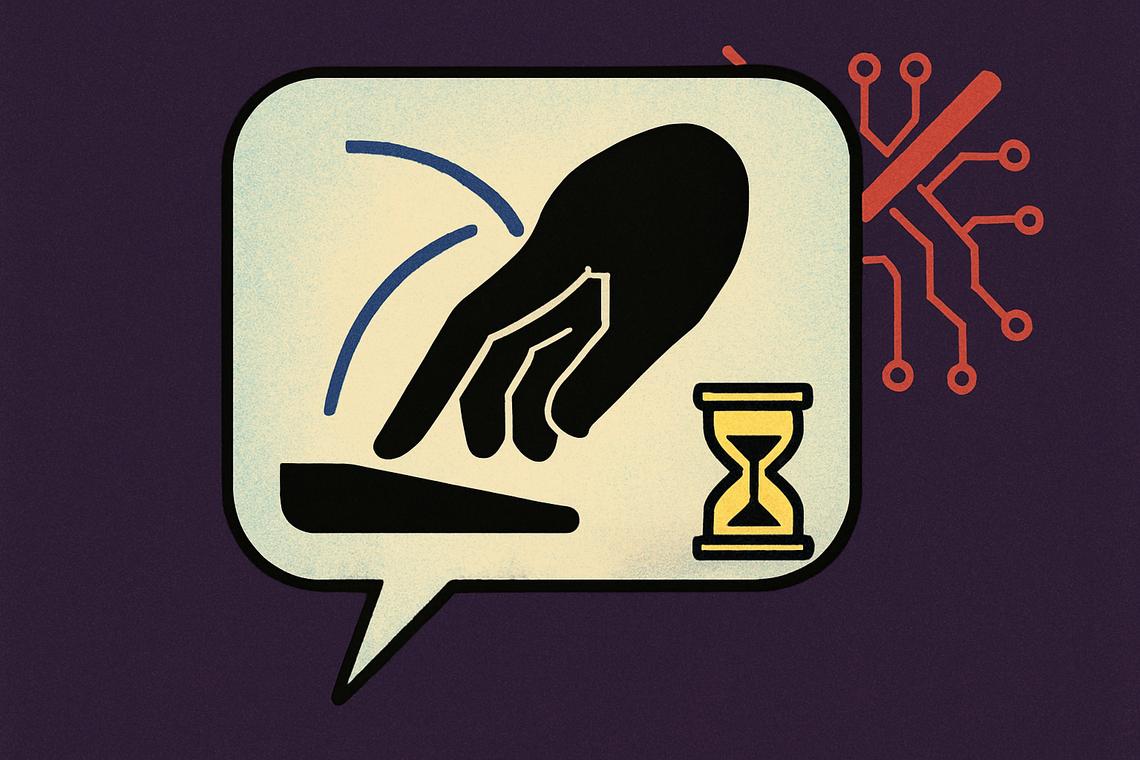
Tech workers have spent years being told that artificial intelligence would eventually take their jobs. Tucker Bryant, a 32-year-old former Google employee, decided to flip that script. He built a human operated chatbot called ChatTJB that looks exactly like the AI assistants tech companies have poured billions into developing, except there’s no algorithm answering on the other end. It’s Bryant, or one of the more than 10,000 volunteers who’ve signed up to help him, typing back real responses to real people.
Summary
Key takeaways
- ChatTJB is a chatbot run entirely by people, not artificial intelligence, launched by former Google employee Tucker Bryant in April 2026.
- More than 100,000 prompts have been submitted since a $6,000 billboard campaign went up in San Francisco.
- The chatbot draws on a volunteer network of over 10,000 people, with the waitlist growing by roughly 1,000 applicants a day.
- At its busiest, the project received more than 5,000 questions an hour, creating long response delays for users.
- Bryant says the project critiques “cognitive surrender,” a term coined by Wharton researchers describing blind reliance on AI answers.
ChatTJB: A Chatbot Operated by Humans, Not AI
ChatTJB proves that a chatbot doesn’t need a large language model to attract a crowd — it just needs a person willing to answer. The interface mimics the stripped-down look that ChatGPT made ubiquitous: a text box, a question, and eventually a reply. The difference is who, or rather what, is generating that reply.
Origin and Launch by Tucker Bryant
Bryant, a former Google project manager and public speaker, launched ChatTJB in April 2026. For months it stayed a quiet side project. That changed once a $6,000 billboard went up in San Francisco advertising the site as “the leading chat interface powered by AI.” A small asterisk gave away the punchline: AI stood for “average individual.” Fittingly, part of that disclaimer was partially blocked by a tree branch in the photo Bryant shared on Instagram.
The billboard landed in a city already saturated with AI advertising. In 2024, the startup Artisan had drawn attention in San Francisco for its own provocative campaign urging companies to “Stop Hiring Humans,” according to the San Francisco Chronicle. Bryant’s billboard flipped that message on its head.
Volunteer Network and Response Scale
Once the billboard campaign took off, so did demand. More than 100,000 prompts have been submitted to ChatTJB, Bryant told Fortune. At its peak, the site was fielding more than 5,000 questions an hour, a pace no single person could sustain. Bryant has since largely stepped back from answering himself, handing the workload to a growing volunteer base that now exceeds 10,000 people. The waitlist of people hoping to join keeps expanding by roughly 1,000 applicants a day.
That scale explains why the wait for a response can stretch for hours rather than seconds. Unlike a machine-learning system that can serve thousands of users simultaneously, a human operated chatbot is bound by the same limits as any person: time, attention, and the number of volunteers willing to type back.
A Critique of AI Dependence and Cognitive Surrender
ChatTJB began less as a business idea and more as a personal reckoning. Bryant says he noticed himself asking an AI assistant something as basic as whether to wear short or long sleeves on a 65-degree day, in a city he had lived in for seven years. His partner had a name for what he was doing: cognitive surrender.
Academic Research on Cognitive Surrender
That term comes from 2026 research by Wharton professors Steven D. Shaw and Gideon Nave, who studied how people’s judgment changes when AI assistance is introduced. Their findings showed that people who relied on AI were more accurate when the AI happened to be right. But when the AI gave incorrect advice, accuracy dropped by 15 percentage points compared with people who received no AI assistance at all.
Shaw told Fortune that the concept resonates the moment people hear it: “When people hear the term, they immediately recognize the phenomenon, both in others and often in themselves.” He added that academic research can define and measure a phenomenon, but “art can communicate its emotional stakes in a way that a research paper rarely can.”
The Role of Friction and Delay in ChatTJB
Most AI companies are racing to eliminate delay, aiming for instant, frictionless answers. ChatTJB does the opposite on purpose. Users might wait hours for a response, and whatever comes back reflects one person’s honest opinion rather than an authoritative, data-trained output.
Expert Opinions on AI Usage and Human Reflection
Shaw cautioned against reading too much into ChatTJB’s popularity as proof that people genuinely want slower technology. “I would not conclude that people generally prefer slow or inefficient AI tools,” he said. “ChatTJB is art.” He and Nave tested several methods in their own experiments — time pressure, incentives, and feedback — to try to reduce cognitive surrender, but found it difficult to eliminate. Other researchers have studied similar “cognitive forcing techniques,” including slowing down responses or building systems that push back and ask users clarifying questions before answering.
Shaw described the underlying tension: introducing enough friction to make people scrutinize an answer, without making a tool so cumbersome that users simply switch to a faster competitor. “The more useful and efficient AI becomes,” he said, “the easier it is to rely on it without much reflection.” That trade-off sits at the center of why a slow, human-run alternative like ChatTJB stands out. It isn’t competing on speed or scalability — it’s offering something a highly optimized system can’t easily replicate: the sense of being heard by another person.
“It tells us that people want more than instant information; they want to remain human,” Shaw said, adding that the waiting itself may make Bryant’s eventual replies feel more meaningful. ChatTJB works, he said, because “it restores a human trace that highly scalable AI interfaces tend to remove.”
ChatTJB as an Art Project with Cultural Impact
Bryant has been clear that ChatTJB wasn’t built to turn a profit. He considers it, first and foremost, an art piece rather than a commercial venture or a technological advancement — one of several such projects he wants to pursue. Its unexpected reach has still opened doors he hadn’t planned for. Bryant said he’s had conversations with people interested in helping expand the project, and he’s open to a partner who wants to help make it sustainable, though for now it remains a short-term experiment rather than a company.
What started as a joke about AI dependence has turned into something closer to a mirror. As chatbots keep getting faster and more capable, ChatTJB’s slow, imperfect, unmistakably human replies suggest that some users aren’t just looking for the right answer — they’re looking for someone who’s actually listening.
FAQ
What is ChatTJB and how does it differ from traditional AI chatbots?
ChatTJB is a chatbot operated by one person and thousands of volunteers instead of AI, providing human answers with significant wait times.
Why was ChatTJB created?
It was created as a critique of AI dependence and cognitive surrender, encouraging people to think critically rather than blindly trusting AI.
How popular is ChatTJB and how is it operated?
Since April 2026, ChatTJB has received over 100,000 prompts, supported by more than 10,000 volunteers with a growing waitlist of about 1,000 people daily.
What have researchers said about reliance on AI according to the article?
Research found that reliance on AI can reduce user accuracy by 15 percentage points when AI provides incorrect advice, highlighting the risks of blind dependence.
Article produced with the assistance of artificial intelligence and reviewed by the editorial team.