



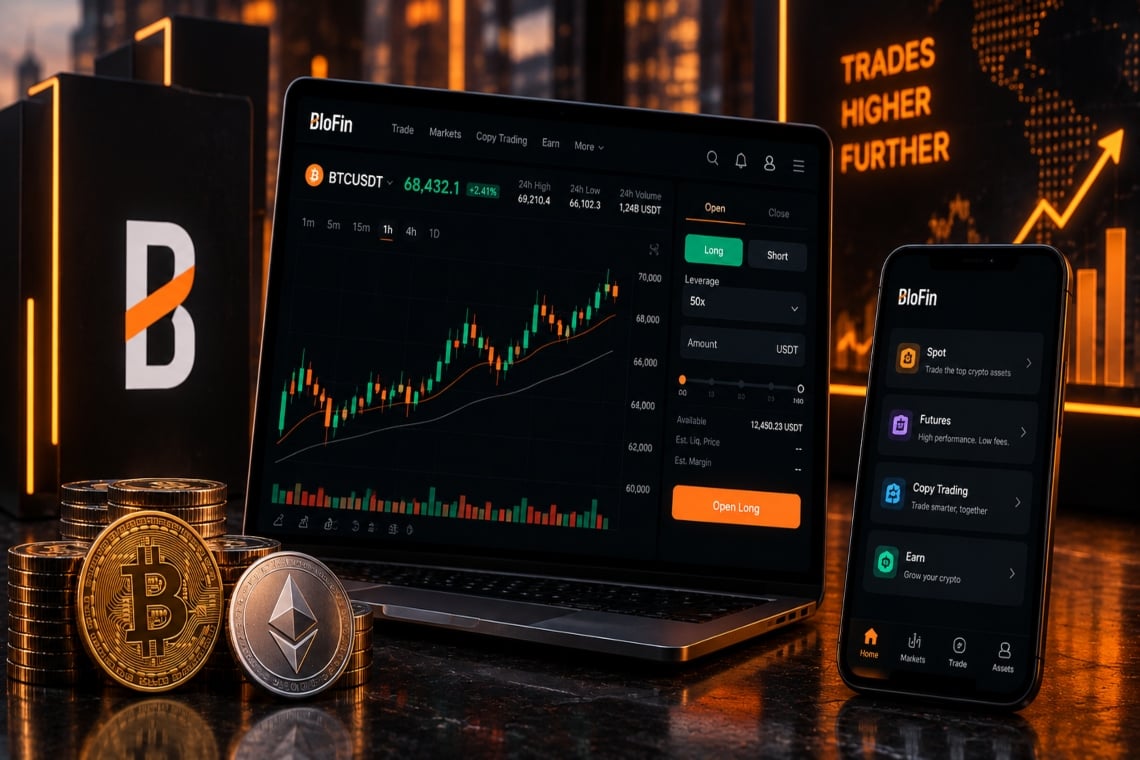
BloFin is a derivatives-focused crypto exchange that has grown, since its founding in 2019, from a perpetual-futures specialist into a fuller platform spanning spot, futures, copy trading, and an earn suite. It has carved out a niche among active traders by pairing high leverage with a fee-discount structure that a normal-size account can actually reach, but it is not the biggest venue in the market, and that shapes both its strengths and its trade-offs. This review looks at what BloFin does well, where it falls short, and who it actually suits, without the marketing gloss.
Every figure below was checked against BloFin’s own documentation, independent reviews, and market data from CoinGecko. Where the platform trails larger rivals, we say so plainly, since a review that only lists positives is not much use.
Risk warning: BloFin is a leveraged-derivatives platform, and trading with leverage carries a high risk of loss. Never trade with funds you cannot afford to lose. This review is informational and is not financial advice.
Summary
BloFin at a glance
| Founded | 2019, registered in the Cayman Islands |
| Products | Spot, perpetual futures, spot and futures copy trading, BloFin Earn |
| Spot fees | 0.10% maker and taker (flat) |
| Futures fees | 0.020% maker / 0.060% taker regular, down to 0.0060% / 0.0500% at VIP 1 |
| Max leverage | Up to 150x on the most liquid perpetuals |
| Margin types | USDT-margined, USDC-margined, coin-margined |
| Security | Merkle-tree proof of reserves (Nansen-tracked), Fireblocks custody, Chainalysis monitoring |
| Main trade-off | Thinner liquidity than the largest exchanges |
Fees: competitive, with a genuinely reachable discount
BloFin’s headline fees are middle-of-the-pack: spot is a flat 0.10% maker and taker, and futures start at 0.020% maker and 0.060% taker, where that regular taker sits at the higher end of the major exchanges alongside Bitget and KuCoin. On the surface, that is unremarkable. What makes BloFin’s pricing genuinely competitive is the discount structure, because VIP 1 cuts the futures taker to 0.0500% and the maker to 0.0060%, and it is reachable by holding $50,000 in account assets, without trading any volume, which is half the $100,000 that Bybit requires for a comparable tier. For a funded mid-size trader who posts limit orders, the effective cost lands well below the headline, and the low 0.020% maker fee rewards liquidity providers. The trade-off is honest: if you never reach VIP 1, the 0.060% regular taker is among the pricier rates in the market.
Products: broader than its perps-first reputation
Although BloFin is known for perpetual futures, its product range is wider than that label suggests. On the perpetuals side it lists USDT-margined, USDC-margined, and coin-margined contracts across a broad set of pairs, with USDC-margined majors added in 2025. It also offers spot trading, a full copy-trading product covering both spot and futures, and BloFin Earn for putting idle assets to work. That combination means a trader can run leveraged positions, follow experienced traders, hold spot, and earn yield from one account. Where it trails the giants is breadth of spot listings and fiat on-ramps, which are narrower than Binance’s or Coinbase’s, so BloFin is better thought of as a serious trading venue than a one-stop retail app.
Leverage and trading experience
Leverage is one of BloFin’s clearest differentiators, topping out at up to 150x on its most liquid perpetuals such as BTC-USDT and ETHUSDT, above the 125x ceiling at Binance, Bybit, and OKX. That extra headroom lets you express a directional view with less margin locked up, though it also brings your liquidation price closer to entry, so it is a tool to use deliberately rather than by default. The trading interface is clean and purpose-built for derivatives, and the platform supports cross, isolated, and portfolio margin modes. The honest limitation is depth: BloFin’s open interest and order books are thinner than the largest venues, so a very large market order can see more slippage than it would on Binance’s BTC-USDT book or Bybit’s BTC-USDT book, and size-sensitive traders should account for that.
Copy trading: transparent metrics stand out
BloFin’s copy trading is one of its stronger features, and not just because it exists on most exchanges now. It covers both spot and futures, is free for copiers beyond a profit share to the lead trader, and its leaderboard is unusually transparent, reporting risk-adjusted metrics including the Sharpe, Sortino, and Calmar ratios. That is more than some larger rivals surface, as Bybit, for instance, shows Sharpe and Sortino but not Calmar, which gives a copier evaluating an unfamiliar trader an extra lens on risk-adjusted performance. Lead traders earn a profit share of 10%, rising to 20% for eligible traders, which aligns their incentives with the people following them. For anyone whose main interest is copy trading, the metric transparency is a real, concrete advantage.
BloFin Earn: flexible yield with a principal-protected option
BloFin Earn lets you earn on idle assets through flexible products you can redeem any time or fixed terms of 2 to 180 days that pay more, across USDT, BTC, ETH, SOL, and others, with flexible USDT around 3.5% and interest accruing daily. Its standout is RWUSD, a principal-protected product whose yield is benchmarked to real-world assets such as tokenised Treasury funds, which is an unusually transparent, lower-risk way to earn on stablecoins in a market where opaque yield sources have burned depositors. Headline APYs on individual proof-of-stake tokens are higher on dedicated staking platforms, so Earn is best seen as a convenient, relatively conservative complement to trading rather than a yield-maximizing destination.
Security and trust
Security is where BloFin makes its case for holding your funds. It publishes Merkle-tree proof of reserves maintained at a 1:1 ratio and above, tracked independently via Nansen, segregates customer assets from corporate funds, and states it does not lend those assets without consent. Custody is backed by Fireblocks, and Chainalysis is used for on-chain monitoring and compliance. It has operated since 2019 without a publicly reported breach. These are solid practices, though it is worth noting that proof of reserves and Merkle-tree verification are increasingly standard across major exchanges rather than unique to BloFin, so this places it in good company rather than clearly ahead. As with any custodial platform, self-custody remains the safest option for long-term holdings.
Pros and cons
Pros: the highest leverage among the mainstream majors at 150x; a VIP 1 discount reachable at $50,000 in assets; a low 0.020% maker fee; genuinely broad products spanning spot, futures, copy trading, and earn; transparent copy-trading metrics including the Calmar ratio; a principal-protected RWUSD earn option; and solid, transparent proof-of-reserves practices.
Cons: thinner liquidity and lower open interest than the largest exchanges, so large orders can slip; a 0.060% regular futures taker that is high until you reach VIP 1; a narrower spot-coin selection and fewer fiat on-ramps than the giants; and the usual regional availability restrictions on derivatives.
Who BloFin is for
BloFin suits the active, funded derivatives trader who values high leverage and a fee discount they can actually reach, and who also wants copy trading and a flexible earn product in the same account. It is a strong fit for mid-size accounts around the $50,000 mark that unlock VIP 1, and for traders who care about transparent copy-trading stats. It is a weaker fit for someone who mainly wants to buy and hold a wide range of spot coins, who needs deep fiat on-ramps, or who trades in very large size where order-book depth matters most. If those describe you, a larger all-rounder may serve you better.
Questions about BloFin
Is BloFin safe? It uses Merkle-tree proof of reserves tracked via Nansen, Fireblocks custody, Chainalysis monitoring, and asset segregation, and has run since 2019 without a publicly reported breach. Those are solid practices, though no custodial platform is risk-free, so use self-custody for long-term holdings.
How high is BloFin’s leverage? Up to 150x on its most liquid perpetuals, the highest among the mainstream major exchanges, though that applies only to the top pairs at small size and should be used cautiously.
Does BloFin have copy trading? Yes, across both spot and futures, with a transparent leaderboard that includes Sharpe, Sortino, and Calmar ratios.
What is BloFin’s biggest weakness? Liquidity. Its order books and open interest are thinner than the largest venues, so large market orders can see more slippage, which is the main reason size-sensitive traders use it alongside a deeper exchange.
Verdict
BloFin is a capable, derivatives-first exchange that punches above its size on the things active traders care about: it offers the highest leverage among the mainstream majors, a fee discount a mid-size account can actually reach, transparent copy-trading metrics, and a principal-protected earn option, all backed by solid proof-of-reserves practices. Its honest weakness is depth, since its liquidity trails the largest exchanges, and its regular taker is high until you reach VIP 1. For a funded active trader who fits its profile, it is a strong choice, and you can explore the current products on BloFin’s crypto futures trading platform before deciding, ideally alongside a deeper venue for size. For live market data as you evaluate, a neutral source like Investing.com’s crypto section is a useful reference.
