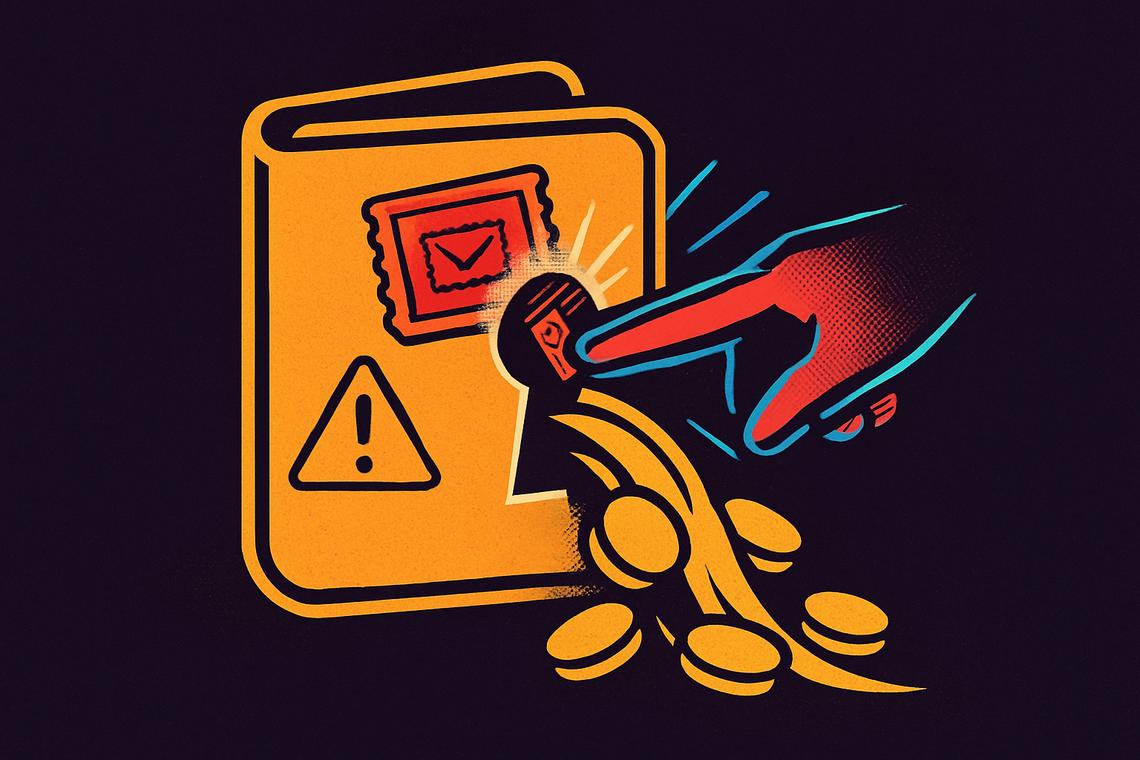
A governance vote that looked like routine blockchain housekeeping turned into one of the more revealing crypto heists of the year. On September 22, an attacker exploited weaknesses in Neutron’s on-chain governance to seize admin control over contracts belonging to Astroport and DropDotMoney, draining roughly $9.4 million in assets before defenders could react. Security firm GoPlus Security, which published a detailed breakdown of the incident, said the Neutron governance attack exposed a fundamental mismatch between how much it costs to control a blockchain’s governance and how much value that governance actually protects.
Summary
Key takeaways
- On September 22, an attacker used a Neutron governance proposal to seize admin rights over Astroport and DropDotMoney contracts, draining about $9.4 million, with roughly $1.96 million already bridged out.
- Neutron’s underlying software, wasmd, let chain-level governance execute MsgUpdateAdmin and override app-level multisig protections that were supposed to be the final safeguard.
- Staked NTRN backing governance was worth only about $113,000 at the time, while that same voting power controlled roughly $9.4 million in contract assets.
- The attacker disguised the exploit as an AI governance research proposal, then bought 31.62 million NTRN just 11 minutes before the vote tally to secure control.
- Within 24 minutes of execution, the attacker migrated and drained 10 contracts, later spreading funds across Neutron, Cosmos Hub, Noble, Axelar, dYdX, Osmosis, and Ethereum addresses.
Neutron Governance Exploit Overview
The exploit unfolded through Neutron‘s own governance process rather than a traditional smart contract bug. According to GoPlus Security, the attacker submitted a proposal that, once approved, granted them administrative rights over contracts operated by Astroport, a decentralized exchange, and DropDotMoney, a separate protocol running on Neutron.
Attack timeline and affected contracts
The takeover happened on September 22 and moved fast once the proposal passed. Rather than breaking into the contracts directly, the attacker used governance-level permissions to rewrite who controlled them, then funneled the assets out through a series of coordinated transactions.
Financial scale of the loss
GoPlus Security put the notional loss at $9.4 million, noting that around $1.96 million of that total had already been bridged out of the affected chains by the time the breakdown was published. That gap between total losses and bridged funds suggests some assets may still be traceable, though the bulk of the value had already moved.
Root Cause: Governance and Security Model Failures
At the heart of the breach was a structural feature of Neutron’s software rather than a coding error. Chain-level governance, it turns out, sat above the multisig protections that app developers had put in place to guard their own contracts.
Chain-level MsgUpdateAdmin override
Neutron runs on wasmd, and that framework allows chain governance to execute a command called MsgUpdateAdmin, which can rewrite a contract’s designated administrator. In practice, that meant the multisig wallets Astroport and DropDotMoney relied on for security were never truly the final authority. Neutron’s own governance layer could override them at will, which is exactly what happened here.
Economic-security imbalance in staked tokens versus contract assets
This is where the incident becomes a cautionary tale for governance-based blockchain security more broadly. At the prices in place when the attack occurred, the staked NTRN securing that governance vote was worth only about $113,000. Yet that same governance mechanism controlled contracts holding close to $9.4 million in assets. In other words, gaining decisive voting power was dramatically cheaper than the funds it was meant to protect — a gap that made the whole system vulnerable to exactly this kind of takeover.
This mismatch matters well beyond Neutron. Any protocol that lets a relatively small pool of staked tokens govern a much larger pool of locked value is exposed to the same arithmetic problem: if buying enough tokens to swing a vote costs less than the assets under that vote’s control, an attacker has every incentive to try.
Attack Mechanics and Execution
The mechanics of the exploit show a deliberate, multi-step plan rather than an opportunistic strike. Each stage built on the last, culminating in a rapid drain once the attacker had secured the votes needed.
Malicious proposal disguised as AI governance research
The vehicle for the attack was Proposal #9, titled “AIATO: AI Agent Takeover.” On its surface, the proposal was framed as an AI governance research experiment — a plausible-sounding initiative that could pass without raising immediate alarm. Underneath that framing, though, the payload consisted of 11 MsgUpdateAdmin messages designed to reassign contract control. GoPlus Security noted the proposal moved through an expedited process: a three-day vote, a 67% approval threshold, and a 1 million NTRN deposit requirement.
Voting manipulation and last-minute token acquisition
Early on, the attacker cast a vote using only around 100 NTRN, a negligible amount on its own. The real move came just 11 minutes before the vote tally closed, when the attacker acquired 31.62 million NTRN using $20,199 in USDC and immediately delegated it to swing the outcome. That last-minute purchase turned a token holding worth roughly twenty thousand dollars into decisive control over millions in locked assets — a striking illustration of how thin the governance safeguard really was.
Malicious code deployment and rapid asset drainage
An hour before voting closed, the attacker uploaded a new piece of code labeled code_id 5399, which contained a malicious withdraw_all function built to send funds to a chosen recipient. Once the proposal passed and execution began, things moved quickly. Within 24 minutes, the attacker ran MsgMigrateContract commands migrating 10 separate contracts to this new code, then called withdraw_all on each one in sequence, systematically emptying them.
Attacker’s Multi-Chain Footprint
Once the funds were extracted, they didn’t stay in one place. GoPlus Security traced attacker-controlled addresses across a wide span of networks: Neutron itself, Cosmos Hub, Noble, Axelar, dYdX, and Osmosis all showed activity tied to the same private key, while Ethereum addresses were also linked to the operation. That cross-chain spread reflects a common pattern in blockchain contract exploit cases, where attackers move funds rapidly across bridges and networks to complicate tracing and recovery efforts.
The scope of this footprint — spanning Cosmos-ecosystem chains alongside Ethereum — underscores why incidents like this rarely stay confined to a single blockchain’s community. Bridged funds and multi-chain wallets mean the consequences of a governance failure on one network can ripple outward almost immediately.
Why This Exploit Matters Beyond Neutron
This episode is less about a single buggy contract and more about a design pattern that many governance-driven blockchains still rely on. When chain governance can unilaterally override application-level protections, the security of every contract on that chain becomes only as strong as the cost of swaying a vote. The Astroport and DropDotMoney hack shows that cost can be startlingly low compared to what’s at stake.
For developers and users evaluating other Cosmos-based or governance-centric protocols, the incident raises a practical question: how much value sits behind contracts whose ultimate control rests with a token-weighted vote, and how expensive would it actually be for someone to buy that control? Cross-chain fund theft of this kind tends to accelerate scrutiny of exactly that ratio across similar ecosystems.
FAQ
How did the attacker gain control over the Astroport and DropDotMoney contracts?
The attacker exploited Neutron’s governance system, which allowed chain governance to execute MsgUpdateAdmin, overriding app-level multisig controls to take admin rights.
What was the financial impact of the Neutron governance attack?
Approximately $9.4 million worth of assets were drained, with about $1.96 million already bridged out following the attack.
What was the role of the malicious proposal in the attack?
Proposal #9, disguised as an AI governance experiment, contained 11 MsgUpdateAdmin messages that enabled the attacker to update contract admins and execute the exploit.
Which blockchain networks were involved in the attacker’s multi-chain operations?
Attacker addresses span Neutron, Cosmos Hub, Noble, Axelar, dYdX, Osmosis, and Ethereum blockchains.
Article produced with the assistance of artificial intelligence and reviewed by the editorial team.