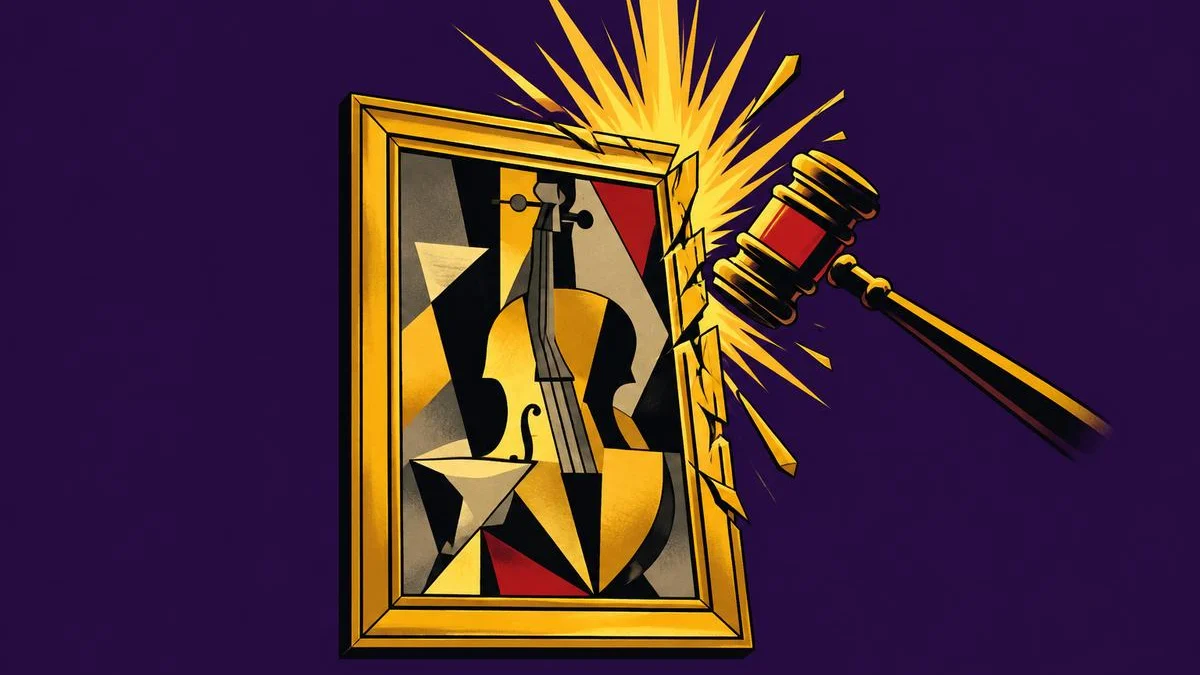
The sale of a long-lost Max Oppenheimer painting brought €3.5 million ($3.91 million) at Dorotheum in Vienna on November 17, 2026, setting an auction record for the Austrian modernist. The Hess Quartet. String Quartet I (1914) fetched more than six times its high estimate after spending nearly 90 years out of public view in the Glück family collection.
Summary
Key takeaways
- The Hess Quartet surpassed Oppenheimer’s previous $740,584 auction record.
- The 1914 painting united his musical interests with Cubism and Futurism.
- Oppenheimer’s auction sales total $3.92 million so far in 2026, his strongest year on record.
The painting sale that reset Max Oppenheimer’s record
The Hess Quartet’s appearance at Dorotheum’s Modern Art sale returned a work long considered lost to public view. Before Bohemian-born businessman Arnold Glück acquired it in the 1930s, the painting had featured in nearly every major Oppenheimer exhibition between 1915 and 1935.
At its final exhibition appearance, it carried a “not for sale” designation. It then remained in the Glück family collection for decades. Dorotheum described the discovery that it had survived as “an art-historical sensation.”
The route back to auction began with another Oppenheimer sale. Hussl-Hoermann said the 2024 result for Self-Portrait (c. 1933) prompted the owner of The Hess Quartet to approach Dorotheum.
A quartet painted through Cubism and Futurism
Oppenheimer’s 1914 painting brought together French Cubism, Italian Futurism and music—interests he developed before and after moving to Berlin. The son of a music publisher, he learned the violin before studying painting.
He painted The Hess Quartet two years after arriving in Berlin, where he encountered both modernist movements and German violinist Willy Hess. After Carl Halir’s death, Hess assumed both his professorship at Berlin’s Royal Academy of Music and his role as leader of Halir’s quartet.
The painting marked Oppenheimer’s first fusion of those movements with his musical interests. His music-centered works became his best-known paintings, drawing admiration from German novelist Thomas Mann, who praised their “incredible acoustic effect.”
Oppenheimer spent World War I in Switzerland, returned to Berlin in the 1920s and moved to Vienna in the 1930s. Hussl-Hoermann described him as successful by the standards of that period. Forced to flee to the United States as World War II loomed, he ended up broke and unknown, and his paintings were scattered, lost or hidden from view.
Exhibitions and rediscoveries rebuild Oppenheimer’s market
The Max Oppenheimer painting sale follows a recovery in public recognition supported by exhibitions and scholarship. A comprehensive 1994 exhibition at the Jewish Museum Vienna preceded art historian Marie-Luise Puttkammer’s 1999 catalogue raisonné.
Hussl-Hoermann credited the Leopold Museum’s 2023–24 exhibition with another breakthrough in public awareness. She also expects further discoveries: “I am convinced that more long-lost paintings will still surface, and that interest in his distinctive style is now growing stronger,” she said. “Prices will adjust accordingly.”
The Artnet Price Database records more than $964,000 in total Oppenheimer auction sales during 2024. That year, Dorotheum’s sale of Self-Portrait (c. 1933) established his previous auction high of $740,584.
With The Hess Quartet’s result included, Oppenheimer’s auction sales stand at $3.92 million so far in 2026—the highest annual total on record for the artist.
Read also: Wrapped Monero token crash sends XMR1 from $488 to $1 in 30 minutes
Article produced with the assistance of artificial intelligence and reviewed by the editorial team.