




Choosing crypto or forex for beginners is often framed as a contest. That is the wrong starting point. Both can produce substantial losses, and easy access says nothing about suitability.
A useful crypto vs forex decision asks what is traded, who holds it, when prices move and how costs are charged. The answers reveal which learning curve a beginner can manage consistently.
Quick Answer: There Is No Universal Winner
The better first market is the one whose risks can be understood, monitored and limited within an ordinary week. That may be forex for one beginner and crypto for another.
Choose by Structure, Risk and Lifestyle – Not Hype
The question “which is better forex or crypto?” has no responsible universal answer. Forex may appeal to people who follow interest rates and prefer defined weekday sessions. Crypto may feel more familiar to people who already use digital wallets and value weekend access. Neither familiarity nor convenience removes market risk.
Before choosing, test whether the active hours fit your life, the price drivers make sense, the provider and custody model are clear, and a loss limit can be followed without constant monitoring. This turns forex vs crypto into a suitability decision, not a price forecast.
Provider quality belongs in that decision too. UK readers considering forex can compare the best forex brokers in the UK as an initial research step, then verify each firm’s current authorisation, permissions, costs and withdrawal terms independently. A comparison can narrow the field; it cannot establish that a particular broker is suitable for every beginner.
| Factor | Forex | Crypto |
| Trading schedule | 24/5 with defined regional sessions | 24/7, including weekends |
| Typical structure | OTC market accessed through brokers | Exchange and blockchain-based venues |
| Key price drivers | Rates, inflation, economic data and central banks | Adoption, regulation, liquidity, narratives and sentiment |
| Primary operational risk | Leverage, broker quality and execution | Volatility, liquidation, venue and custody risk |
| Best fit | Learners who prefer routine and macro structure | Learners comfortable with continuous markets and higher uncertainty |
Crypto and Forex at a Glance
The first distinction in crypto trading vs forex trading is not the chart. It is the market infrastructure behind the chart and the claim the trader holds.
What Is Being Traded?
Forex exchanges one national currency for another. EUR/USD, for example, expresses the euro’s value in US dollars. Retail traders commonly use rolling spot forex or contracts for difference. A CFD tracks price movement without transferring ownership of the underlying currency.
Crypto covers several exposures. Buying bitcoin on a spot exchange generally creates a claim to the asset at that venue, often with an option to withdraw it to a personal wallet. A crypto perpetual or CFD is instead a derivative with its own leverage, funding and liquidation terms.
Where and How Trades Are Executed
Foreign exchange is an over-the-counter, or OTC, market: trading occurs across banks, dealers and brokers rather than one central exchange. The BIS Triennial Survey published in September 2025 recorded average OTC FX turnover of $9.6 trillion per day in April 2025. Despite that scale, a retail customer still depends on a particular broker’s prices and execution.
Crypto trading is split across centralised exchanges, decentralised protocols and blockchain transactions. Prices can differ by venue. An exchange matches buyers and sellers; it is not automatically a bank, custodian or regulated investment firm.
Market Hours and Lifestyle Fit
Continuous access can sound attractive, but more opening hours also create more opportunities to monitor, react and overtrade. The better schedule is the one a beginner can turn into boundaries.
Forex: A 24/5 Weekly Rhythm
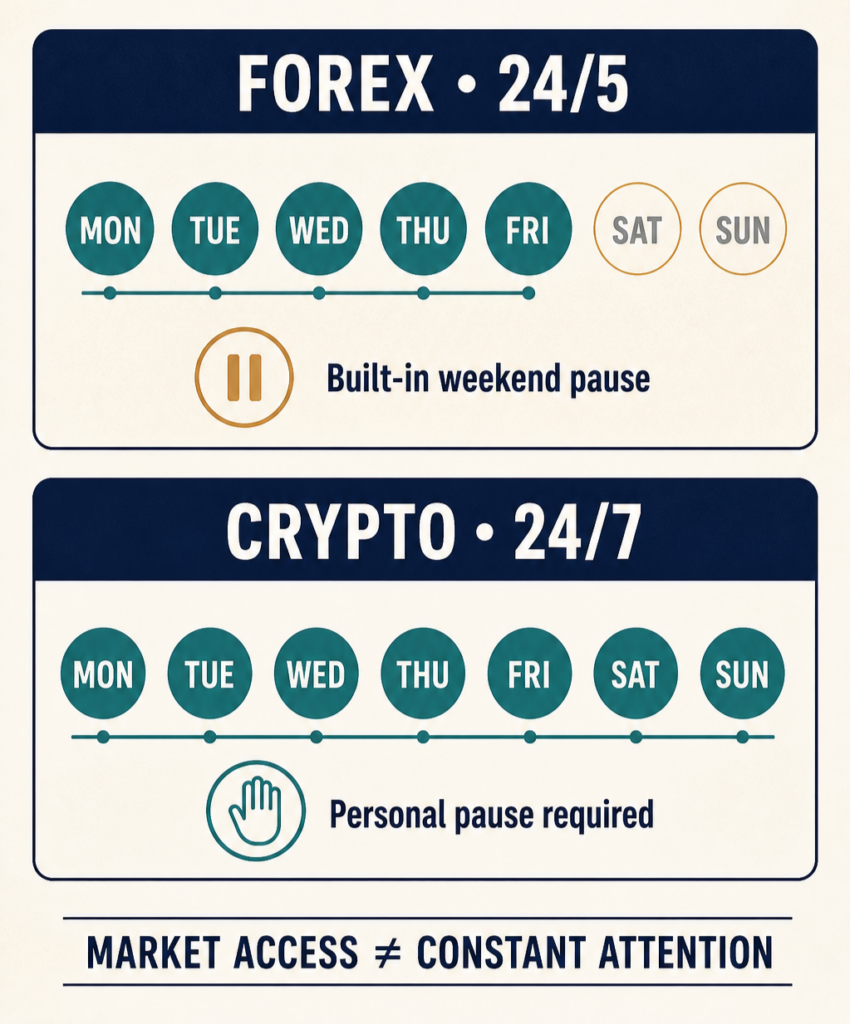
Forex trading hours generally run from Sunday evening to Friday evening as activity moves through Asia, Europe and North America. Liquidity often improves when sessions overlap. Weekends create a pause, but also a gap risk if the market reopens at a different price.
This rhythm can suit someone who selects one session and stops when it ends, but not a person free only on weekends. What matters is whether the chosen pair is liquid during the hours available.
Crypto: Continuous 24/7 Exposure
Crypto trading hours do not stop for weekends or holidays. Positions can move while a trader sleeps or works. This helps people poorly served by traditional sessions but removes forex’s market-enforced break.
Beginners, therefore, need their own closing time. Alerts and predetermined exits reduce screen-watching but cannot guarantee an exact fill during a rapid move or outage.
Which Schedule Is Easier to Manage?
Choose the schedule that permits repeatable observation without disrupting sleep or work. A weekday routine may favour forex; genuine weekend availability may favour crypto. If 24/7 access creates a feeling that every move must be watched, it is a liability rather than a benefit.
Volatility, Leverage and Liquidation Risk
Price movement and account risk are related but not identical. A volatile asset can be traded without borrowing, while a comparatively small currency move can cause a large loss when leverage is high.
Why Crypto Moves Can Be More Extreme
Crypto can react sharply to regulation, token news, liquidations and sentiment. Smaller tokens may have limited depth, concentrated ownership or few buyers during stress, allowing prices to fall through expected levels.
Leverage controls a position larger than the cash committed. Liquidation is its forced closure when collateral can no longer support it. Thresholds, pricing methods and fees vary by venue, making contract terms part of crypto exchange risk.
Why Forex Leverage Still Makes Small Moves Dangerous
Major currency pairs usually move less dramatically than small cryptoassets, but retail forex is often leveraged. At 30:1, £100 of margin controls £3,000 of exposure. A move of only 1% against the position equals £30 before costs – a 30% hit to the margin initially committed.
Forex for beginners should therefore start with position size, stop distance and maximum loss. A broker’s leverage ceiling is a restriction, not a suggested setting.
Liquidity, Spreads and Execution
Liquidity describes how easily an order can be completed without moving the price substantially. It varies by asset, venue, time and conditions.
Major Currency Pairs versus Major and Long-Tail Crypto Assets
Pairs such as EUR/USD and USD/JPY usually have many active participants and narrow spreads during busy sessions. The spread is the gap between the price available to buy and the price available to sell; it is an immediate trading cost.
Bitcoin and ether can have substantial depth on large venues. Smaller cryptoassets may show a price supported by few orders. Compare the specific pair and venue, not the headline size of either market.
Slippage and Market Depth
Market depth shows buying and selling interest at successive prices. Slippage is a fill at a different price from the one expected. It becomes more likely during news or when an order is large relative to available depth.
A tight advertised spread does not guarantee a low final cost. Demo testing, small initial orders and review of actual fills can reveal more than a pricing claim on a homepage.
Regulation, Custody and Provider Risk
The two markets require different provider checks. Forex due diligence focuses on the broker and the legal entity holding the account. Crypto adds questions about exchanges, wallets, private keys and blockchain transfers.
Forex Broker Oversight and Retail Protections
“Regulated” is incomplete without naming the regulator and authorised entity. In the UK, the FCA’s CFD rules cover rolling spot forex and require leverage limits between 30:1 and 2:1, margin close-out at 50% of required margin, negative-balance protection and standardised loss warnings. The FCA still classifies CFDs as high risk.
A customer who opts up as a professional may lose retail safeguards. Forex broker regulation reduces certain risks; it does not prevent market losses or every firm failure.
Crypto Exchange, Wallet and Custody Risks
Custody means who controls the assets or private keys needed to move them. Exchange custody creates dependence on the venue’s security, solvency and withdrawals. Self-custody shifts responsibility for seed phrases, transaction accuracy and device security to the user; mistaken transfers may be irreversible.
UK oversight is changing. The Cryptonomist reported on 30 June 2026 that the broader FCA crypto framework is scheduled for 25 October 2027, with applications opening in September 2026. Until then, an AML registration or compliant promotion should not be mistaken for the protections attached to an FCA-regulated retail CFD account.
Costs New Traders Commonly Miss
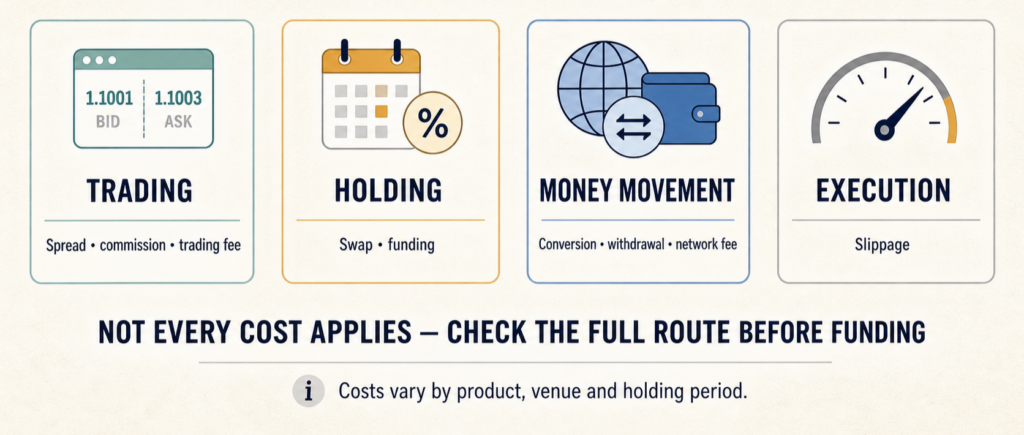
Costs should be estimated over the planned holding period, not reduced to whichever venue advertises the lowest headline fee.
Spreads, Commissions and Overnight Financing
A forex account may charge a spread, commission or both. Positions held beyond a daily cut-off can incur overnight financing, or a swap, with different rates for long and short positions. Inactivity and conversion fees may also matter.
Exchange Fees, Withdrawal Fees and Network Costs
Crypto exchanges commonly use maker-taker fees based on order type and volume. A spot purchase may also involve a spread, deposit cost, withdrawal charge and network fee. Perpetual contracts can add recurring funding payments.
The cheapest route for buying is not necessarily the cheapest route for exiting to a bank account or personal wallet. A beginner should price the complete cycle before funding it.
For UK Readers: How to Evaluate a Forex Broker
UK readers can reduce avoidable provider risk by checking the legal entity first and the platform features second. A polished app is not evidence of authorisation.
Verify Authorisation and Permissions
Search the FCA Financial Services Register independently. Match the legal name, reference number, domain, contact details and permissions. Confirm that the account agreement names the same entity and treats you as a retail client.
Clone firms copy genuine names while changing phone numbers or websites, so use contact details from the register. Verify the entity behind the interface.
Compare Costs, Execution and Withdrawals
Once authorisation is confirmed, compare the conditions that affect actual use:
- Calculate spreads, commissions and financing for the pairs and holding periods you expect to trade.
- Check order types, execution policy, minimum size, slippage disclosures and what happens during price gaps.
- Read withdrawal rules, test customer support and confirm how complaints and client money are handled.
Which Market Fits Which Beginner?
Profiles are more useful than a universal winner because they connect market structure to behaviour. The following prompts are filters, not recommendations.
Choose Forex If…
Forex may fit if you follow central banks and economic releases, prefer a weekday routine and want to focus on a few major pairs. It still requires understanding how leverage changes position risk.
Choose Crypto If…
Crypto trading for beginners may fit people comfortable with wallets, blockchain transfers and exchange interfaces, or those needing weekend access. It also requires accepting custody responsibility, fragmented venues and abrupt moves.
Consider Learning Both – but Trading One First
Learning both improves perspective, but trading both immediately doubles the rules, costs and information streams to manage. Study broadly, then paper-trade one market long enough to build a consistent review process.
A Safer First-Step Plan
The first objective is not to maximise return. It is to discover whether the chosen market and process remain manageable when outcomes are uncertain.
Learn the Mechanics
Explain the instrument, order type, spread, leverage, liquidation rule and exit process in plain language. If custody is involved, know who controls the asset and how it can be withdrawn. Unresolved confusion is a reason to pause.
Use a Demo or Paper-Trading Environment
A simulator tests routine, order entry and record-keeping without market loss. It cannot reproduce fear, slippage or live-trading temptation, so good demo results show familiarity – not future profitability.
Define a Maximum Affordable Loss
Set a per-trade limit and total learning budget before depositing. MoneyHelper’s guidance on high-risk products emphasises suitability, risk appetite and what one can afford to lose. Exclude rent, debt payments, emergency savings and money needed soon.
Final Verdict: Start with the Market You Can Manage Consistently
The useful answer to crypto vs forex is a fit test. Forex offers a weekday rhythm, macro structure and jurisdiction-dependent retail protections. Crypto offers continuous access and direct ownership possibilities alongside distinct volatility, venue and custody risks.
Choose the market whose mechanics you can explain, hours you can contain and providers you can verify. Narrow the instrument list, practise the workflow and define the maximum affordable loss before going live. The right first market is the one you can approach with fewer avoidable mistakes and a repeatable process.
*This article was paid for. Cryptonomist did not write the article or test the platform.