



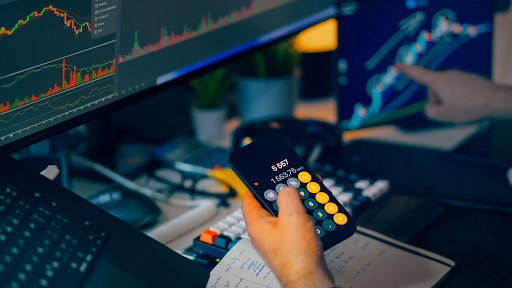
Position sizing determines how much money a price move puts at risk; the platform’s maximum order allowance does not. The BIS 2025 Triennial Central Bank Survey documents the scale of the global OTC FX market. For position sizing, however, the useful starting point is a maximum planned loss, not a profit target.
Quick Answer: Lot Size Converts a Risk Limit into Trade Exposure
Forex position sizing combines account balance, risk percentage, stop-loss distance and pip value. A consistent risk per trade forex rule converts the chosen percentage into money before the position size is selected.
Once those inputs are defined, a Forex lot size calculator can estimate the size for the selected pair. The calculator uses the account currency, balance, risk percentage, stop-loss distance and currency pair entered by the user. Its result is a planning input, not a forecast, and is only as reliable as those assumptions.
What Is a Lot in Forex?
A lot expresses trade size in standard units of the base currency, which is listed first in a pair. In EUR/USD, EUR is the base and USD is the quote currency.
Standard, Mini and Micro Lots
Standard, mini and micro lots make large currency quantities easier to compare.
| Lot type | Lots | Base-currency units |
| Standard | 1.00 | 100,000 |
| Mini | 0.10 | 10,000 |
| Micro | 0.01 | 1,000 |
Check the contract specification: metals, indices and crypto-linked products may use different sizes.
The Four Inputs That Drive Position Size
Each input can change the appropriate size even when the trade idea remains unchanged.
Account Balance
Balance provides the base for planned monetary risk. Some methods use current equity when positions are open. Apply the chosen method consistently; do not substitute available margin.
Risk Percentage
The risk percentage is the maximum planned share exposed if the stop fills as expected. It is not a guaranteed loss ceiling: costs and imperfect execution can increase the realised result.
Stop-Loss Distance
Stop-loss distance is the gap from entry to the intended exit. A pip is commonly 0.0001 for many pairs and 0.01 for many JPY pairs. Confirm the instrument’s convention rather than relying on displayed decimals.
Pip Value and Currency Pair
Pip value converts one pip into the account currency. It varies with size, pair, exchange rate and account currency; cross-currency combinations may require conversion. Never reuse one assumed pip value across every pair.
How the Calculation Works
Risk-first sizing moves from the account limit to trade size, not from available margin to the largest possible order.
Start with Maximum Planned Monetary Loss
The first step is:
Maximum planned loss = account balance or equity base × chosen risk percentage
In a hypothetical calculation, 1% is entered as 0.01. This establishes the cash limit before expected reward influences the decision.
Translate That Limit into Lots
For a pair whose pip value per standard lot is known, the core position-size formula for forex is:
Lot size = maximum planned loss ÷ (stop-loss pips × pip value per standard lot)
Round down if the provider’s size increment would otherwise exceed the limit. Allow for spread, commission and slippage; the stop calculation does not capture every cost.
Use a Calculator Without Outsourcing Judgment
A calculator can check manual arithmetic. It cannot judge the stop, select the correct balance base or identify concentrated exposure across positions. Precise output from weak inputs remains a weak plan.
A Hypothetical Worked Example
These hypothetical numbers demonstrate mechanics only, not expected performance or suitable risk tolerance.
State All Assumptions Before Showing the Result
Assume a USD 10,000 account, 1% risk, a 50-pip stop and EUR/USD hypothetically. The account currency is USD and the simplified pip value is USD 10 per standard lot.
Maximum planned loss: USD 10,000 × 0.01 = USD 100
Calculated size: USD 100 ÷ (50 pips × USD 10 per pip per lot) = 0.20 lots
At 0.20 lots, the hypothetical pip value is USD 2, so 50 pips equals USD 100 before costs, gaps or slippage. A 100-pip stop with the same limit would reduce the size to 0.10 lots. The size adapts while planned risk remains constant.
Why the Same Lot Size Can Mean Different Risk
Fixed-lot trading ignores stop distance and pip value. In a hypothetical comparison, a 0.20-lot position with a 25-pip stop has half the planned price-distance risk of the same size with a 50-pip stop, assuming equal pip value. Changing the pair or account currency may change that value.
Two correctly sized positions can still concentrate exposure if both depend on the same currency or theme. Forex risk management needs an account-wide view.
Leverage versus Position Size: Do Not Confuse the Two
Leverage determines required margin; position size determines market exposure. More leverage can reduce the deposit needed, but not the loss from a given adverse move. The CFTC’s retail forex advisory warns that leverage amplifies gains and losses and that traders may lose all margin and more.
The FCA’s CFD guidance describes CFDs as high-risk products unsuitable for some retail consumers. The leverage vs position size distinction is simple: Margin asks, “Can this order open?” Risk sizing asks, “What could the move cost?”
Common Position-Sizing Mistakes
Three common errors occur before the formula is used:
- Choosing the lot first and moving the stop until the order appears affordable.
- Increasing risk after a win, or in an attempt to recover a loss, without changing the written plan.
- Ignoring spread, correlated positions, market gaps or slippage when estimating the worst plausible outcome.
Each disconnects the order from its monetary limit.
Final Checklist Before Placing a Trade
The calculation is ready only when every input can be checked.
| Input | What it controls | Common mistake |
| Account balance or equity | Base used for planned monetary risk | Substituting available margin without a defined method |
| Risk percentage | Maximum planned share exposed | Changing it in response to emotion or recent results |
| Stop-loss distance | Price movement allowed before the planned exit | Choosing size first and forcing the stop to fit |
| Pair and pip value | Conversion of price movement into money | Assuming every pair has the same pip value |
| Costs and slippage | Difference between planned and realised loss | Ignoring spreads, gaps and execution differences |
To calculate lot size forex responsibly, set the cash limit, define the stop, verify pip value, calculate size and review total exposure – in that order. The aim is a consistent risk process, not certainty about the market’s next move.