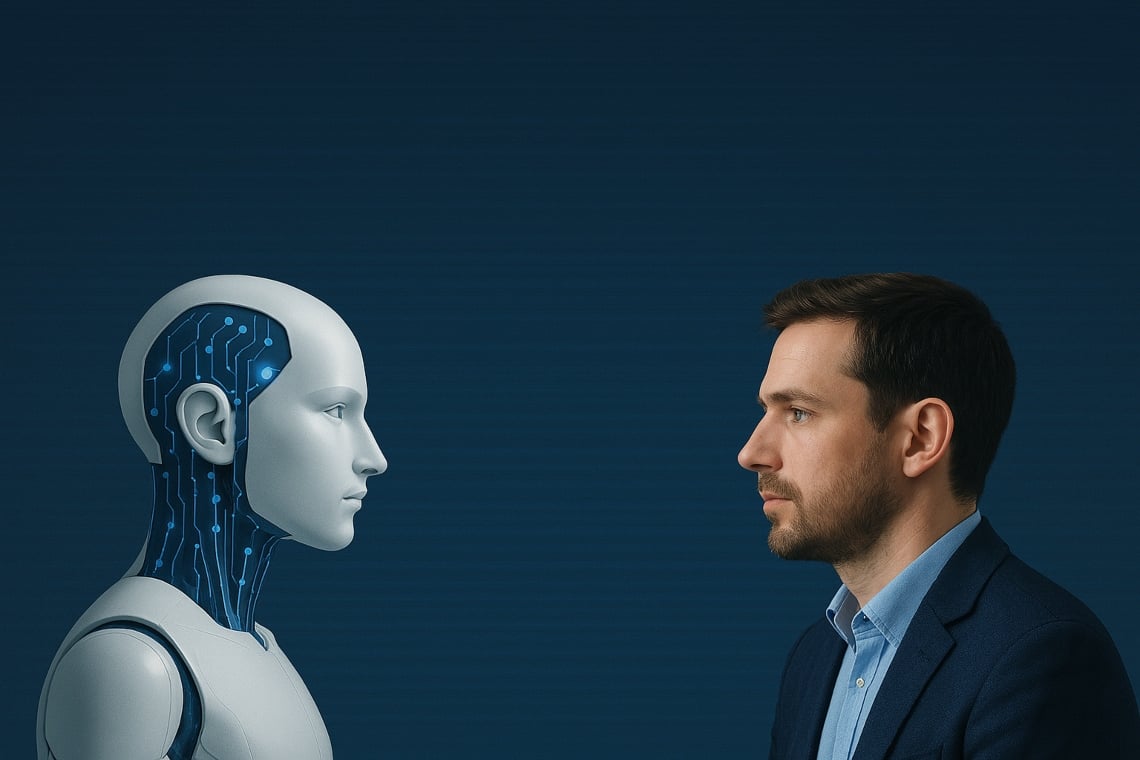
It is official: artificial intelligence (AI), specifically GPT-4.5, has passed the Turing test.
A study conducted by the University of San Diego has shown that GPT-4.5, an advanced language model developed by OpenAI, was recognized as human more often than humans themselves.
Summary
In 73% of cases, participants believed that GPT-4.5 was human: a new era for AI after passing the Turing test

Devised in 1950 by Alan Turing, the eponymous test aims to answer a revolutionary question: can machines think? In the test, an evaluator interacts with two interlocutors, one human, one artificial, without knowing their identity.
If it cannot distinguish which of the two is human, the machine has passed the test.
The test does not measure consciousness, but the ability of the machine to credibly simulate human behavior. Until today, no system had passed this test so decisively.
The researchers involved two groups of evaluators — university students and users of the Prolific platform — asked to engage in text conversations with a real person and an artificial intelligence.
At the end of the chat, they had to choose who was the real human being.
The AI systems put to the test included:
- ELIZA – symbolic chatbot of the ’60s
- GPT-4o – OpenAI model optimized for multimodal use
- LLaMa 3.1 – open-source model by Meta
- GPT-4.5 – the most advanced version of OpenAI, tested here with and without “persona”
A determining factor in the experiment was the use of two types of prompts:
- NO-PERSONA: neutral, standard responses;
- PERSONA: responses with a defined personality to appear more human.
Each evaluator viewed this interface after the conversation. They had to indicate who the real human was between the two “witnesses,” also specifying the level of confidence in their choice. In many cases, the choice fell on artificial intelligence.

GPT-4.5 with “persona”: 73% success rate
The GPT-4.5-PERSONA model has achieved an impressive 73% win rate, appearing more credible as a human being compared to the human participant in nearly three out of four interactions.
The systems with “persona” achieved significantly superior performance, demonstrating that the addition of an artificial personality increases the perception of humanity.
The bar chart shows the win rates of each model. GPT-4.5-PERSONA dominates among both Prolific participants and university students.
On the right, another chart indicates the security level expressed by the evaluators: often, the most advanced AIs were mistaken for humans with surprisingly high confidence.

What allowed GPT-4.5 to achieve this historic result? Not only a greater linguistic ability, but also a refined ability to simulate human imperfection: hesitations, less perfect responses, strategic courtesy.
Elements that make the interaction more natural and believable.
And now?
If a machine manages to appear more human than humans themselves, how will our trust in AI change? The implications are enormous, not only in the technological field, but also ethical and social.
- Will it be necessary to clearly label AI in public contexts?
- Will we be able to distinguish a conversation with a person from one with a machine?
- What changes when our artificial interlocutor is more empathetic, coherent, and attentive?
The passing of the Turing test by GPT-4.5 represents a milestone in the evolution of artificial intelligence. It is not proof that AI has consciousness, but that it has learned to “appear human” in such a refined way as to deceive even humans themselves.
Are we ready for a world in which we will no longer know for certain if we are talking to a real person?