As energy markets and computing costs shift worldwide, bitcoin decentralization is taking on new forms that challenge early assumptions about how open networks should spread.
Summary
Mining costs push Bitcoin operators out of the US
Soaring power prices in parts of the United States have pushed the cost of mining a single Bitcoin above $100,000 in some locations, forcing operators to shut down or relocate. Moreover, higher regulatory uncertainty has added another layer of pressure on industrial-scale miners.
According to crypto exchange KuCoin, this exodus is already visible on-chain, with network hash rate steadily shifting toward what analysts describe as the Global South. That said, the migration is not uniform, and some regions in North America continue to attract new facilities with long-term power contracts.
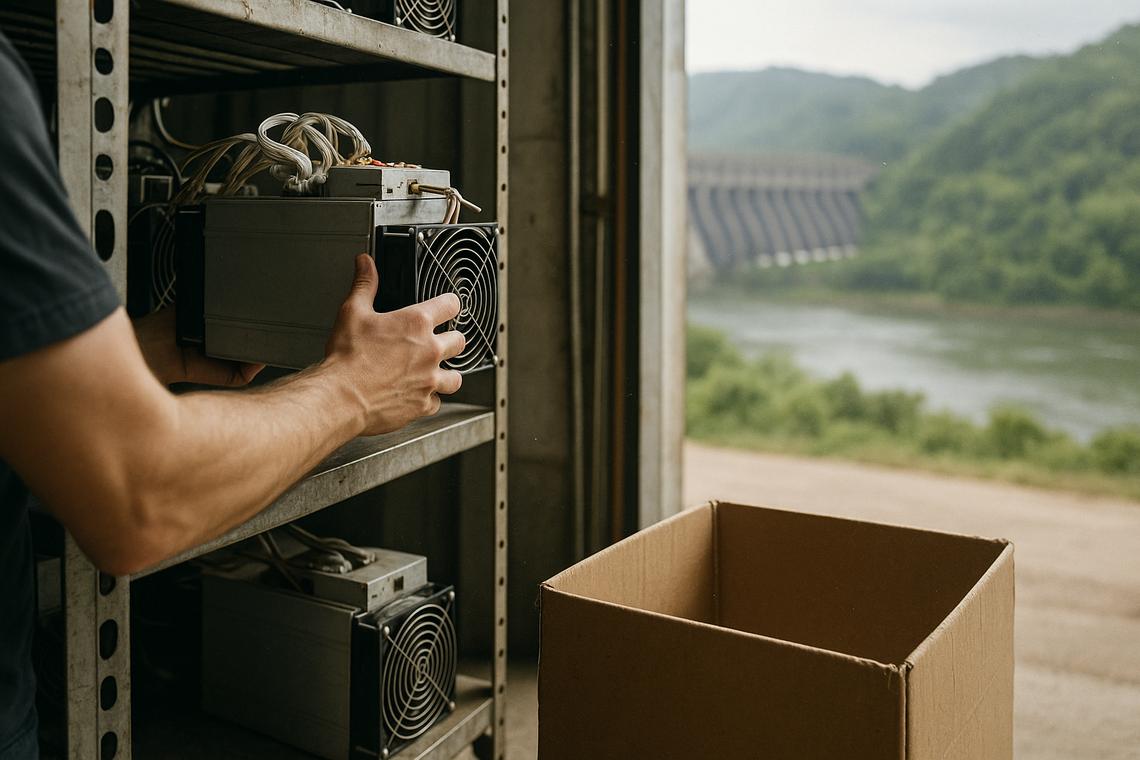
Paraguay and Ethiopia have emerged as two of the most sought-after destinations. Both countries offer surplus hydroelectric generation that helps keep electricity prices low and relatively stable, a critical factor for miners whose margins track power costs almost one-for-one.
Hydroelectric power and the new mining map
In Paraguay, access to abundant hydropower has become a central selling point for foreign miners and local policymakers alike. However, the influx of energy-intensive data centers has also sparked debate about export pricing and how much cheap electricity should be reserved for domestic industry and households.
Ethiopia is following a similar path, using large hydroelectric projects to court digital infrastructure investors. Moreover, agreements with overseas mining firms are being framed as a way to monetize excess generation while building out national grid capacity and supporting broader economic development.
KuCoin argues that this growing geographic diversification actually strengthens the Bitcoin network. By spreading hash rate across multiple political and regulatory environments, the protocol reduces its exposure to any single government’s policy shift, blackout, or sudden energy shock.
This represents a different version of decentralization than the one many early adopters imagined. Instead of millions of home miners, the network now relies on clusters of industrial operators distributed across several countries, including new centers in the Global South.
The opposite decentralization paths of Bitcoin and AI
While mining infrastructure grows more concentrated in fewer, larger facilities, artificial intelligence appears to be moving in the opposite direction. The contrast underscores how technology sectors may decentralize along very different axes even when they share overlapping hardware and energy needs.
Alex Thorn, head of research at Galaxy, highlighted this divergence on Sunday, noting that mainstream AI originally lived almost exclusively in massive, corporate-controlled data centers. However, rising costs, hardware bottlenecks, and growing demand for privacy-friendly computing are now pushing development toward smaller, more flexible models.
As leading-edge systems run into constraints such as data scarcity, memory ceilings, and context windows, open-source AI projects have gained ground. Moreover, more efficient architectures are enabling capable models to run on laptops and high-end smartphones rather than only in remote server farms.
Thorn argues that if local models continue to become smaller, cheaper, and more efficient, AI could grow increasingly personal and predominantly on-device. In his view, that trajectory points to a more distributed computing landscape, with significant processing power pushed out to the network edge instead of being centralized in a few hyperscale locations.
Bitcoin mining followed the opposite trajectory. In the protocol’s early years, ordinary users routinely mined from home computers or small GPU rigs. However, rising competition and rapid difficulty adjustments soon made hobbyist setups uneconomical.
Today, serious participation demands specialized ASIC hardware, long-term power contracts, and often access to industrial-scale sites. As a result, the gap between a casual enthusiast and a professional mining firm has never been wider, even as the global footprint of facilities becomes more geographically diverse.
BTCUSD is now trading at $70,791, a price level that makes energy costs and hardware efficiency even more central to profitability calculations for miners planning multi-year deployments.
Edge computing and the rise of on-device AI
The push toward running AI models locally on phones, laptops, and embedded hardware is often described as edge computing. Instead of routing every query to a remote data center, computation happens near the user, reducing latency and potentially improving privacy.
Industry data suggests the global edge AI market was valued at roughly $25 billion in 2025. Moreover, projections from Grand View Research indicate that this figure could approach $120 billion by 2033, implying growth of nearly 300% over eight years as more devices gain AI capabilities.
This expansion is being powered by the rapid spread of connected hardware, from industrial sensors to consumer wearables, along with rising demand for real-time processing. That said, concerns over data privacy, regulatory compliance, and bandwidth costs are equally important catalysts for moving workloads away from centralized clouds.
Sectors where delays can translate directly into risk or lost revenue, such as manufacturing, healthcare, and logistics, are early adopters of this architecture. In these environments, processing data on-site can reduce response times, improve reliability, and allow sensitive information to remain inside local networks.
Rethinking bitcoin decentralization in a changing landscape
For Bitcoin, the main concern runs in the opposite direction from AI. As mining becomes more capital-intensive, questions resurface about long-term network security and what practical decentralization really means in a system where only a limited set of actors can compete at scale. The evolving pattern of bitcoin decentralization therefore mixes industrial concentration with regional dispersion.
A network dominated by a small group of large mining entities could, in theory, become more vulnerable to coordinated disruption, regulatory capture, or targeted sanctions. However, the ongoing relocation of hash rate to multiple countries, including emerging markets with surplus hydropower, provides a counterweight to those risks by diluting jurisdictional concentration.
The recent migration away from parts of the US may help diversify the protocol’s political and energy exposure. Whether this geographic spread is sufficient to offset industrial concentration remains unresolved, but it illustrates how decentralization can evolve along multiple dimensions at once.
In summary, Bitcoin and AI now appear to be trading places on the decentralization spectrum. As mining consolidates in large facilities scattered across new energy hubs, AI is gradually moving outward to the edge, where individual devices perform more of the work once reserved for centralized data centers.