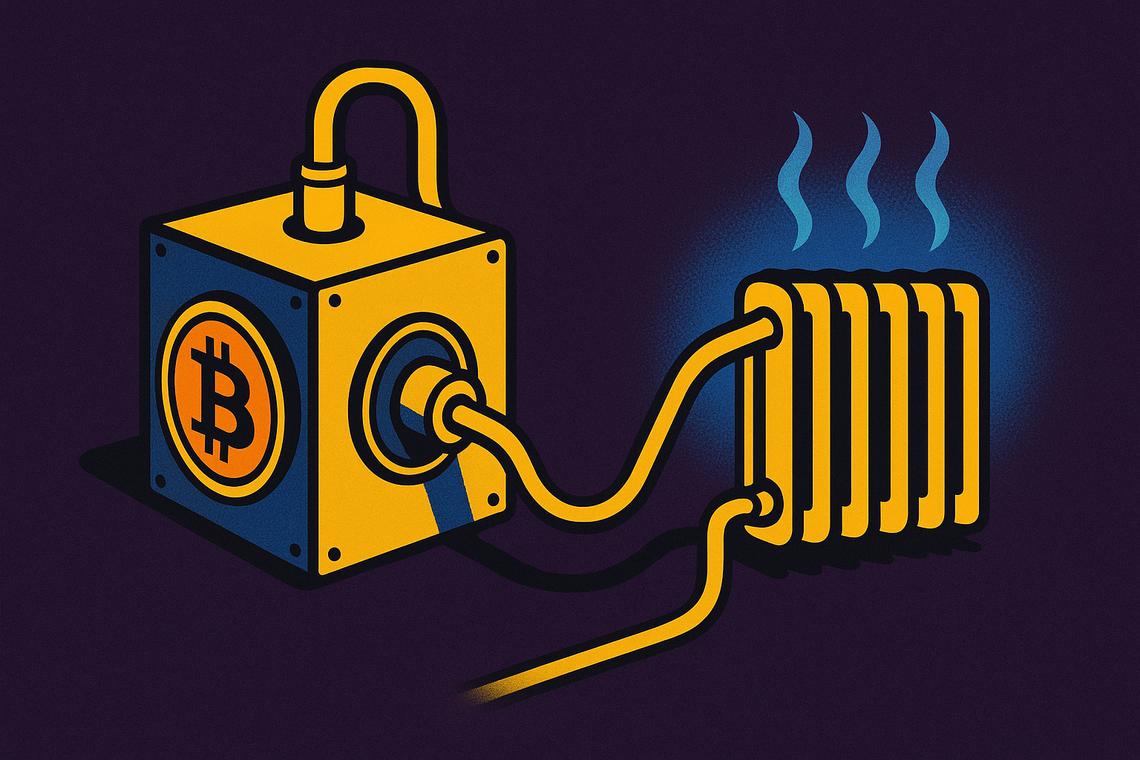
Bitcoin mining usually brings to mind warehouses full of machines and huge power bills. However, the Canaan Bitcoin heating project is trying to sell a different picture: miners as part of everyday heat infrastructure. In the Nordic region, Canaan has been selected for an 8-megawatt district heating project that aims to turn mining hardware into a source of hot water for homes.
That shift matters because it pushes Bitcoin hardware beyond its usual role as pure computing equipment. Instead of treating heat as waste, the project uses it as the product. Canaan says the full system could eventually provide heating for about 2,800 homes, giving the company a high-profile test of whether “hash-to-heat” can work at meaningful scale.
The setup is already partly live. About 2 MW of the system, made up of 228 units, is operating in the region and providing hot water to local residents. After that initial deployment, a follow-on order for another 6 MW, or 692 additional units, was placed in March.
Summary
Canaan lands a Nordic district heating project
The new deployment centers on A1566HA hydro-cooled Bitcoin miners, part of Canaan’s Avalon lineup. Those machines are being used to feed hot water into a local district heating network in the Nordic region.
At its core, the Canaan Bitcoin heating project is an attempt to reframe mining economics. The value is not just in producing Bitcoin. It is also in generating useful thermal output that can plug into existing heating systems, especially in colder markets where district heating is already common.
That helps explain why this kind of project is drawing attention. For the crypto industry, it offers a more practical case for mining infrastructure. For heating networks, it points to an alternative heat source that comes bundled with compute.
Part of the system is already running
Canaan says roughly a quarter of the total planned capacity is already online. The operating portion, about 2 MW, is currently supplying hot water in the region.
The next phase moved quickly. In March, a follow-on order added another 6 MW, expanding the planned installation to the full 8 MW. Once complete, the project is expected to provide heating for around 2,800 homes.
- 8 MW total project capacity
- About 2 MW already operating through 228 units
- Another 6 MW, or 692 additional units, ordered in March
- Heating potential for about 2,800 homes
Why this matters is fairly simple: most heat-reuse crypto projects have been discussed as experiments. This one is being presented as district-level infrastructure, with residential heating as the real-world use case.
How the Canaan Bitcoin heating project is supposed to work
Canaan says its hydro-cooled miners can produce hot water at around 80 degrees Celsius. That is a key detail, because one of the biggest challenges in heat-reuse systems is whether the output is hot enough to work inside established heating networks without extra layers of support.
The company also says the system’s design gives it more flexibility than a single-source heating setup. Its heating nodes are built from many individual miners that can be overclocked or underclocked, allowing output to be adjusted across the system.
There is also a maintenance argument here. Canaan says individual units can be serviced without shutting down the entire thermal source. In a district heating context, that point is more than a technical footnote. It speaks directly to uptime, reliability, and whether mining-based heat can behave like infrastructure instead of a side project.
Heat reuse is now part of Canaan’s wider strategy
The Nordic installation did not emerge in isolation. It fits into a broader push by Canaan to position mining machines around energy reuse and practical heating applications.
Earlier this year, the company announced a 3 MW proof-of-concept project in Manitoba, Canada, with Bitforest Investment Ltd. That system used 360 liquid-cooled Avalon A1566HA units as supplemental heat for greenhouse operations. Canaan said the setup was designed to preheat water for electric boilers through a closed-loop heat exchanger.
The company has also taken the idea to the consumer market. At CES 2025, it introduced the Avalon Mini 3, a home Bitcoin miner designed to double as a space heater.
Taken together, those moves suggest Canaan is trying to build a larger narrative around mining hardware: not just machines that secure the Bitcoin network, but devices that can sell heat in industrial, agricultural, and residential settings too.
Why Europe is becoming a test bed for hash-to-heat
Europe is described as one of the most active testing grounds for hash-to-heat projects, and the Nordic deployment helps explain why. Cold climates, strong heating demand, and existing district heating infrastructure create a setting where heat from Bitcoin miners can be used more directly.
Other companies have explored similar routes. Hashlabs has worked on mining-based heating in Finland, while MARA Holdings has publicized a 2 MW pilot in Finland that recycles heat from digital asset compute into a local district heating facility.
That wider context matters for the Canaan Bitcoin heating project because it places the deployment inside a competitive and fast-evolving corner of the mining industry. The race is no longer only about hashrate and efficiency. It is also about whether miners can become useful energy assets in places that already need large volumes of heat.
Canaan’s Nordic project now stands as one of its clearest attempts yet to prove that point at district scale, with Bitcoin miners moving from the server room into the heating network.