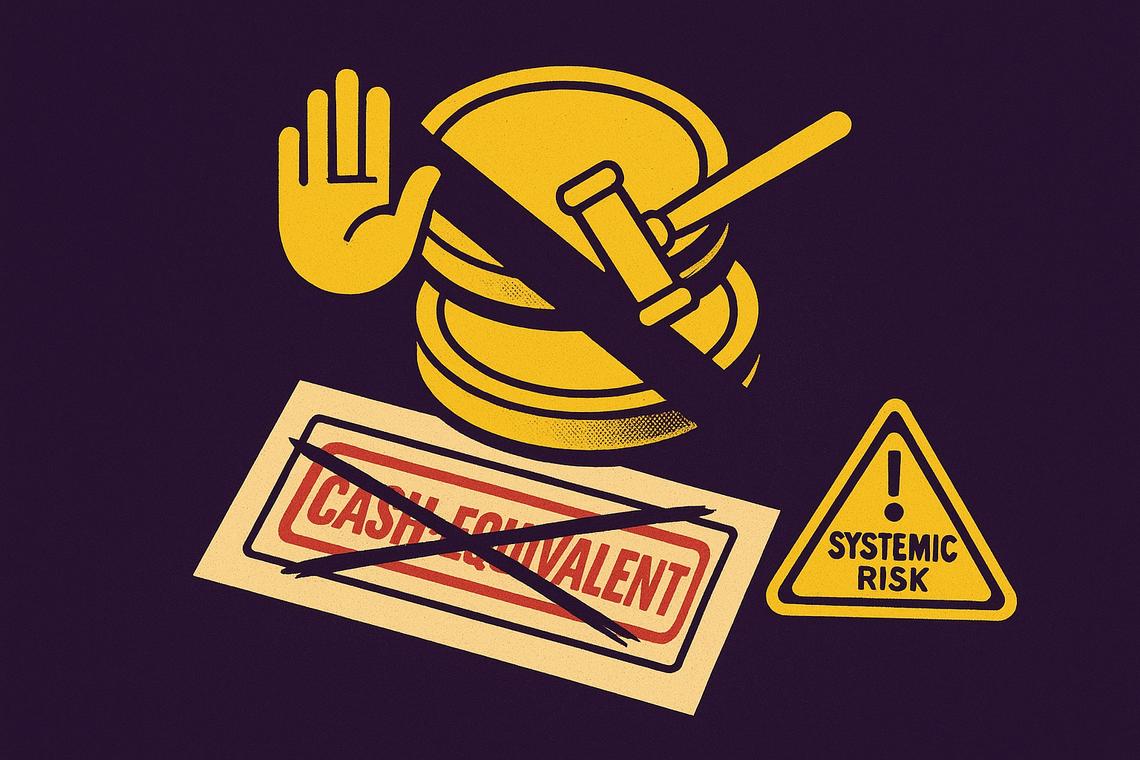
The debate over stablecoin regulation just got sharper. Two tokens, Tether and Circle’s USD Coin, account for nearly 90% of global stablecoin circulation, yet some institutional voices are now questioning whether either one should count as a true cash equivalent.
That criticism lands at a sensitive moment for crypto. Stablecoins are supposed to be the calm center of digital markets: the place traders park funds, companies settle transactions, and institutions manage on-chain cash. However, at the Digital Money Summit 2026 in London, Christoph Hock of Union Investment argued that the market’s two biggest names do not meet that standard.
His verdict was blunt: neither Tether nor USDC is an authentic stablecoin.
Summary
Why the largest stablecoins are under scrutiny
Hock, who leads Tokenization and Digital Assets at Union Investment, framed the issue around structure rather than branding. If a token is meant to function like cash, the assets behind it matter just as much as its market size.
That is why the scale of the market matters here. Tether and USD Coin together represent nearly 90% of global stablecoin circulation. As a result, when doubts surface around reserve quality or redemption resilience at the top of the market, the question is no longer about a niche crypto product. It becomes a broader issue of stablecoin systemic risk.
This criticism also carries weight beyond a conference stage. A market dominated by two private issuers leaves little room for failure. If either token wobbles under stress, the impact can move quickly through exchanges, trading firms, corporate treasury operations, and other parts of crypto that rely on fast digital dollars.
What critics say is wrong with Tether reserves
Hock’s central complaint about Tether focused on the makeup of its backing. He argued that Tether’s collateral includes precious metals and cryptocurrency in addition to government securities, which, in his view, makes it look less like a pure cash substitute and more like a mixed investment vehicle.
He put it plainly: “When looking at the invested assets of Tether, they have massive holdings in gold, they have massive holdings in bitcoin.”
That reserve mix matters because stablecoins sell certainty. If users believe a token is effectively digital cash, they expect something close to immediate and dependable redemption, even during a rush for the exits. Assets such as bitcoin and gold may be valuable, but critics argue they do not behave like cash in moments of market stress.
By January 2026, Tether’s gold reserves had reached approximately 148 tonnes, valued at around $23 billion. That is a striking figure on its own, and it shows how far the issuer’s balance sheet extends beyond short-term government paper.
At the same time, the Bank for International Settlements said Tether was the seventh-largest buyer of United States Treasury securities in 2024, with $33.1 billion in net purchases during the year. That points to substantial holdings of high-quality government assets. However, the BIS warning, as presented here, was that asset quality alone does not solve the core redemption problem: speed. In a mass withdrawal event, even Treasury-heavy reserves may not convert to cash quickly enough to satisfy everyone at once.
Why this matters for crypto and institutions
This is where stablecoin regulation moves from theory to market plumbing.
A token used for cash settlement is judged differently from a token used for speculation. Institutional users want predictability, not a portfolio that can swing with metals or crypto prices. Hock’s critique cuts at that exact point: a stablecoin can be large, liquid, and deeply embedded in crypto markets, yet still fall short of what treasury desks or regulated financial firms expect from a cash-equivalent instrument.
USDC volatility exposed the stress test
Tether is not the only target. USDC, often seen as the more conservative alternative, has also faced sharp questions after losing its dollar peg during periods of stress.
After the failure of a cryptocurrency-focused banking institution in early 2023, USDC fell to $0.87. For a product marketed around one-to-one stability with the dollar, that was a serious break.
Then came another jolt. In March 2024, USDC dropped to $0.74 on three distinct occasions.
Those episodes give critics a concrete case for stricter stablecoin regulation. The issue is not just whether reserves exist on paper. It is whether a token can hold its peg when confidence cracks and redemption pressure spikes.
For institutional market participants, that distinction is huge. A double-digit drawdown in something meant to function as operational cash is not a routine trading event. It changes treasury assumptions, collateral decisions, and settlement planning.
Why regulators want bank-style rules
The push from American and European regulators is increasingly clear in direction, even if the exact policy design is still not detailed here. The article says regulators on both sides of the Atlantic are advocating for banking-equivalent supervision of stablecoin issuers.
That reflects a broader concern already flagged by the European Central Bank and the Federal Reserve, both of which have identified vulnerabilities in stablecoins. The concern is not only about investors. It is also about what happens when large pools of money sit in private digital-dollar systems that do not face the same safeguards as banks or money market funds.
The gap is especially visible in crisis tools. Conventional money market funds have mechanisms such as liquidity charges and withdrawal restrictions. Stablecoin issuers, according to the material here, generally do not operate with comparable safeguards in most jurisdictions.
That difference helps explain the regulatory shift. If stablecoins want to function like money, regulators appear increasingly interested in supervising them more like money institutions.
What banking-style supervision could change
The case for tighter oversight rests on a few pressure points raised in this debate:
- reserve requirements
- audit protocols
- possible redemption mechanisms
- protections comparable to liquidity charges or withdrawal limits
This is the practical core of stablecoin regulation. The argument is no longer just about whether stablecoins help crypto markets move faster. It is about whether private issuers that sit at the center of dollar-like settlement should meet standards closer to banks when markets turn disorderly.
The bigger issue behind the fight
There is also a deeper strategic tension in this story. Stablecoins became popular partly because they offered a faster, more flexible bridge between traditional money and crypto markets. However, that success has made them systemically important enough to attract heavier scrutiny.
The Federal Reserve has also pointed to another risk: if consumers shift savings out of bank deposits and into stablecoins, banks lose an important funding base. That means the rise of digital-dollar tokens is no longer just a crypto adoption story. It becomes a question about how money moves through the wider financial system.
For Bitcoin and crypto advocates, that tension is familiar. The more useful stablecoins become, the harder it is for regulators to ignore them. And the more they are treated as core financial infrastructure, the more pressure there will be to hold them to bank-like standards.
That leaves the industry in a pivotal spot. Tether reserves, USDC volatility, and warnings about stablecoin systemic risk are no longer fringe talking points. They are becoming the framework through which major institutions and regulators judge the next phase of digital-dollar growth.