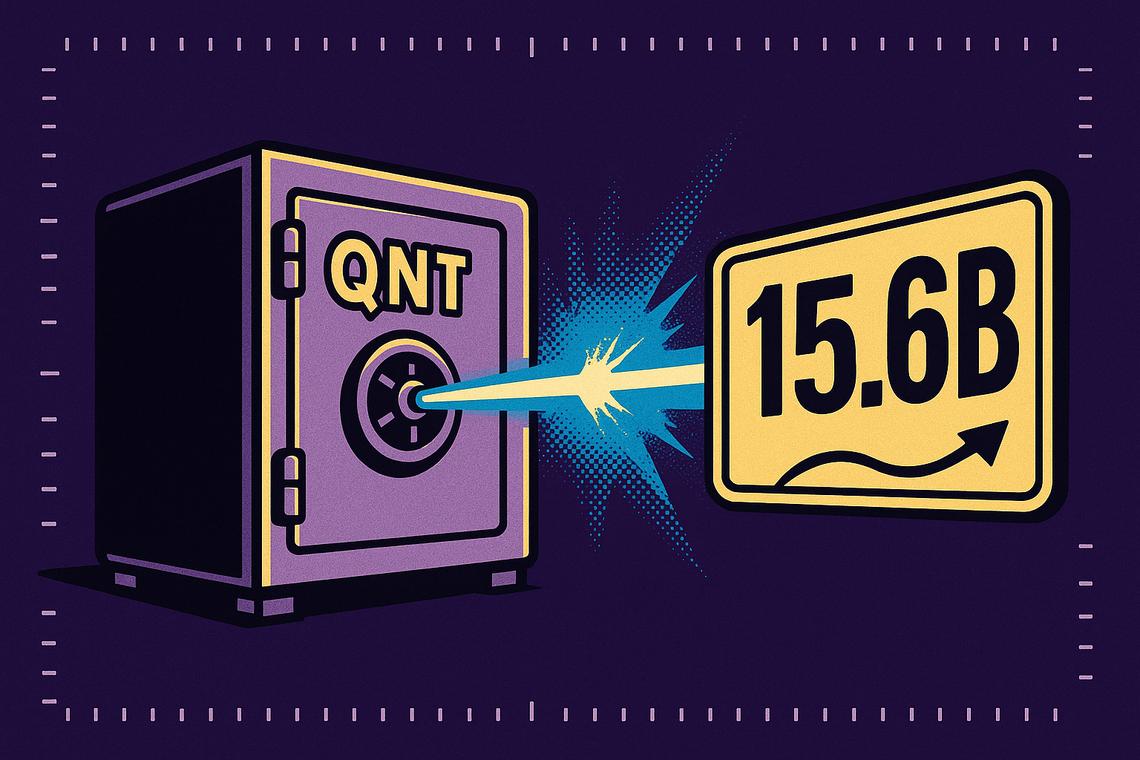
Quantinuum quantum computing IPO just gave the sector its biggest Wall Street moment yet. The Honeywell-backed quantum company priced its IPO at $60 per share on June 3, 2026, raised $1.68 billion, and landed a post-IPO valuation of $15.6 billion. For investors watching quantum computing move from theory to market reality, the numbers point to strong institutional demand and a clean traditional offering.
The scale of the deal stood out immediately. Quantinuum’s original fundraising target was $1.05 billion, but the company pushed that higher by more than 60% after upsizing the offering to 28 million shares. It also priced above its initial range of $53 to $55 per share. The company began trading on the Nasdaq Global Market under the ticker QNT the next day.
In practice, that makes Quantinuum’s debut one of the clearest signs yet that public markets are willing to back a full-stack quantum company with serious capital, especially when the business comes with Honeywell support and a growing policy tailwind.
Summary
Why the Quantinuum quantum computing IPO outperformed expectations
Pricing and trading details on Nasdaq
Pricing an IPO above the initial range usually signals strong institutional appetite. In Quantinuum’s case, the response was especially notable because quantum computing still feels speculative to many retail investors. Even so, the company’s $60 price per share exceeded the projected band and validated a valuation that climbed well beyond its pre-IPO target of $12.7 billion.
The final figure was $15.6 billion. That is the valuation Quantinuum now carries as a publicly traded company on Nasdaq under QNT.
How the fundraising compared with earlier targets
Quantinuum’s valuation path shows how quickly confidence in quantum computing has grown. An earlier private round valued the company at $5 billion. Then a $600 million private funding round in September 2025 lifted that to $10 billion. The IPO added another 56% on top of that September figure, reaching $15.6 billion.
That matters because very few deep-tech companies compress that kind of growth into such a short period. Moreover, the fact that a traditional IPO — rather than a SPAC or another private round — brought in nearly $1.7 billion with real institutional support marks a meaningful shift in how markets are treating quantum computing.
How Quantinuum was built
The 2021 merger that shaped the company
Quantinuum was formed in 2021 through the merger of Honeywell Quantum Solutions and Cambridge Quantum Computing. The structure of that merger helps explain why the company has drawn so much attention from investors and policymakers alike.
Honeywell brought hardware expertise and trapped-ion quantum processors, while Cambridge Quantum contributed software and algorithm capabilities. Together, they created an end-to-end platform that is unusual in the sector, where many competitors focus on only one side of the stack.
That combination has become one of Quantinuum’s biggest selling points. Investors looking at quantum computing are increasingly separating narrow technical plays from companies building integrated platforms, and Quantinuum fits squarely in the second group.
US government quantum funding adds momentum
What the $2 billion initiative means for Quantinuum
The IPO also benefited from a timely policy backdrop. On May 21, 2026, the US government announced a $2 billion quantum initiative, and Quantinuum is set to receive $100 million from that program.
Added to the $1.68 billion raised in the IPO, that gives Quantinuum approximately $1.78 billion in fresh capital. For a sector that has historically needed frequent fundraising to keep research, hiring, and commercialization moving, that is a significant cushion.
Beyond that, government backing at this scale signals that Quantinuum sits inside the broader national quantum strategy. For institutional investors, that kind of support can matter because it strengthens the company’s long-term positioning.
What Quantinuum means for Nasdaq quantum computing stocks
The public quantum computing market already includes IonQ, Rigetti Computing, and D-Wave Quantum. However, all three reached the market through SPAC mergers rather than traditional IPOs. IonQ, for example, went public via SPAC in 2021, bypassing the conventional roadshow process that comes with a standard offering.
Quantinuum’s path was different. A traditional IPO that raised close to $1.7 billion, with institutional demand baked into the price, gives the company a more conventional market debut. It also stands apart because Quantinuum combines Honeywell-backed quantum company status, full-stack hardware and software capabilities, confirmed US government quantum funding, and substantial capital deployment capacity.
As a result, Quantinuum enters the public market with a profile that is harder to replicate than any single technical advantage.
Frequently asked questions
What was the final IPO pricing for Quantinuum?
Quantinuum priced its IPO at $60 per share on June 3, 2026, above its initial range of $53 to $55.
How much funding did Quantinuum raise through its IPO?
Quantinuum raised $1.68 billion through its IPO, well above its initial $1.05 billion target, by upsizing the offering to 28 million shares.
What is Quantinuum’s valuation after going public?
Quantinuum’s post-IPO valuation is $15.6 billion, up from a $10 billion valuation in its September 2025 private funding round.
When was Quantinuum formed and through what merger?
Quantinuum was formed in 2021 through the merger of Honeywell Quantum Solutions and Cambridge Quantum Computing.
What government funding is Quantinuum receiving?
Quantinuum is set to receive $100 million from the US government’s $2 billion quantum initiative, which was announced on May 21, 2026.