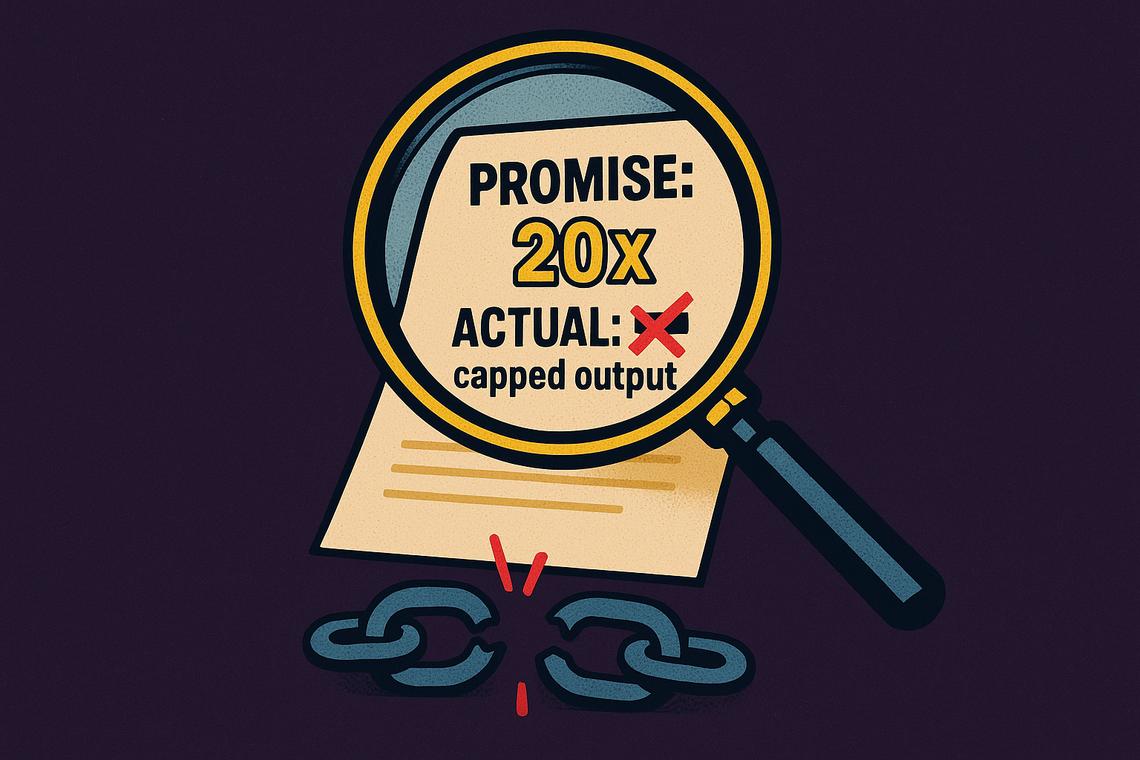
A legal dispute is putting Anthropic’s Claude AI subscription under the microscope, with consumers taking the company to court over what they say were misleading promises about how much they could actually use the service.
Summary
Key takeaways
- Anthropic has been sued by consumers over usage restrictions on its $200 per month Claude Max AI subscription plan.
- The lawsuit alleges that Anthropic made exaggerated promises about usage allowances when selling the subscription.
- The controversy centers on a gap between what subscribers were told they’d get and the limits they encountered in practice.
- The lawsuit was first reported by the Wall Street Journal and covered by Odaily on June 15, 2026.
- Anthropic is simultaneously facing separate regulatory pressure after a US government order to disable its most advanced AI models over national security concerns.
What Is the Claude Max Plan?
The Claude Max subscription is Anthropic’s most expensive consumer-facing tier, priced at $200 per month — billed annually at roughly $2,400 a year. The plan promises significantly higher usage capacity compared to cheaper tiers, marketed specifically at daily users who rely heavily on the Claude AI assistant for professional and personal tasks.
According to Business Insider reporting, the Max 20x plan — the tier at the center of the lawsuit — offers 20 times the usage capacity of Anthropic’s standard Pro plan per session. Below it sits a Max 5x plan at $100 per month, which offers five times the Pro capacity. For context, Anthropic’s basic Pro tier costs $20 per month, making the Max 20x plan ten times pricier.
Subscribers interviewed by Business Insider described the plan as a professional necessity. One user, Drew Dawson, a 23-year-old philosophy, politics, and economics student at the University of Southern California, said he used the plan to support multiple income streams and freelance gigs, despite calling the $400-a-month combined AI subscription bill “quite steep.” Others, like Sterling Cobb, CTO of FlowStay, go even further — running three Claude Max accounts alongside other AI services, spending over $1,000 a month total on AI subscriptions.
The Lawsuit: Promises vs. Reality
The core allegation is straightforward: consumers say Anthropic oversold what the subscription would deliver. According to the lawsuit, reported by the Wall Street Journal and flagged by Odaily on June 15, 2026, subscribers were led to believe they would receive generous usage allowances — and those promises did not hold up once they were paying customers.
The complaint centers on the gap between what buyers were told at the point of sale and the restrictions they encountered in practice. Specific details about the nature or extent of the usage caps involved have not been publicly confirmed, nor has Anthropic issued a public response to the claims.
This kind of dispute — over what “unlimited” or “high-capacity” usage actually means in a subscription context — is increasingly common in the AI industry. When companies compete aggressively to attract power users at premium price points, the language used to describe service levels can create legal exposure if real-world limits fall short of what was implied during the sales process.
Why This Matters for AI Subscription Services
The lawsuit arrives at a sensitive moment for Anthropic. The company recently confidentially filed for a US IPO, and is navigating a separate — and significantly more dramatic — dispute with the US government, which ordered Anthropic to disable its most advanced models, Fable 5 and Mythos 5, for all foreign nationals over national security concerns related to potential jailbreaking vulnerabilities.
That government order forced Anthropic to “abruptly disable” the two models for all users to ensure compliance, a decision the company publicly pushed back on, calling the action disproportionate. The combination of regulatory friction and now consumer litigation paints a complicated picture for a company on the path to public markets.
More broadly, the consumer lawsuit against the Claude Max subscription raises questions that extend well beyond Anthropic. AI service providers across the industry have attracted paying subscribers with language that emphasizes access and capacity. As those subscribers become more sophisticated — and more financially invested — disputes over what was actually promised are likely to multiply. A $200-per-month commitment is not an impulse purchase. Users at that price point tend to integrate the service deeply into their workflows, which makes any perceived shortfall in availability or performance feel like a direct economic loss.
Subscriber Expectations at Premium Price Points
The business reality is that power users of AI subscriptions often build their professional output around these tools. Dominik Martin, a 29-year-old product designer from southern Germany who holds five jobs simultaneously, told Business Insider he uses Claude Max to manage the workload across all of them — and that he’d consider paying as much as $1,000 per month if the capability justified it. Vincent Vukovic, a consultant from Stockholm, said his ceiling was around $250, while AI engineer Devin Hill from Nashville suggested he’d pay $300 to $500 if the value were there.
That willingness to pay reflects a level of dependency that makes usage restrictions particularly painful. When someone structures their income around a tool and then hits a wall mid-session, the frustration is immediate and measurable. That’s precisely the dynamic the lawsuit appears to be built around.
Whether the case proceeds as a class action or stays limited to the initial filers remains unclear, as do the identities of the plaintiffs and the jurisdiction in which the complaint was filed. Anthropic has not publicly addressed the allegations.
For a company that has publicly championed the idea of responsible AI deployment — and even called for greater US government oversight of AI risks — facing a consumer protection dispute over subscription terms adds an ironic layer to an already turbulent stretch. The legal outcome could set a precedent not just for Anthropic, but for how the entire premium AI subscription market defines and defends the promises it makes to users.
FAQ
What subscription plan is involved in the Anthropic lawsuit?
The lawsuit involves Anthropic’s $200 per month Claude Max AI subscription plan, specifically the Max 20x tier, which promises 20 times the usage capacity of Anthropic’s standard Pro plan.
What are the consumers alleging in the lawsuit against Anthropic?
Consumers allege that Anthropic made exaggerated promises about the usage allowances included with the subscription at the point of sale, meaning the actual service limits did not match what buyers were led to expect.
Who reported the lawsuit against Anthropic?
The lawsuit was originally reported by the Wall Street Journal and subsequently covered by Odaily on June 15, 2026.
Article produced with the assistance of artificial intelligence and reviewed by the editorial team.