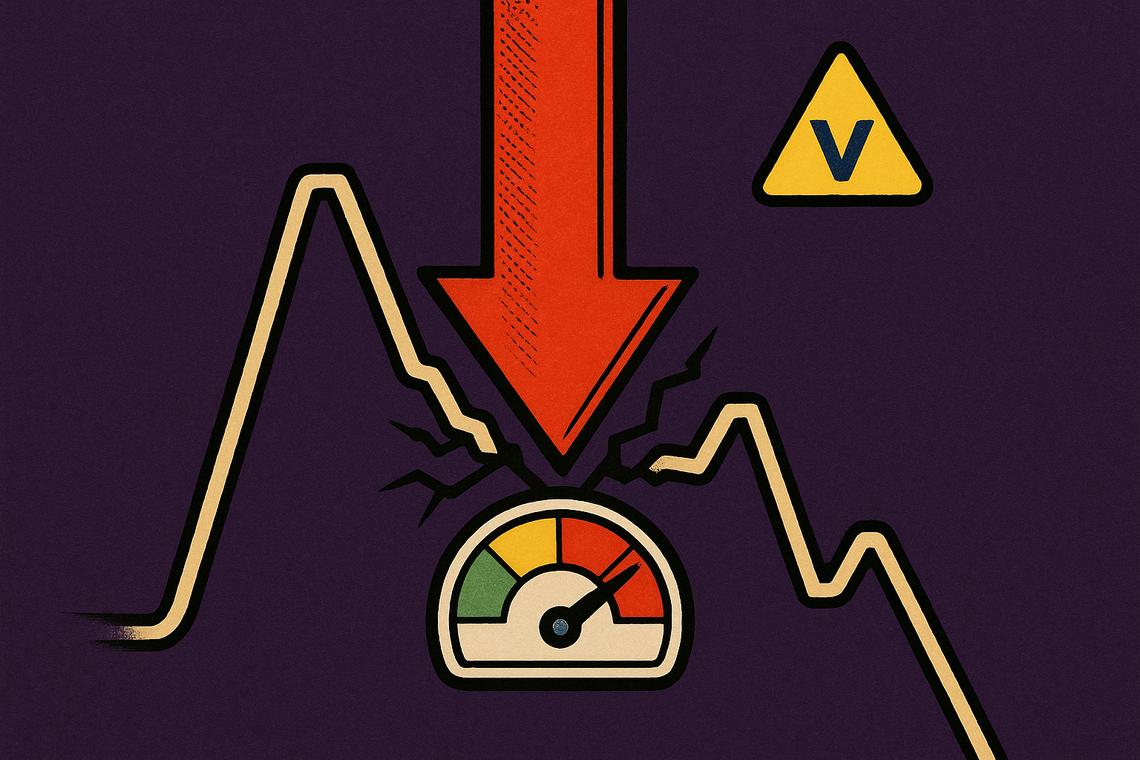
One day after SK Hynix became South Korea’s most valuable publicly traded company, the market that celebrated that milestone went into freefall. The speed and severity of the reversal captured something important about South Korea stock volatility in the current era: when the rally is this concentrated, so is the risk.
Summary
Key takeaways
- The KOSPI index fell 9.99% on June 23, closing at 8,204 points — its steepest single-day drop in over three months, triggering a trading halt.
- SK Hynix and Samsung Electronics each declined more than 12% on the day, dragging the broader index down due to their combined ~40–50% share of KOSPI’s market cap.
- The Kospi 200 Volatility Index spiked to around 75, far above its normal reading of approximately 20.
- SK Hynix reached a $1.35 trillion market capitalization on June 22, 2026, the day before the crash, making it South Korea’s most valuable listed company.
- The South Korean government is negotiating large-scale semiconductor investments to accelerate chip cluster construction to a revised target of 2034–2035, more than 10 years ahead of previous timelines.
Sharp Decline After a Rally That Doubled the Index
By June 2026, the KOSPI had surged more than 100% year-to-date, peaking above 9,000 points. That extraordinary run was almost entirely built on one story: insatiable demand for advanced memory chips used in AI data centers and training infrastructure. SK Hynix and Samsung Electronics were the engines of that rally, and when they stalled, the index had nowhere to hide.
On June 23, the KOSPI fell 9.99%, closing at 8,204 points in its steepest single-day decline in over three months. The sell-off was severe enough to trigger circuit breakers, halting trading for 20 minutes. SK Hynix and Samsung Electronics each shed more than 12% in the session, and given that the two chipmakers together represent roughly 40–50% of the entire index’s market capitalization, their losses became the market’s losses almost by arithmetic necessity.
This is the structural vulnerability embedded in the KOSPI’s recent configuration. An index so heavily weighted toward two names in a single industry isn’t really a broad market benchmark anymore — it behaves closer to a concentrated sector fund. When the thesis powering those two names gets questioned, the entire index absorbs the shock.
Record Volatility Highlights Market Uncertainty
The fear gauge told the full story. The Kospi 200 Volatility Index, South Korea’s equivalent of Wall Street’s VIX, spiked to around 75 — more than three times its normal reading of approximately 20. That kind of volatility reading doesn’t signal a routine correction. It signals a market that has lost its footing.
The June 23 session wasn’t an isolated event. The KOSPI had already experienced violent swings in preceding days, including drops of 8–9% followed by sharp rebounds, suggesting that speculative positioning had become deeply unstable well before the largest single-day plunge landed.
Part of what amplified the move was the nature of money that had poured into South Korean equities during the AI-driven rally. Leveraged trading products, which magnify returns on the way up, do the same on the way down — and a market that rode leverage to a 100% year-to-date gain is one that can give back a significant portion of that gain very quickly when sentiment shifts.
Regulatory Scrutiny Enters the Picture
South Korean regulators have responded to the turbulence by increasing scrutiny on leveraged trading products. The move signals official concern that speculative capital, not fundamental demand, was doing a meaningful share of the work driving prices higher.
Tightening the rules around leveraged instruments is a double-edged intervention. It could reduce the risk of another violent unwind of this kind, but it may also remove a key source of buying pressure that sustained the rally in the first place. If speculative capital exits as a result of stricter oversight, the KOSPI would need genuine long-term institutional demand to fill that gap — and whether that demand exists at current valuations remains an open question.
Government Semiconductor Investments Accelerate
The sell-off hasn’t rattled South Korea’s longer-term strategic ambitions. The government is actively negotiating large-scale semiconductor investments with both Samsung Electronics and SK Hynix, with an official announcement expected. The scale being discussed involves hundreds of billions of dollars across a broader cluster initiative, of which SK Hynix’s previously announced $15 billion investment in new semiconductor facilities — committed in February 2026 — appears to be an early component.
Presidential policy adviser Kim Yong-beom pointed to surging AI-driven demand as justification for compressing construction timelines for a planned chip cluster by more than 10 years, with a revised target completion date of 2034–2035. That acceleration is a significant signal: it suggests the government views the current AI infrastructure buildout not as a temporary boom but as a structural, multi-decade shift in global technology.
One area receiving specific attention is the Honam region, including potential semiconductor packaging facilities in Gwangju. That geographic choice reflects the administration’s interest in distributing the economic benefits of the chip boom across the country, not concentrating them in a single industrial corridor.
Defensive and Offensive at the Same Time
South Korea’s semiconductor push carries a dual logic. The US, Japan, and the EU have all launched their own chip subsidy programs in recent years, each trying to reduce dependency on supply chains concentrated in a small number of Asian producers. Seoul’s accelerated investment plan can be read as a defensive move — protecting existing market share — and as an offensive one, expanding capacity before competing subsidy-backed programs can close the gap.
Whether the compressed 2034–2035 timeline is achievable, and what the broader national investment framework ultimately looks like in concrete commitments, remains to be seen. The strategic intent is clear; the execution details are still being negotiated.
SK Hynix’s Milestone and What It Represents
The timing of SK Hynix’s market cap milestone — reaching $1.35 trillion on June 22, 2026, to become South Korea’s most valuable publicly traded company — now looks almost cinematic given what followed 24 hours later. A 5.6% surge to a historic peak, then a 12%-plus drop the next session.
The business case for SK Hynix is real. Its dominance in high-bandwidth memory (HBM) chips — the specialized components that power AI training and inference workloads — gives it a structural position at the center of the most important technology buildout happening globally right now. No serious AI data center operates without large quantities of HBM, and SK Hynix is the category’s dominant supplier.
The harder question isn’t whether SK Hynix’s technology matters. It clearly does. The harder question is whether a 100%-plus year-to-date rally in the broader index, built almost entirely on that one narrative, had priced in too much of the future too quickly. Tuesday’s session suggested that at least some investors think the answer is yes.
The volatility South Korea’s market is experiencing right now reflects a genuine tension: between a chip industry with strong long-term fundamentals and a stock market that may have run well ahead of even the most optimistic version of those fundamentals. Government investment plans can strengthen the former. They don’t automatically resolve the latter.
FAQ
Why did the KOSPI index experience a sharp decline on June 23, 2026?
The decline was driven primarily by SK Hynix and Samsung Electronics each falling more than 12% in a single session. Because those two companies together account for roughly 40–50% of the KOSPI’s total market capitalization, their losses translated directly into a near-10% drop for the entire index.
What caused the high volatility in South Korea’s stock market recently?
The Kospi 200 Volatility Index spiked to around 75, compared to a normal reading of approximately 20. The surge in volatility reflected rapid and extreme price swings across multiple sessions, amplified by leveraged trading products that are now under increased regulatory scrutiny from South Korean authorities.
What are the South Korean government’s plans for semiconductor industry investments?
The government is negotiating large-scale investments with SK Hynix and Samsung to build a major semiconductor cluster. Construction timelines have been compressed by more than 10 years, with a revised target completion date of 2034–2035. The Honam region, including potential packaging facilities in Gwangju, is among the areas receiving specific focus.
How has SK Hynix’s market position changed recently?
On June 22, 2026, SK Hynix became South Korea’s most valuable publicly traded company, reaching a market capitalization of approximately $1.35 trillion following a 5.6% surge. The milestone reflects its dominant position in high-bandwidth memory chips, which are essential for AI training and inference workloads globally.
Article produced with the assistance of artificial intelligence and reviewed by the editorial team.