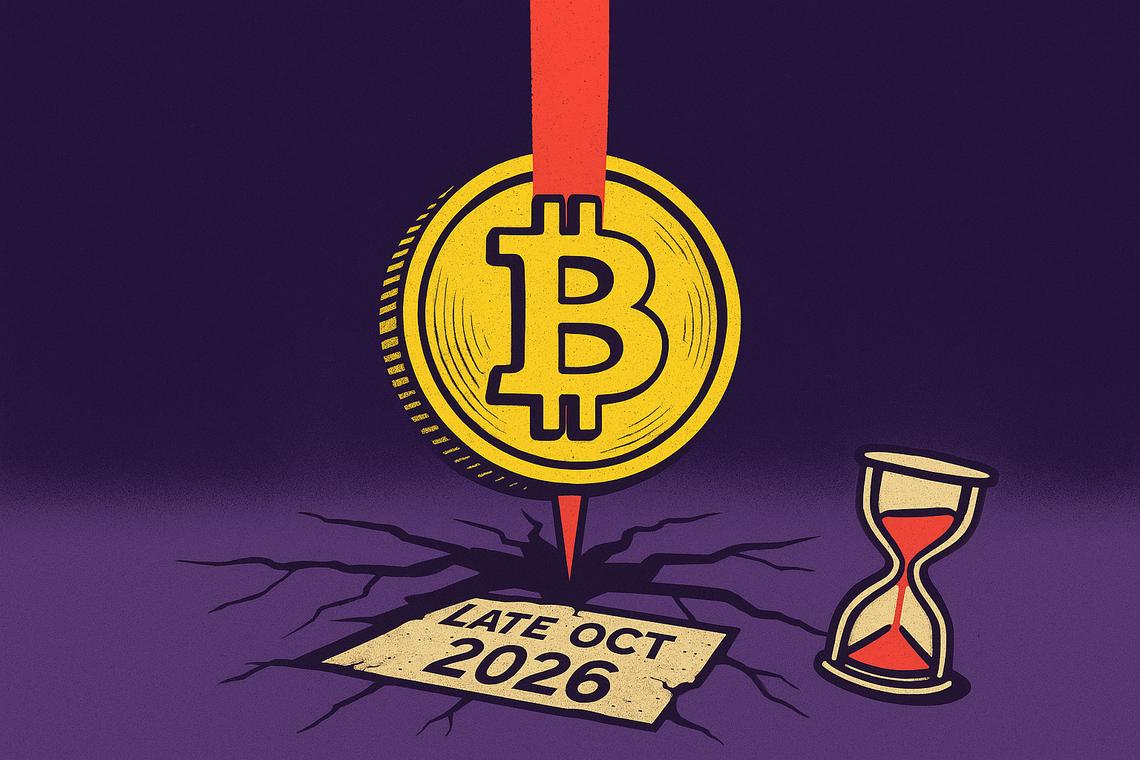
Wall Street research firm Cantor Fitzgerald has drawn a precise timeline on the current bitcoin bear cycle, projecting that the market could finally hit its cyclical floor around late October 2026 — a conclusion built not on speculation, but on the hard arithmetic of three prior crypto downturns.
Summary
Key takeaways
- Cantor Fitzgerald projects Bitcoin’s bear cycle bottom around late October 2026, based on historical cycle averages.
- Bitcoin was trading near $59,500 as of the report, roughly 252 days past its 2025 peak and down about 51%.
- Historical data shows Bitcoin typically bottoms an average of 384 days after a peak — placing the expected floor in late October 2026.
- Cantor advises shifting from speculative positions to blockchain networks with fee-based, sustainable value capture, singling out Hyperliquid as a standout model.
- SEC regulatory clarity and ETF infrastructure remain the most consequential recovery catalysts, according to the firm’s analysis.
Cantor Fitzgerald’s Bitcoin Bear Cycle Forecast
The math behind Cantor’s call is straightforward. As of June 10, Bitcoin was trading 252 days after its 2025 peak, having shed roughly 51% of its value. Across the three previous market cycles, the firm found that Bitcoin historically reached its nadir an average of 384 days after a peak. Running that calculation forward puts the expected bottom somewhere in late October 2026 — still roughly four to five months away from the time of reporting.
Cantor was careful not to frame this as a guaranteed outcome. Macroeconomic conditions, regulatory developments, and geopolitical tensions could all compress or extend the timeline. But the firm noted that crypto’s pattern-repeating tendencies give the historical framework meaningful predictive weight.
Where Bitcoin stands right now
At press time, Bitcoin was changing hands near $59,500. That number tells most of the story: a market that peaked with considerable momentum in late 2025 has spent the better part of a year grinding lower. A sharp June correction — driven by ETF capital withdrawals, higher borrowing costs, and reduced risk appetite — pushed BTC more than 50% below its late-2025 record. Ether and most major altcoins underperformed Bitcoin during the drawdown, though decentralized finance protocols and asset tokenization projects showed pockets of relative resilience.
Why the Timing Matters for Investors
Four months is not a long time in traditional markets. In crypto, it can feel like an era. The implication of Cantor’s forecast is that investors who act before a confirmed bottom — rather than after one — may be positioning themselves during the most favorable entry window of the current cycle.
That said, the firm stopped well short of calling a precise bottom date. The 384-day average is drawn from a limited sample of prior cycles, and conditions that are genuinely new — including the growing influence of spot Bitcoin ETFs and institutional treasury strategies — could meaningfully alter how this cycle resolves. Macroeconomic turbulence and regulatory ambiguity remain the two primary downside threats, while enhanced ETF infrastructure and a more favorable market structure represent the key upside catalysts.
Investment Strategy Shifts and Emerging Opportunities
With markets approaching what Cantor calls an inflection point, the firm is pushing investors to rethink where they allocate within the digital asset space. The core message: move away from speculative bets and toward blockchain networks with sustainable value capture mechanisms.
Transaction volume alone, the firm argues, does not guarantee token appreciation. What matters is whether a network can convert that activity into steady revenue streams or durable monetary demand. Projects that do are better positioned to survive and thrive in the recovery phase.
Hyperliquid, Bitcoin, and Ethereum as benchmarks
Hyperliquid drew specific praise as the clearest example of fee-based token economics in the current market. Its buyback and burn mechanism — where protocol fees are used to reduce token supply — represents the kind of model Cantor believes investors should prioritize. Bitcoin was recognized as the foundational monetary asset of the ecosystem, while Ethereum earned designation as the premier collateral infrastructure for on-chain financial systems.
Solana, Sui, XRP, and Zcash were each acknowledged for possessing distinct competitive advantages, though Cantor noted these networks still need to demonstrate they can translate ecosystem growth into lasting token value.
Digital asset treasury corporations and new coverage
The firm also spotlighted an underappreciated investment category: digital asset treasury corporations. These companies are evolving beyond simple custody operations toward active yield generation and infrastructure building — a shift that Cantor sees as materially undervalued by the market.
In a direct move tied to that thesis, Cantor launched coverage of Forward Industries and Cypherpunk Technologies, both with overweight recommendations. Price targets were set at $7.90 for Forward Industries and $0.90 for Cypherpunk Technologies.
Regulatory Impact and Market Recovery Catalysts
No analysis of crypto’s recovery path is complete without addressing regulation — and Cantor’s is no exception. Regulatory transparency from the SEC is identified as a critical factor for increased market participation. Without it, institutional capital that might otherwise enter the space remains on the sidelines, regardless of what historical cycle data suggests.
CoinShares data shows that BTC-focused investment vehicles dominated net capital inflows to cryptocurrency products throughout 2026, reflecting where institutional conviction is consolidating even amid the downturn. And Nasdaq reported IPO volume reaching $129.3 billion on its exchange in the first half of 2026 — a signal that capital markets broadly are not in retreat mode, which could support a faster rotation back into risk assets like Bitcoin once macro conditions stabilize.
The convergence of a historically-guided bear cycle timeline, clearer institutional infrastructure, and a slowly improving regulatory environment gives Cantor’s late-2026 forecast more structural support than a simple pattern match. Whether that support holds depends heavily on what the SEC does next — and on how well crypto projects like Hyperliquid continue to demonstrate that digital assets can generate real, sustainable economic value rather than just price momentum.
FAQ
When does Cantor Fitzgerald predict Bitcoin’s bear cycle will end?
Cantor Fitzgerald predicts the Bitcoin bear cycle could conclude by late October 2026, based on historical cycle analysis showing Bitcoin typically bottoms an average of 384 days after a peak.
What factors could modify the predicted Bitcoin bear market timeline?
Macroeconomic conditions, regulatory developments, and geopolitical tensions could all alter the bear cycle timing, potentially shortening or extending the path to a bottom.
What investment strategy does Cantor Fitzgerald recommend during this market phase?
Cantor Fitzgerald advises shifting from speculative bets to investing in blockchain networks with sustainable value capture mechanisms, highlighting Hyperliquid’s fee-based model with buyback and burn as a standout example.
Why is regulatory clarity important for the crypto market recovery?
Regulatory transparency, especially from the SEC, is critical to increasing institutional market participation and supporting recovery. Without it, large pools of capital remain unable or unwilling to enter the space, limiting the speed and scale of any rebound.
Article produced with the assistance of artificial intelligence and reviewed by the editorial team.