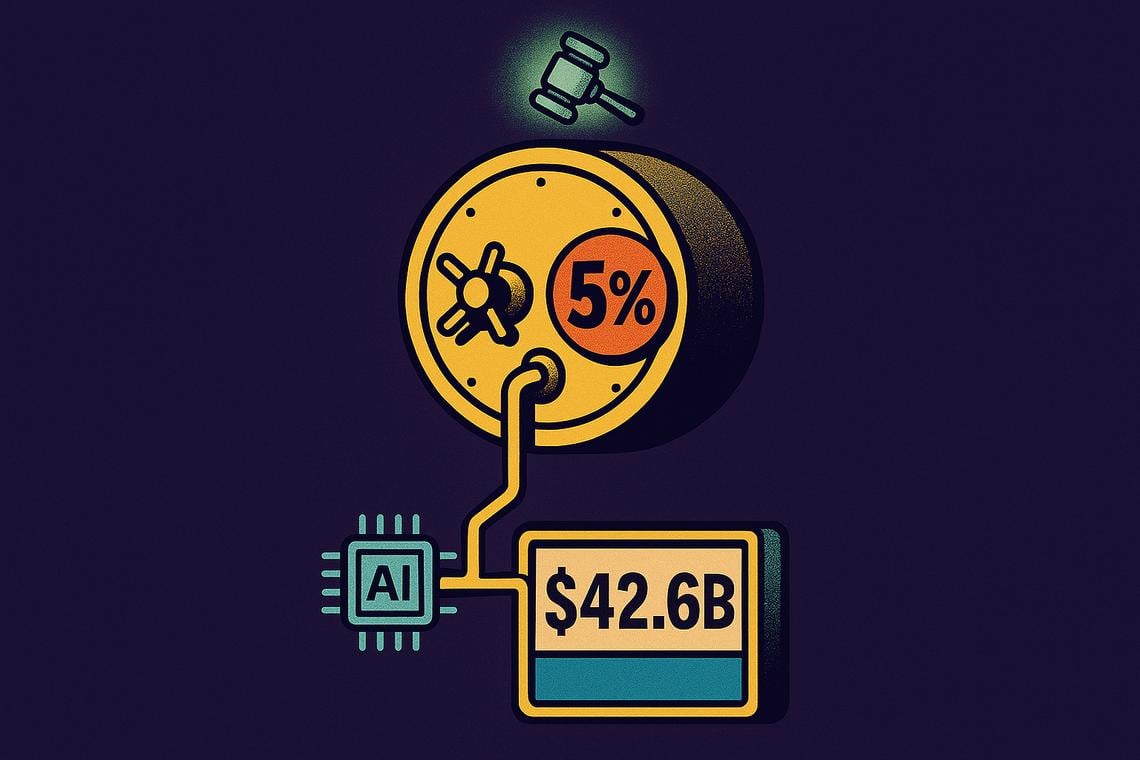
OpenAI is reportedly in talks to hand the U.S. government a 5% ownership stake in the company — a move that, if confirmed, would be worth roughly $42.6 billion based on the AI lab’s most recent post-money valuation of $852 billion. The proposal, first reported by the Financial Times, frames the equity offer not just as a political concession but as a broader argument that the public deserves a financial stake in the AI revolution. Neither OpenAI nor the White House has confirmed the negotiations.
Summary
Key takeaways
- OpenAI is negotiating to give the U.S. government a 5% equity stake, worth approximately $42.6 billion at the company’s $852 billion valuation.
- CEO Sam Altman has held talks with President Trump, Commerce Secretary Howard Lutnick, Treasury Secretary Scott Bessent, and Senator Bernie Sanders.
- The proposed framework could extend to other leading U.S. AI companies, including Anthropic, Google, and Meta.
- Senator Sanders supports the American AI Sovereign Wealth Fund Act, which could potentially reach $7 trillion in value.
- The discussions remain in preliminary stages and are unconfirmed by both OpenAI and the White House.
OpenAI’s Pitch and the People Behind the Talks
Sam Altman has been doing the rounds in Washington. The OpenAI CEO reportedly pitched the equity concept directly to the Trump administration as early as 2025, and discussions have continued through mid-2026. His recent conversations have included President Donald Trump, Commerce Secretary Howard Lutnick, Treasury Secretary Scott Bessent, and Senator Bernie Sanders — a politically diverse list that signals just how broadly OpenAI is trying to build support.
According to the Financial Times, Altman framed the stake as the most practical way to give ordinary Americans a financial interest in AI’s economic upside. In April, OpenAI had already floated the idea of a “public wealth fund” that would hold assets tied to AI company growth and distribute the benefits more widely. The government equity proposal appears to be an evolution of that thinking — a direct structural offer rather than a conceptual one.
Trump himself has publicly described the U.S. taking ownership stakes in AI giants as “a beautiful thing” that would make Americans “partners in this revolution.” That framing matters: it suggests the administration sees ideological alignment with the idea, even if the details remain unresolved.
Why Washington Is Paying Attention Now
The timing isn’t accidental. Pressure on major U.S. AI firms has been building as Washington grows increasingly concerned about cybersecurity vulnerabilities, the rapid expansion of AI data centers, and the rise of competitive Chinese open-source models that are proving nearly as capable as top American alternatives at a fraction of the cost. Anthropic, for instance, was forced to temporarily disable access to its most advanced Mythos and Fable models last month to comply with an export control directive, before being cleared to restore access after addressing policymakers’ safety concerns.
For OpenAI, offering the government a financial stake may serve a dual purpose: it could reduce regulatory friction while repositioning the company as a partner in U.S. strategic interests rather than a private actor operating above public accountability.
A Framework That Could Reshape the Entire AI Industry
The equity proposal doesn’t stop at OpenAI. The broader arrangement Altman reportedly pitched envisions Washington holding a 5% stake in each of the leading U.S. AI developers through a government vehicle — effectively a sovereign wealth fund structure applied to the AI sector. Companies named in connection with this framework include Anthropic, Google, and Meta, though it remains unclear whether any of them would agree to the terms.
Sanders and the $7 Trillion Fund
Senator Bernie Sanders has been one of the more vocal advocates for redistributing AI wealth. His American AI Sovereign Wealth Fund Act goes further than the OpenAI proposal, envisioning a fund that could potentially reach approximately $7 trillion in value. Sanders has consistently argued that AI profits should not remain concentrated among a narrow group of tech executives — a position that gives the equity-stake concept bipartisan political traction, even if from very different ideological angles.
The convergence of Sanders’ legislative push and the Trump administration’s apparent appetite for government ownership in AI companies creates an unusual political alignment. Both sides are reaching the same conclusion — that the public should benefit from AI’s economic gains — through very different motivations.
The Trump Administration’s Growing Portfolio in Strategic Industries
If a deal with OpenAI materializes, it would fit a pattern the current administration has been building for over a year. The government has already been acquiring meaningful equity positions across sectors it considers strategically vital.
In 2025, the U.S. government purchased 433.3 million Intel shares at $20.47 per share, investing $8.9 billion for a 9.9% stake — a transaction tied to CHIPS Act funding. With Intel’s stock trading near $127 at the time of these reports, that investment has grown to approximately $55 billion in value, representing roughly a 6.2x return. Trump has since publicly said he regrets not asking for a larger stake.
Beyond Intel, the administration holds:
- A 15% stake in MP Materials, a rare earth mining company
- A 10% position in Lithium Americas
- A 10% stake in Trilogy Metals
- A “golden share” in U.S. Steel, granting veto authority over major corporate decisions without traditional equity ownership
The Intel investment, in particular, has become a reference point for how lucrative early government equity positions in strategic tech companies can be. It also explains why Trump expressed public regret over not negotiating harder — and why OpenAI’s offer of 5% in a company valued at $852 billion is likely to be met with serious interest, and possibly a counteroffer for something larger.
What a 5% Stake Would Actually Mean
The math is striking on its own. A 5% holding in OpenAI at its current valuation translates to roughly $42.6 billion — more than four times the government’s initial outlay for Intel, and in a company widely viewed as one of the most consequential technology firms of this generation.
But the implications go beyond the dollar figure. Government ownership in a leading AI company would raise immediate questions about OpenAI’s operational independence, its data governance, and how the company navigates future regulatory decisions when one of its shareholders is also its regulator. These are questions the inputs leave deliberately open — and they’re likely to define the negotiation’s real sticking points far more than the percentage itself.
For the broader AI industry, the precedent could be transformative. If OpenAI agrees and the framework extends to Anthropic, Google, and Meta, the U.S. government would effectively hold a financial stake in the most powerful AI systems on the planet — a structural shift in the relationship between Washington and Silicon Valley that no previous administration has attempted at this scale. Whether that serves as a stabilizing force or a new source of friction may depend entirely on how the governance terms are written.
FAQ
What is the proposed ownership stake for the U.S. government in OpenAI?
OpenAI is negotiating to grant the U.S. government a 5% ownership stake in the company, which would be worth approximately $42.6 billion based on OpenAI’s most recent valuation of $852 billion.
Who are the key government figures involved in the talks with OpenAI?
CEO Sam Altman has met with President Donald Trump, Commerce Secretary Howard Lutnick, Treasury Secretary Scott Bessent, and Senator Bernie Sanders regarding the equity arrangement.
Will other U.S.-based AI companies be required to grant ownership stakes to the government?
The proposed equity framework envisions other leading U.S. AI companies — including Anthropic, Google, and Meta — ceding similar 5% stakes through a government vehicle. However, participation remains uncertain and no company outside OpenAI has confirmed involvement.
What legislation supports profit sharing from AI companies with the public?
Senator Bernie Sanders supports the American AI Sovereign Wealth Fund Act, which could create a fund potentially reaching approximately $7 trillion in value, designed to distribute AI-generated profits more broadly to the American public.
Article produced with the assistance of artificial intelligence and reviewed by the editorial team.