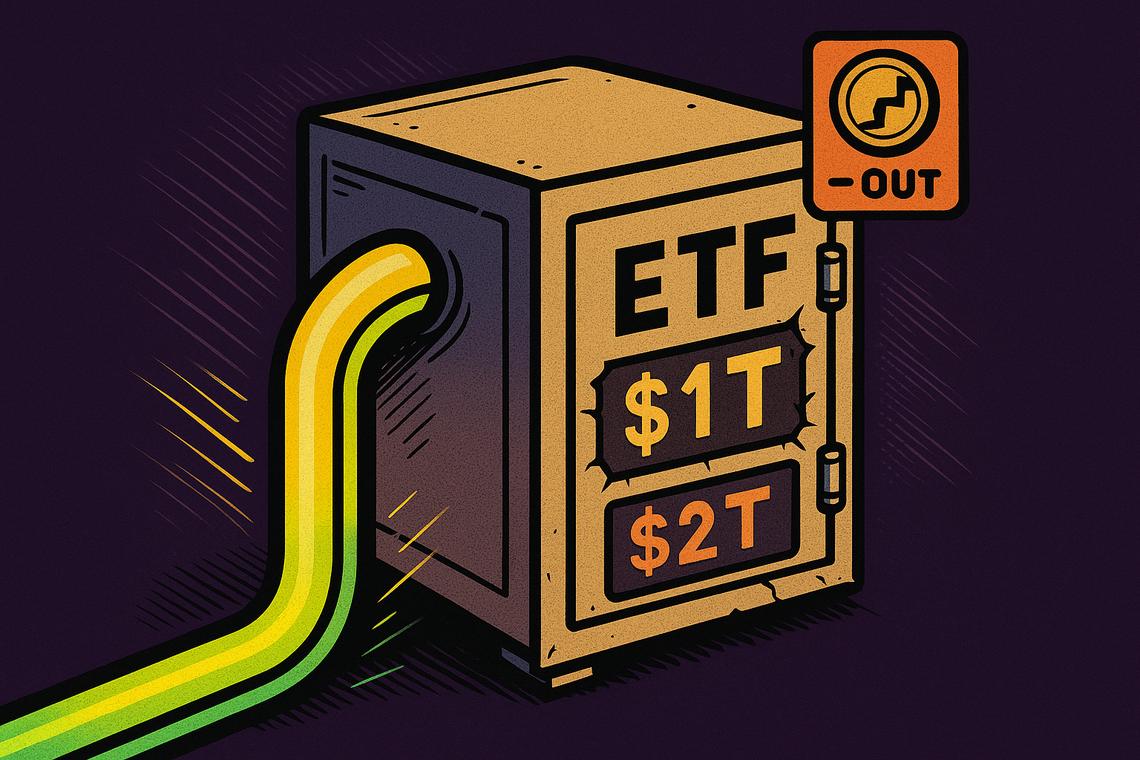
The US exchange-traded fund industry just crossed a threshold that felt theoretical not long ago. ETF inflows growth has been so relentless in 2026 that US-listed ETFs surpassed $1 trillion in net inflows before the calendar reached July — a milestone Goldman Sachs flagged as evidence of what it describes as full-scale growth in a wrapper that has systematically eaten the investment world.
Summary
Key takeaways
- US-listed ETFs crossed $1 trillion in net inflows before July 2026, with the industry potentially on pace for $2 trillion by year-end.
- June 2026 alone generated roughly $210 billion in net inflows, with $103 billion going into equity ETFs.
- Vanguard’s S&P 500 ETF (VOO) pulled in approximately $78 billion year to date through June 2026.
- Actively managed ETFs accounted for about 36% of all 2026 inflows, a striking shift for an industry built on passive indexing.
- Bitcoin ETFs saw roughly $4.21 billion in net outflows during late May and early June 2026, sharply diverging from the broader ETF boom.
Record Inflows Propel US-Listed ETFs Past $1 Trillion
The speed of this milestone is what makes it significant. The ETF industry is now on track to potentially hit $2 trillion in annual inflows by the end of 2026 — which would mark a fourth consecutive year of record growth. That is not a rounding error. That is a structural transformation of where Americans, and increasingly institutions globally, are putting their money.
Monthly and Year-to-Date Inflow Trends
June 2026 alone tells the story. The month generated roughly $210 billion in net inflows across all ETF categories. To put that single-month figure in context: there are entire years in the ETF industry’s earlier history where total annual inflows did not reach that level.
Of that June total, $103 billion flowed into equity ETFs, with technology-focused and S&P 500 products doing the heaviest lifting. The demand is not spreading evenly — it is concentrating in a handful of familiar, large-cap buckets.
Equity ETFs Leading Growth
No single fund illustrates this concentration more vividly than Vanguard’s S&P 500 ETF (VOO), which attracted approximately $78 billion year to date through June 2026. That figure, for one fund tracking one index, captures how lopsided the inflow picture has become. VOO absorbing that much capital in six months means an enormous amount of price-insensitive buying flowing into the 500 largest US companies — a dynamic that carries its own long-term implications.
Active Management Gains Traction Within the ETF Market
Actively managed ETFs are having a genuine breakout moment, and it cuts against the conventional wisdom about why ETFs became popular in the first place.
Actively managed strategies accounted for about 36% of all 2026 inflows — a share that would have seemed improbable when ETFs were essentially synonymous with passive index tracking. The active ETF surge suggests investors are not just seeking cheap beta. They want the structural advantages of the ETF wrapper — tax efficiency, intraday liquidity, transparent holdings — combined with active stock selection or tactical allocation.
Changing Investment Strategies
This is worth pausing on. The ETF structure originally disrupted the asset management industry by stripping out cost and complexity. Now that structure is being used to package active strategies that were previously locked inside mutual funds or separate accounts. The wrapper has become the product, regardless of what sits inside it. That shift has meaningful implications for how asset managers compete going forward — and for how advisors build portfolios.
Crypto ETFs Face Net Outflows Despite Growing Infrastructure
While traditional ETFs celebrated a trillion-dollar milestone, crypto ETFs moved in the opposite direction. Bitcoin and Ethereum ETFs experienced net outflows during late May and early June 2026 — a conspicuous absence from what is otherwise an industry-wide celebration.
Outflows in Bitcoin and Ethereum ETFs
Approximately $4.21 billion was withdrawn from Bitcoin ETF products alone during that stretch. The contrast is stark enough to demand explanation. Spot Bitcoin ETFs launched to enormous fanfare. Goldman Sachs itself filed for Bitcoin ETF products and previously increased its stakes in crypto-related funds. The regulatory infrastructure for institutional crypto adoption is now in place.
Yet the capital did not follow. At least not yet.
Comparing Crypto and Traditional ETF Trends
The divergence between traditional and crypto ETF flows points to something more uncomfortable than a short-term dip. Crypto ETFs were positioned as the next great growth engine for the industry — the category that would bring digital assets into mainstream portfolios the same way equity ETFs brought index investing to retail investors. The infrastructure exists. The product exists. What appears to be missing, at this moment, is sustained institutional conviction.
That gap matters because it suggests mainstream capital has not yet treated digital assets as a permanent portfolio allocation. Temporary outflows can reverse. But a structural mismatch between available product and investor appetite is a harder problem to solve with marketing.
Structural Shifts and Risks in the ETF Market
Underneath the record numbers, a deeper transition is playing out. ETFs are systematically replacing mutual funds as the default investment vehicle for both retail and institutional investors. The advantages are well established — lower expense ratios, better tax efficiency, intraday liquidity, and transparent holdings. But the pace of that replacement has accelerated sharply.
ETFs Replacing Mutual Funds
Financial advisors have driven much of this acceleration. As fee-based advisory models replaced commission-based brokerage, advisors lost the incentive to recommend loaded mutual funds and gained every structural reason to use low-cost ETFs as portfolio building blocks. That advisory shift is not cyclical. It is a one-way door, and the $1 trillion milestone before July reflects just how far that door has swung open.
Crowding Concerns in Large-Cap Equity ETFs
The risk that comes with this scale is not hard to identify, even if it is hard to quantify. The concentration of inflows into US large-cap equity ETFs — and into VOO specifically — raises familiar concerns about crowding. When a single fund pulls in $78 billion over six months, the buying pressure it creates in the underlying stocks is largely price-insensitive. Passive flows do not pause to ask whether valuations are stretched. They buy because money came in, full stop.
If the ETF industry does reach $2 trillion in annual inflows by year-end, that question of concentration will only grow louder. The record itself is not the risk. What gets done with the record is.
FAQ
What milestone did US-listed ETFs achieve in net inflows before July 2026?
US-listed ETFs surpassed $1 trillion in net inflows before July 2026, a milestone Goldman Sachs described as evidence of full-scale growth in the ETF industry.
Which ETF attracted the most inflows year-to-date in 2026?
Vanguard’s S&P 500 ETF (VOO) attracted approximately $78 billion in inflows year to date through June 2026, making it the standout single-fund destination for investor capital.
How have crypto ETFs performed compared to traditional ETFs in 2026?
Bitcoin and Ethereum ETFs experienced net outflows in late May and early June 2026, with roughly $4.21 billion withdrawn from Bitcoin ETFs alone during that period — sharply contrasting with the record inflows flowing into traditional equity ETFs.
What structural shift is impacting the investment landscape regarding ETFs?
ETFs are systematically replacing mutual funds as the default investment vehicle for both retail and institutional investors, driven by lower costs, tax efficiency, intraday liquidity, and a structural shift in how financial advisors build and charge for portfolios.
Article produced with the assistance of artificial intelligence and reviewed by the editorial team.