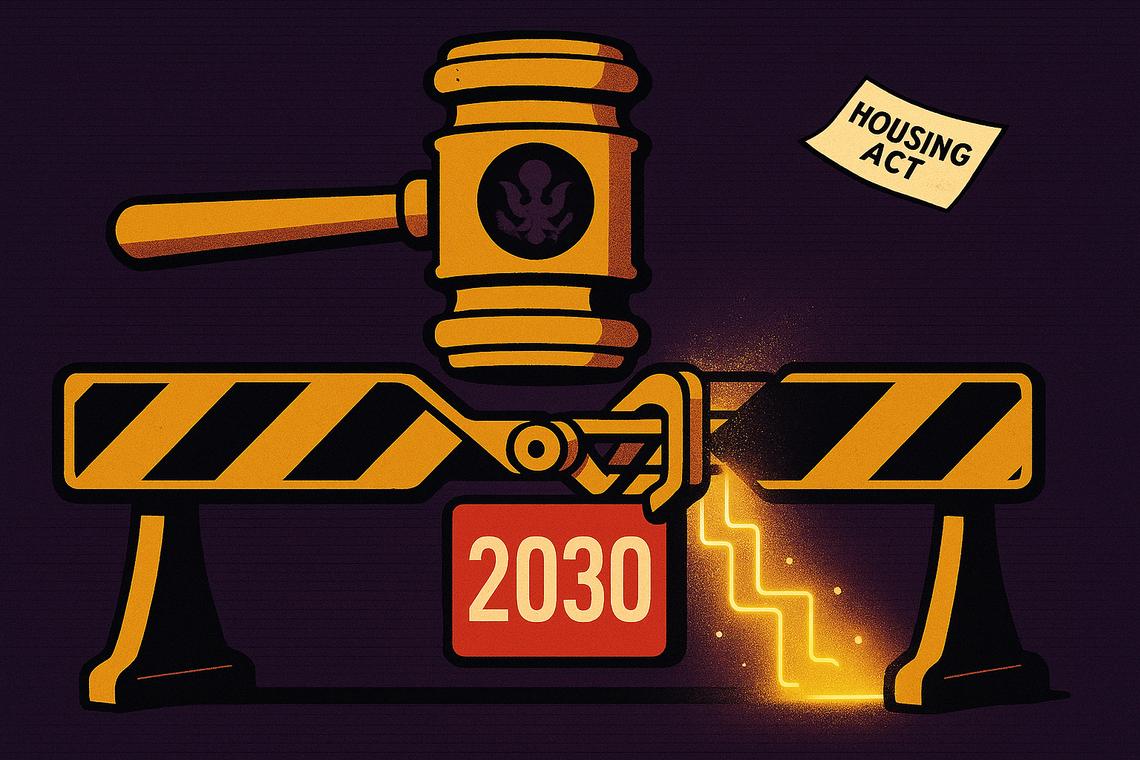
A US digital dollar ban just became one of the more unusual footnotes in American legislative history — buried inside a housing bill, signed by no one, and set to become law anyway. As of Friday night, the 21st Century ROAD to Housing Act takes effect automatically, carrying with it a four-year prohibition on the Federal Reserve issuing any form of central bank digital currency.
Summary
Key takeaways
- A four-year ban on a U.S. CBDC is now embedded in the housing-affordability bill, blocking the Federal Reserve from issuing a digital dollar until the end of 2030.
- President Trump refused to sign the bill but did not veto it, so it becomes law automatically after a 10-day constitutional window.
- Republicans inserted the CBDC prohibition into unrelated housing legislation, not a standalone digital currency bill.
- The Federal Reserve had no active plans to issue a digital dollar before the ban, and had previously said any such effort would require congressional authorization.
- The crypto industry strongly opposes a U.S. CBDC, arguing it would compete with privately issued stablecoins.
Four-Year Ban on a U.S. Central Bank Digital Currency Enacted
The Federal Reserve cannot issue a digital dollar until at least the end of 2030. That is now federal law — not through a landmark crypto bill or a dedicated monetary policy debate, but through a provision tucked into housing legislation primarily designed to boost residential construction and limit institutional investor purchases of homes.
Republicans managed to insert the CBDC prohibition into the 21st Century ROAD to Housing Act, a bill focused on cutting regulations and addressing affordability in the U.S. housing market. The digital currency restriction was not the bill’s purpose, but it will be among its most lasting consequences for financial markets and monetary policy.
The ban expires at the end of 2030. By that point, the chances of a Fed-issued digital currency having reached launch-ready status were already slim. The central bank had repeatedly said that issuing a CBDC would require explicit authorization from Congress — authorization that has never had wide support on Capitol Hill. Even before Kevin Warsh took the helm as Federal Reserve Chair, prior leadership had consistently signaled limited appetite for a digital dollar without a clear political mandate.
How a Housing Bill Became a Crypto Policy Milestone
The CBDC provision did not arrive through the front door. Republicans had previously attempted to attach similar restrictions to a range of unrelated legislation, including the Foreign Intelligence Surveillance Act. The housing bill ultimately became the vehicle that worked.
That strategy reflects how politically toxic the idea of a government-issued digital dollar has become in Washington — at least on one side of the aisle. A U.S. CBDC has drawn fierce opposition from crypto advocates and privacy groups alike, who argue it would give federal authorities unprecedented visibility into Americans’ financial transactions. For the crypto industry specifically, the concern is more competitive: a digital dollar backed by the full faith of the U.S. government could undercut the market for privately issued stablecoins.
Political Context and Legislative Process
Trump publicly opposed the housing bill but chose not to formally veto it — a distinction that carries real constitutional weight. Under the U.S. Constitution, once Congress passes a bill and sends it to the White House, the president has a 10-day window to act. If he neither signs nor vetoes it, and Congress remains in session, the bill automatically becomes law. That deadline expires Friday night.
On Truth Social, Trump framed his non-signature as a protest. “I will not sign the Housing Bill, which has been fully approved by Congress and sent to the White House, in PROTEST over the fact that the United States Senate is not capable of passing THE SAVE AMERICA ACT,” he wrote. His condition for signing anything was Congress first passing new proof-of-citizenship and identity verification requirements for voters — legislation his own Republican leadership has said stands little to no chance of passage.
A White House spokesperson declined to clarify whether a formal veto was coming, pointing only to Trump’s Truth Social post.
Veto-Proof and Going Through Anyway
Even if Trump had issued a formal veto, it likely would not have held. The legislation passed both chambers with margins that would override any presidential rejection. The Senate approved it 85-5; the House passed it 358-32. Those are not close votes. The bipartisan strength of the housing bill made the CBDC provision a passenger that was always going to arrive at its destination, regardless of what the president decided.
That dynamic also illustrates something important about how the CBDC ban actually came to pass: it didn’t win on its own merits in a standalone debate. It hitched a ride on genuinely popular legislation and crossed the finish line on the back of votes that were primarily about housing policy.
Federal Reserve and Crypto Industry Reactions
For the Federal Reserve, the ban changes very little in the immediate term. The central bank was not working toward a digital dollar. Its previous leadership had long maintained that any CBDC would require both White House support and an act of Congress before the Fed could move forward. That position made a near-term digital dollar essentially theoretical well before this restriction was written into law.
Still, the ban matters beyond its practical effect on the Fed’s current roadmap. It sets a political precedent. The idea of a U.S. CBDC — already unpopular in Congress — now has a formal statutory barrier attached to it, and one that runs through the end of 2030. If attitudes shift after that, reopening the door will require new legislation, not just a change in central bank priorities.
Why the Crypto Industry Cares
The crypto industry’s opposition to a U.S. CBDC has always been about competition. A government-backed digital dollar would enter a space already occupied by privately issued stablecoins, with the full weight of sovereign credibility behind it. For stablecoin issuers and the broader digital asset ecosystem, that kind of state-backed competitor represents an existential market threat — not just a policy disagreement.
Meanwhile, other major economies are not standing still. Europe and China are both actively pursuing central bank digital currency development, which adds a geopolitical dimension to the domestic U.S. debate. Blocking the Federal Reserve from even exploring a live issuance through 2030 could leave the United States on the outside of a global shift in how sovereign digital money evolves — or it could prove to be the right call if private-sector stablecoins demonstrate they can do the job more effectively.
That question remains genuinely open. And it points to a larger tension now embedded in U.S. law: the same political environment that produced a historic housing bill also used that bill to quietly foreclose one vision of America’s monetary future, at least for now. What happens when that ban expires in 2030 — and whether the Digital Asset Market Clarity Act can survive similar last-minute political turbulence as it moves through Congress — will define what comes next.
FAQ
What does the new housing bill say about a U.S. digital dollar?
It includes a four-year ban blocking the Federal Reserve from issuing any central bank digital currency until the end of 2030.
Did President Trump sign the housing bill containing the CBDC ban?
No. Trump publicly opposed the bill and said he would not sign it, but he did not formally veto it. Under the U.S. Constitution, the bill becomes law automatically after a 10-day window without a presidential signature.
Why was the CBDC ban added to the housing bill?
Republicans inserted the CBDC ban into unrelated housing legislation as a deliberate political move against central bank digital currency development. They had previously attempted to attach similar provisions to other bills, including the Foreign Intelligence Surveillance Act.
What is the crypto industry’s stance on a U.S. CBDC?
The crypto industry strongly opposes a U.S. CBDC because it could compete directly with and undermine privately issued stablecoins, which form a core part of the digital asset market.
Article produced with the assistance of artificial intelligence and reviewed by the editorial team.