



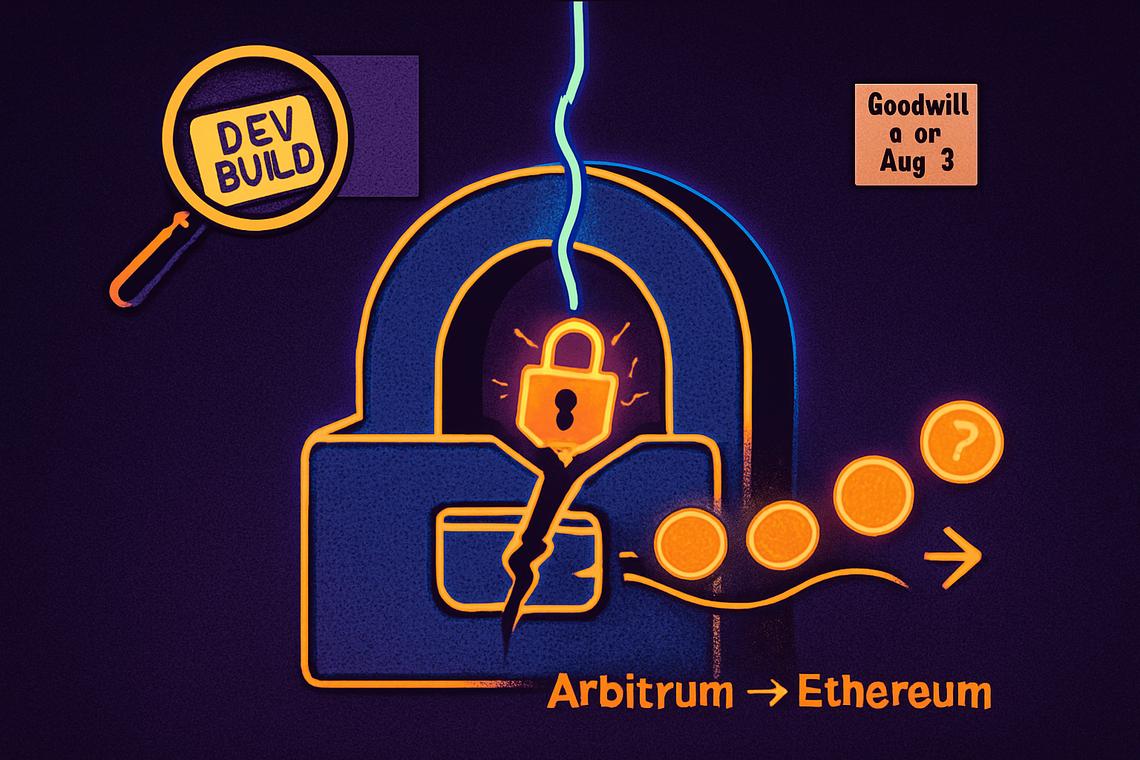
A North Korean-linked hacking group walked away with $24.15 million in USDC from a decentralized derivatives protocol — and the method had nothing to do with faulty smart contracts. The AFX bridge exploit recovery process is now entering a critical public phase, with the protocol set to unveil a goodwill plan for affected users on August 3, following one of the most technically sophisticated supply chain attacks seen in DeFi this year.
Summary
Key takeaways
- AFX will release a goodwill recovery plan for users affected by the exploit on August 3, 2026.
- About $24.15 million USDC was stolen from AFX’s custody bridge on July 22 and later converted into approximately 12,467 ETH.
- The attack originated from a social engineering campaign starting July 9, targeting an AFX developer via a fake recruiter posing as Oddium Lab.
- Arbitrum’s native bridge and network were not compromised; the breach was entirely contained within AFX-managed infrastructure.
- Forensic evidence links the attack to UNC4899, also known as TraderTraitor, a DPRK-backed threat group tracked by Mandiant, Microsoft Threat Intelligence, the FBI, and CISA.
AFX announces goodwill plan for $24.15 million bridge exploit victims
The announcement, published July 31, confirmed that AFX is finalizing a goodwill plan and will release the full details on Monday, August 3. The team acknowledged that investors, employees, and early supporters had all been affected and asked the community for patience while the proposal is completed. The exact structure of any compensation or recovery mechanism has not yet been disclosed.
What makes this moment significant is the broader trust calculation now facing AFX’s user base. A goodwill plan typically signals that full restitution of stolen funds is not guaranteed — it represents a protocol’s effort to demonstrate accountability when recovery from the attacker remains uncertain. No public reports have confirmed that any portion of the stolen assets has been returned.
AFX had earlier proposed a white-hat bounty arrangement to the attacker, offering to let them keep 30% of the stolen funds in exchange for returning the remaining 70%. The outcome of that offer has not been publicly confirmed.
How a fake recruiter brought down a $24 million bridge
The attack did not exploit a bug in AFX’s on-chain code. Instead, it started with a message on July 9 — nearly two weeks before any funds moved.
According to AFX’s detailed post-mortem, the attacker posed as a recruiter from a company called Oddium Lab and approached one of AFX’s developers. The developer was convinced to clone what appeared to be a legitimate software repository. Hidden inside was a malicious Git configuration that executed a payload automatically during a standard Git workflow, giving the attacker an initial foothold on the developer’s workstation.
From there, the intrusion escalated methodically. The attacker expanded access across internal development systems and eventually uploaded a malicious Groovy plugin into AFX’s JFrog artifact repository. This gave them remote code execution inside the protocol’s software delivery environment. Critically, repeated out-of-memory events on the JFrog server were flagged as routine operational issues — even with vendor assistance — allowing the malicious plugin to persist through multiple restarts without triggering a security response.
Forensic analysis uncovered that system binaries had been replaced with trojanized versions, malicious shared libraries had been injected, and the attacker had attempted to erase security logs before portions of the malware crashed. SELinux logs ultimately preserved critical evidence: outbound command-and-control traffic, shell execution, and in-memory code execution patterns that became central to the investigation.
Validator compromise enabled the final theft
Once embedded in the development environment, the attacker pivoted into operational infrastructure through an internal Ansible-based management service that already held privileged access to validator nodes. No new credentials needed to be stolen. The attacker simply exploited existing internal trust relationships to push malicious payloads to a subset of validators.
The infected validators downloaded a second-stage payload from a remote server and then interfered with consensus-message handling. At 9:27 p.m. UTC on July 22, those compromised validators co-signed a fraudulent bridge transaction, transferring roughly $24.15 million in USDC out of AFX’s custody bridge. The stolen USDC subsequently moved from Arbitrum to Ethereum, where it was converted into approximately 12,467 ETH.
Arbitrum’s native bridge was never at risk
A key distinction emerged early in the incident response: the breach was entirely contained within infrastructure managed and operated by AFX. Arbitrum’s native bridge inherits its security from the rollup’s architecture, which ultimately relies on Ethereum’s security guarantees — a fundamentally different trust model from third-party bridges like AFX’s custody bridge, which operate their own validator sets and key management practices.
Offchain Labs co-founder and CEO Steven Goldfeder confirmed publicly that the suspicious transaction originated from a third-party protocol, not from Arbitrum’s core bridge. Blockchain security firm Blockaid also investigated and reached the same conclusion. AFX’s post-mortem corroborated those findings, stating that no evidence of compromise to the Arbitrum network or its native bridge was found.
The distinction matters enormously for users. It draws a clear line between the security guarantees that come with Arbitrum’s rollup architecture and those offered by third-party protocols that operate independently within the ecosystem. July 2026 alone saw at least 14 recorded security breaches across the crypto sector, according to reporting by Crypto Briefing — a volume that gives added weight to bridge selection decisions.
DPRK attribution and the supply chain threat to DeFi
AFX said its forensic findings are consistent with external attribution linking the attack to UNC4899, also known as TraderTraitor — a DPRK-linked threat group independently tracked by Mandiant, Microsoft Threat Intelligence, the FBI, and CISA. The techniques observed align with a pattern that North Korean state-sponsored actors have refined over multiple high-profile crypto thefts: target developers through fake job offers, establish deep persistence inside build systems, then leverage internal trust relationships to authorize fraudulent transactions.
What this incident illustrates is a structural vulnerability that blockchain security audits rarely address. Smart contract audits check on-chain code. They say nothing about whether a developer might clone a malicious repository, or whether a CI/CD pipeline could be used to silently compromise validator nodes. The AFX bridge exploit recovery effort is, in that sense, a case study in how the attack surface for DeFi protocols extends far beyond the blockchain itself.
Post-attack security overhaul
AFX has moved quickly on infrastructure remediation. The protocol rebuilt affected systems, rotated operational credentials, increased monitoring sensitivity, and migrated production environments into a more isolated architecture using zero-trust segmentation. Additional measures planned over the coming months include expanded behavioral monitoring, mandatory security reviews before restarting production services, broader threat-hunting exercises, and employee training specifically targeting social engineering tactics.
The incident also fits into a broader pattern of off-chain attacks affecting DeFi protocols. On July 30, Ostium disclosed that a separate $23.75 million USDC exploit resulted from unauthorized access to off-chain infrastructure that allowed fraudulent BTC-USD price data to drain its liquidity vault — while its smart contracts remained intact. Singapore-based payments firm Triple-A similarly reported unauthorized access to company-owned treasury wallets, though it said customer funds were not affected.
The August 3 goodwill plan announcement will be watched closely across the DeFi community — not just for what AFX offers affected users, but for what it signals about how protocols handle accountability when state-sponsored attackers are involved and funds remain unrecovered.
FAQ
What caused the AFX bridge exploit?
The attack started with a social engineering campaign on July 9 in which an attacker posed as a recruiter from Oddium Lab and convinced an AFX developer to clone a malicious Git repository. That gave the attacker an initial foothold, which was later used to compromise internal development systems, upload a malicious Groovy plugin into the JFrog repository, and ultimately gain access to validator nodes via an internal Ansible management service.
How much was stolen in the AFX bridge exploit and what happened to the funds?
Approximately $24.15 million in USDC was stolen from AFX’s custody bridge on July 22, 2026. The funds were moved from Arbitrum to Ethereum and converted into roughly 12,467 ETH. No public reports have confirmed that any portion of the stolen assets has been recovered.
Did the exploit affect the Arbitrum native bridge or network?
No. The exploit targeted only AFX’s own custody bridge. Arbitrum’s native bridge and network were not compromised, as confirmed by AFX’s post-mortem, Offchain Labs CEO Steven Goldfeder, and blockchain security firm Blockaid.
What is AFX’s planned response to the exploit?
AFX will release a goodwill recovery plan for affected users on August 3, 2026. The protocol has already rebuilt key infrastructure, rotated credentials, implemented zero-trust segmentation, and enhanced monitoring as part of its post-attack security overhaul. The exact compensation structure for affected users had not been publicly disclosed ahead of the August 3 announcement.
Article produced with the assistance of artificial intelligence and reviewed by the editorial team.
