Google’s newest entry in the Nano Banana image generation lineup promises to cut costs in half and deliver results nearly three times faster — but the trade-offs are more nuanced than a simple spec sheet suggests. Whether Nano Banana 2 Lite earns its place in a professional workflow depends almost entirely on what kind of images you’re making.
Summary
Key takeaways
- Nano Banana 2 Lite generates images in about 4 seconds at $0.034 per image at 1K resolution — roughly half the cost of Nano Banana 2 at $0.067.
- The Lite model is 2.7 times faster than Nano Banana 2 and sits at the entry point of Google’s three-tier image generation lineup.
- It matches or beats Nano Banana 2 on many tasks, but shows clear gaps in photographic realism, fine detail, and in-image text accuracy.
- Nano Banana 2 Lite is integrated across Google AI Studio, Gemini API, Enterprise Agent Platform, Search, NotebookLM, and Google Photos.
- Competitors like Reve 2.0 undercut it on price at roughly $0.0067 per image, but none match the depth of Google’s deployment infrastructure.
Overview of Nano Banana 2 Lite and Its Place in the Lineup
Google positioned Nano Banana 2 Lite — officially gemini-3.1-flash-lite-image — as the direct replacement for the original Nano Banana model and the entry point of a now clearly defined three-tier stack: Lite for speed and cost, Nano Banana 2 for the quality-speed balance, and Nano Banana Pro for demanding professional work. The architecture is clean and deliberate.
Performance and cost comparison
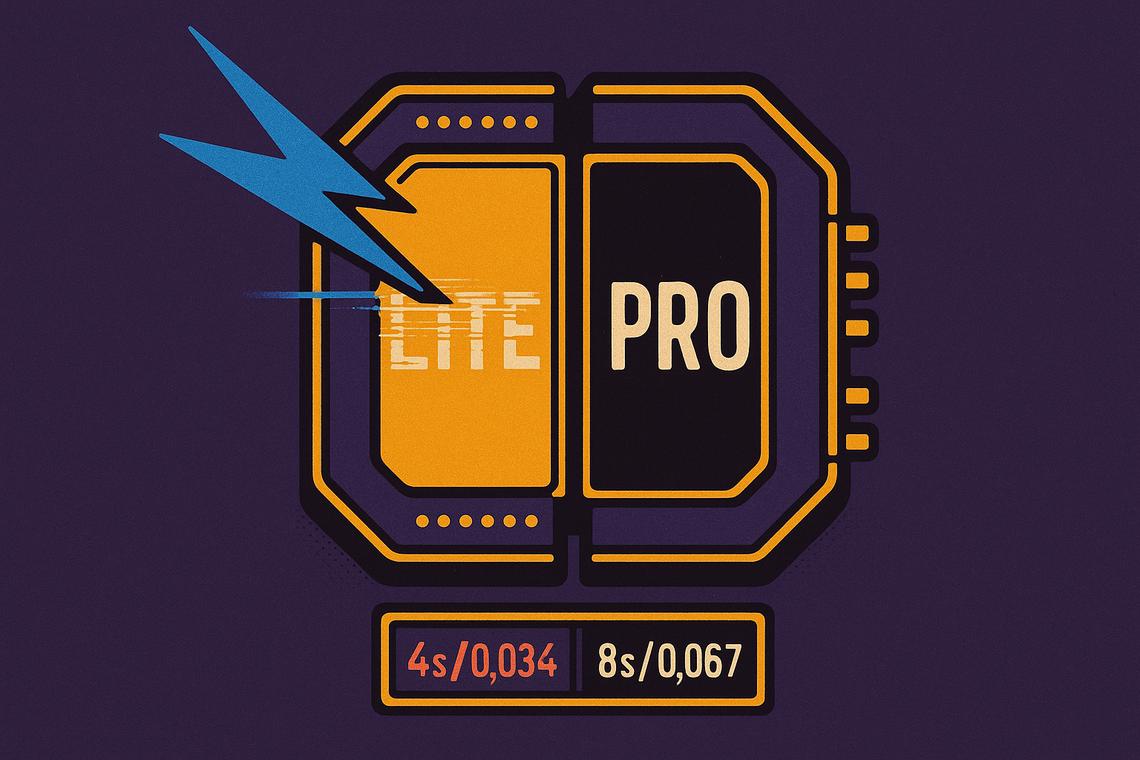
At $0.034 per image at 1K resolution and a generation time of roughly four seconds, the Lite model cuts the cost of Nano Banana 2 almost exactly in half. Nano Banana 2 runs at $0.067 per image at the same resolution and is 2.7 times slower. For teams running high-volume generation pipelines, that gap compounds quickly.
What makes the comparison interesting is where the savings show up and where they don’t. The Lite model isn’t a uniformly degraded version of its sibling — it trades certain capabilities against others in ways that are specific enough to change the calculus depending on use case.
Positioning within Google’s AI image generation lineup
The three-tier structure gives Google a clear answer for every budget segment. Nano Banana 2 Lite occupies the high-volume, lower-stakes tier. Nano Banana Pro handles work where image quality is non-negotiable. Nano Banana 2 sits between them, and that middle position turns out to be the most consequential for professional users trying to figure out when the upgrade actually pays.
Integration and Deployment Within Google’s Ecosystem
Nano Banana 2 Lite is already embedded across Google’s infrastructure in a way that no API-only competitor can match. The model is available through Google AI Studio, the Gemini API, and the Enterprise Agent Platform, and it runs inside consumer products including Search, the Gemini app, NotebookLM, and Google Photos.
It also works alongside Gemini Omni Flash — Google’s video generation model — through the Interactions API, which supports up to three sequential edits within a single session. That pairing extends the Lite model’s utility beyond static image generation into iterative creative workflows.
For teams already operating inside Google’s infrastructure, this matters in a way that raw pricing comparisons don’t capture. Switching to a cheaper API-only alternative means managing a separate platform, separate credentials, separate latency profiles, and separate failure modes. That platform-switching cost is invisible in per-image pricing but very real in engineering overhead. Reve 2.0 offers a striking $0.0067 per image via API — roughly one-fifth the cost of the Lite model — but it doesn’t carry that deployment footprint. Seedream 5.0 Lite trades blow-for-blow on price at $0.031–0.035 per image, but the same ecosystem gap applies.
Image Quality and Task Performance Comparison
Head-to-head testing across five categories produced results that are harder to summarize than either “just use the cheap one” or “always pay for Nano Banana 2.” The gaps are real, but they’re concentrated in specific failure modes rather than distributed evenly across all tasks.
Photographic realism and fine detail
Photographic realism is where the Lite model makes its largest single concession — and it makes it consistently. Given a demanding portrait prompt specifying cinematic lighting, shallow depth of field, a precise rim light, and realistic skin texture, the Lite version produced a competent image that communicated the concept. But on close inspection, the rim light was barely perceptible, skin texture didn’t survive scrutiny above thumbnail scale, and the subject’s proportions showed anatomical issues.
Nano Banana 2’s output was photographically different in kind — not just better on the same scale. A fully realized New York City skyline at magic hour, dramatic depth of field, bokeh city lights, and a warm rim light that correctly separated the subject from the background. For social media mockups or rapid iteration, the Lite version is workable. For hero images, client deliverables, or portfolio work, the gap becomes visible at any resolution above a thumbnail.
Text and prompt adherence accuracy
Prompt adherence testing produced a more nuanced split. A dense steampunk cityscape prompt with ten simultaneous labeled constraints — specific establishment dates, named cable car routes, legible newspaper headlines — exposed a clear weakness in the Lite model. The balloon rendered “Est. 1942” instead of 1842. The cable car route label came out garbled. The foreground newspaper headline lost legibility at the edges.
Nano Banana 2 got almost everything right: the correct date, a readable cable car sign (“Upper Vantis – 4 Stops”), a legible newspaper headline (“Clocktower Falls Silent – City Mourns”). The difference is narrow in casual use — most viewers won’t catch a one-digit transposition on a fictional date. But for concept artists, worldbuilders, and creative directors using these models to communicate specific logic to clients, the Lite model’s tendency to blur or transpose in-image labels introduces a manual correction step that compounds badly at scale.
Spatial awareness and scene composition
Spatial awareness was the smallest gap across all tests. Both models correctly established foreground, mid-ground, and background in a complex multi-object scene without misplacing elements or collapsing depth planes. Nano Banana 2 produced richer atmospheric depth — candlelight fading naturally toward stone walls, background haziness reading as genuine spatial recession. The Lite version’s depth was structurally correct but slightly compressed, reading marginally more like a painted flat than a room with actual air in it.
For storyboards, game asset concepts, and most editorial illustration contexts, both models handle spatial reasoning adequately. The Lite model’s flatter depth only becomes meaningful at high resolution or under detailed compositional analysis — and even then, the gap is arguable.
The text generation result, however, was the most counterintuitive finding. Faced with a nighttime hardware store scene requiring dozens of simultaneous readable text elements at different scales — store signage, graffiti, concert posters, window decals, a lost cat notice with a legible phone number — the Lite model delivered a genuinely strong output. Every requested text element rendered correctly and remained readable in a single image, an impressive result at any price point. The trade-off was realism: some elements looked digitally assembled rather than genuinely aged into the scene. Nano Banana 2’s darker, moodier atmospheric rendering — usually an asset — actually worked against it here, pushing smaller sticker text into shadow and killing legibility. The Lite model’s brighter default lighting, a liability in portrait work, became a direct advantage when the evaluation criterion was whether all the text in the scene could actually be read.
Competitive Positioning and Cost Trade-Offs
The cost math is straightforward on the surface: Nano Banana 2 Lite at $0.034 per image versus Nano Banana 2 at $0.067, with Seedream 5.0 Lite sitting at $0.031–0.035 in the same tier. Reve 2.0 sits far below both at approximately $0.0067 per image via API — a dramatic undercut that makes sense for pure-API deployments running outside Google’s infrastructure.
The more important question is whether the Lite model’s quality profile matches the demands of a given pipeline. For workflows involving signage mockups, branded graphics, editorial composites with text-heavy elements, or any production context where multiple readable text strings need to coexist in one image, the Lite model is worth reaching for first. For photographic realism work — hero images, cinematic portraits, campaigns where close-inspection quality matters — the additional $0.033 per image for Nano Banana 2 is probably justified.
What the pure per-image price doesn’t reflect is the value of having the same model running across Search, NotebookLM, Google Photos, and the Gemini app simultaneously. For organizations standardizing on Google’s stack, that coherence removes architectural complexity that cheaper alternatives can’t compensate for with lower unit costs alone. The Lite model’s real competitive advantage isn’t the $0.034 price point — it’s the $0.034 price point combined with the infrastructure it already lives inside.
FAQ
How fast is Nano Banana 2 Lite compared to Nano Banana 2?
Nano Banana 2 Lite generates images about 2.7 times faster than Nano Banana 2, producing outputs in roughly 4 seconds.
What are the cost differences between Nano Banana 2 Lite and Nano Banana 2?
Nano Banana 2 Lite costs approximately $0.034 per image at 1K resolution, about half the $0.067 per image charged by Nano Banana 2.
Which model offers better photographic realism?
Nano Banana 2 provides superior photographic realism, fine detail, and lighting effects. Nano Banana 2 Lite shows a noticeable drop in these areas, performing more like a competent stock photo generator than a cinematic image tool.
Is Nano Banana 2 Lite suitable for workflows requiring precise text in images?
Not reliably. Nano Banana 2 Lite has reduced accuracy on textual details within images — transposing dates, garbling route labels, and blurring headlines — which can affect workflows requiring precise label adherence. For text-heavy scene generation where legibility is the primary metric, it can actually outperform Nano Banana 2 in some contexts, but workflows that demand exact in-image labels should default to Nano Banana 2.
Article produced with the assistance of artificial intelligence and reviewed by the editorial team.