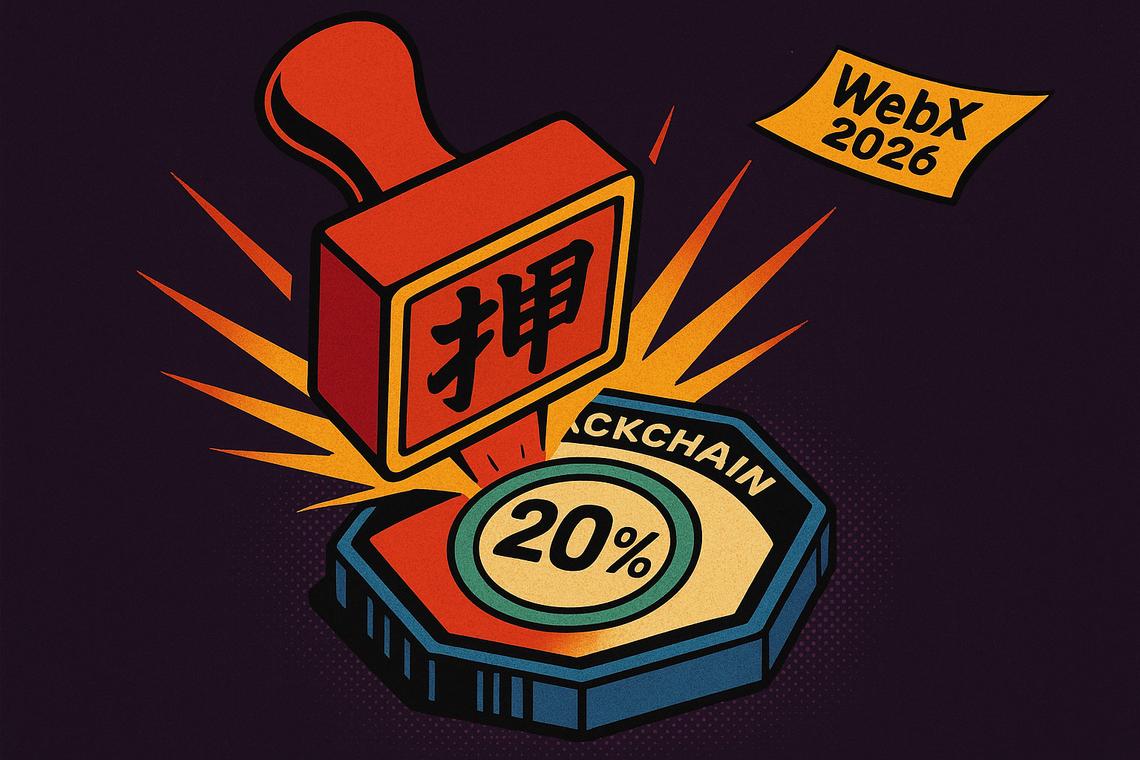
Japan’s push to become Asia’s premier hub for Japan Web3 investment and startup development is moving beyond political rhetoric — at least on paper. On July 13, 2026, Prime Minister Sanae Takaichi addressed attendees at the WebX 2026 conference in Tokyo, reaffirming the government’s commitment to nurturing startups and Web3 enterprises. The appearance continued a pattern set by former Prime Ministers Fumio Kishida and Shigeru Ishiba, signaling that Web3 has become a bipartisan fixture in Japan’s economic agenda. But as the country rolls out ambitious targets and regulatory overhauls, the real question is whether institutional and governmental momentum can actually deliver at scale.
Summary
Key takeaways
- PM Sanae Takaichi reaffirmed Japan’s support for Web3 and startups at WebX 2026 on July 13, 2026, but announced no new dedicated funding mechanisms.
- Japan’s five-year blueprint targets approximately 10 trillion yen in annual startup investment by fiscal 2027, with goals of 100 unicorn companies and 100,000 startups.
- A proposed uniform 20% tax rate on cryptocurrency profits — down from the current 55% — would align crypto with equities, potentially taking effect in 2028.
- Ripple and Web3 Salon are offering grants of up to $200,000 to Japanese teams building on the XRP Ledger, covering payments, asset tokenization, and decentralized finance.
- Financial conglomerate SBI Holdings has made a series of major crypto investments, signaling that private capital is not waiting for policy clarity to arrive.
Takaichi at WebX 2026: Web3 as National Strategy
Takaichi’s appearance via video presentation at WebX 2026 — one of Asia’s largest Web3 gatherings, with approximately 15,000 attendees expected — was more than ceremonial. She framed Web3 technology not as a niche cryptocurrency project but as an integral part of Japan’s broader innovation strategy, commending the conference for connecting emerging companies with investors and facilitating discussions on next-generation services.
Her remarks built on the Comprehensive Startup Support Package, formulated in May 2025, which itself expanded upon Japan’s Five-Year Startup Development Plan originally established in 2022. The package advocates for expanded capital deployment through government-supported investment vehicles and banking institutions, alongside regulatory modifications designed to help emerging ventures scale, hire, and access new markets.
That said, Takaichi stopped short of announcing any dedicated Web3 funding mechanism or immediate regulatory adjustments for digital currency businesses. The speech was a signal of direction, not a policy unveiling — an important distinction when assessing how quickly the ecosystem might actually shift.
Japan’s Ambitious Startup Investment and Regulatory Framework
The 10 Trillion Yen Target and Unicorn Goals
Japan’s five-year strategic blueprint carries numbers that are hard to ignore. The government is targeting approximately 10 trillion yen in annual startup investment by fiscal 2027, with the broader ambition of establishing Japan as a leading entrepreneurial center across Asia. The official documentation sets even longer-horizon objectives: 100 unicorn-status companies and 100,000 total startups within five years.
These targets reflect how seriously Japan’s political establishment has come to view startup ecosystems as engines of national competitiveness. The Comprehensive Startup Support Package is designed to broaden capital access and remove structural bottlenecks that have historically slowed venture formation and scaling in Japan’s more conservative financial culture.
Cryptocurrency Tax Reform: From 55% to 20%
Possibly the most consequential near-term development for crypto participants is the proposed overhaul of digital asset taxation. Legislative bodies are advancing a bill that would implement a uniform 20% tax rate on cryptocurrency profits, bringing it in line with equities and fixed-income securities — a dramatic reduction from the current maximum rate of 55%.
The lower house of Japan’s parliament has already advanced a version of this bill. If it clears the upper house as expected, the tax provisions could become effective beginning in 2028. The legislation may also create a framework for domestic cryptocurrency exchange-traded funds, opening the door to regulated institutional products that do not currently exist in Japan’s market.
This regulatory shift matters enormously. A 55% tax rate on crypto gains has long been cited as a structural deterrent for both retail investors and institutional participants in Japan. Moving to 20% would materially change the economics of holding and trading digital assets domestically, and could accelerate inflows into the sector that have previously gone offshore.
Private Sector Moves: SBI Holdings and the XRP Ledger Grants
Ripple and Web3 Salon Back Japanese Builders
Ripple and Web3 Salon — which operates with backing from the Japan External Trade Organization — have launched a grant program offering up to $200,000 for Japanese development teams building on the XRP Ledger. The initiative targets projects in payment solutions, asset tokenization, and decentralized finance, areas where Japan’s regulatory trajectory now offers a clearer runway than in many other jurisdictions.
These grants operate independently from government programs, but they illustrate how public institutions and commercial entities are simultaneously and concurrently engaging Japan’s entrepreneurial community — even when direct coordination is limited.
SBI Holdings: Building the Plumbing of Onchain Finance
The most striking evidence that Japan’s Web3 investment ambitions are moving from policy to capital deployment may come from SBI Holdings. Over recent weeks, the Japanese financial conglomerate has made a series of major moves: a $125 million sole investment in Gauntlet’s Series C, a $76 million sole investment in EDX Markets’ Series C, an agreement to acquire Japanese crypto exchange Bitbank for nearly $289 million, a controlling stake in Singapore-based exchange Coinhako, and participation in funding rounds for Digital Asset ($355 million), Morpho ($175 million token round), and Circle’s $222 million Arc token presale. SBI also launched JPYSC, described as Japan’s first trust bank-backed yen stablecoin.
SBI’s stated goal is to drive what it calls the “onchain transformation” of its entire group, building capabilities spanning exchanges, asset tokenization, and market platforms. As one analyst put it, SBI is not buying exposure to crypto — it is buying the infrastructure of the next financial system. The company has explicitly framed the “token economy,” in which every asset is tokenized and transactions execute on blockchain, as imminent.
The timing is deliberate. SBI appears to be positioning ahead of Japan’s regulatory changes rather than waiting for them. Analysts note that bear market conditions tend to produce more attractive entry valuations, and institutions with long investment horizons typically benefit most from deploying capital during cyclical troughs.
The Gap Between Vision and Execution
Japan’s Web3 and startup strategy carries genuine momentum, but the distance between political statements and measurable outcomes remains real. Takaichi did not establish concrete timelines for individual initiatives at WebX 2026, and the effectiveness of government-supported investment vehicles is still unproven. Rhetorical support from successive prime ministers — Kishida, Ishiba, and now Takaichi — provides the sector with political access channels, but does not automatically translate into appropriated funds or legislative action.
The proposed crypto tax reform is similarly contingent. The bill still needs to clear Japan’s upper house before the 2028 effective date becomes certain, and the impact on the broader startup ecosystem remains difficult to predict in advance. Coordination between private sector grant programs and government-backed initiatives also lacks a clear structural framework, which could limit the multiplier effect of concurrent activity.
What distinguishes the current moment from earlier cycles of Japanese governmental Web3 enthusiasm is the private capital now moving in parallel. SBI’s aggressive deployment strategy, combined with targeted grant programs from Ripple and infrastructure initiatives across tokenization and stablecoins, suggests that institutional players are not treating government support as a prerequisite. They are building regardless — which may ultimately do more to validate Japan’s Web3 ambitions than any single policy announcement.
FAQ
What commitment did PM Sanae Takaichi make regarding Web3 at WebX 2026?
Takaichi reaffirmed the Japanese government’s commitment to nurturing startups and Web3 enterprises, positioning Web3 as part of Japan’s broader national innovation strategy rather than an isolated sector. She did not announce any new dedicated funding mechanisms or immediate regulatory changes for digital currency businesses.
What are Japan’s startup investment goals?
Japan aims for approximately 10 trillion yen in annual startup investment by fiscal 2027, with targets of 100 unicorn companies and 100,000 total startups within five years, as outlined in the country’s five-year strategic blueprint.
What regulatory changes are proposed for cryptocurrency taxation in Japan?
A uniform 20% tax rate on cryptocurrency profits is proposed, significantly reducing the current maximum rate of 55% and aligning crypto gains with stocks and bonds. The provisions could take effect starting in 2028, pending final approval in Japan’s upper house of parliament.
How are private companies supporting Web3 innovation in Japan?
Ripple and Web3 Salon — backed by the Japan External Trade Organization — are offering grants of up to $200,000 to Japanese teams developing on the XRP Ledger, with a focus on payment solutions, asset tokenization, and decentralized finance applications. SBI Holdings has separately deployed capital across multiple major crypto investments as part of a broader onchain finance strategy.
Article produced with the assistance of artificial intelligence and reviewed by the editorial team.