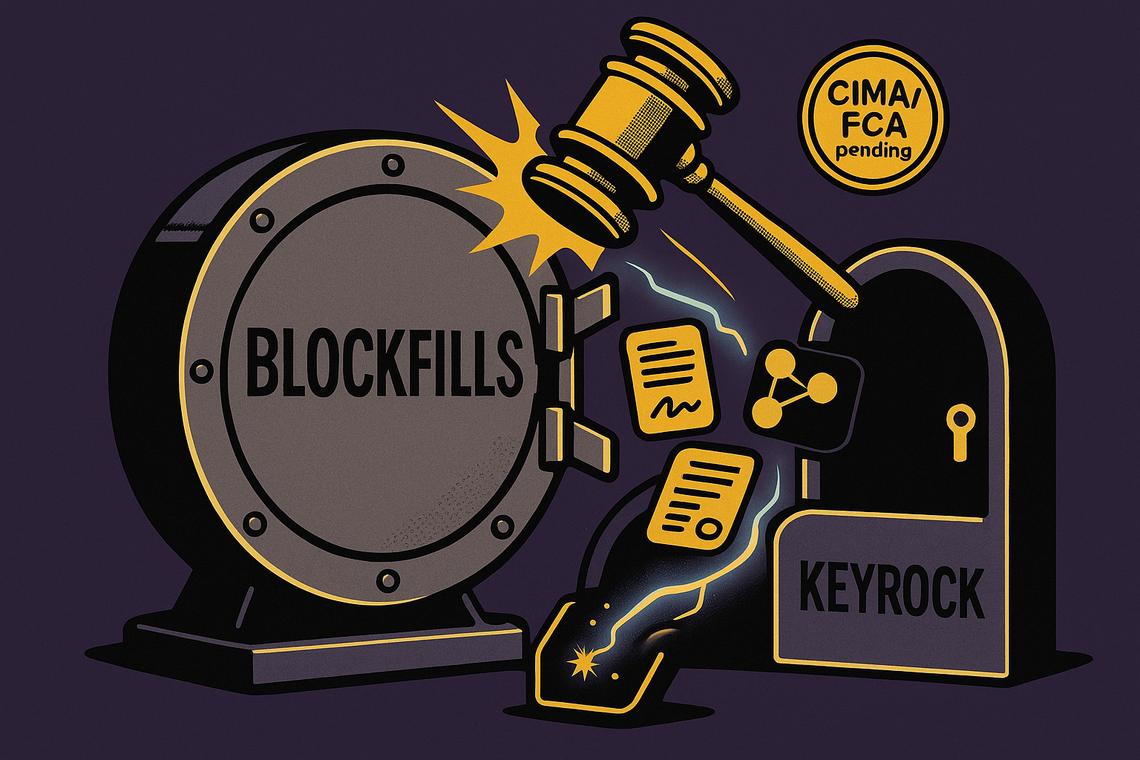
When BlockFills collapsed under the weight of a reported $75 million lending loss earlier this year, it left a gap in the institutional crypto derivatives market. Keyrock just moved to fill it — and then some. The Brussels-based market maker has completed the Keyrock BlockFills acquisition, picking up the distressed firm’s trading and brokerage assets for $3.25 million, a figure disclosed in U.S. bankruptcy court filings rather than Keyrock’s own announcement.
Summary
Key takeaways
- Keyrock acquired BlockFills’ institutional digital asset trading and brokerage assets for $3.25 million, per U.S. bankruptcy court filings, with a judge approving the sale in June.
- BlockFills entered Chapter 11 bankruptcy protection in March after a reported $75 million lending loss and a freeze on deposits and withdrawals in February.
- The deal expands Keyrock’s regulatory footprint to include a CIMA-registered entity in the Cayman Islands and a proposed FCA-authorized entity in the U.K., pending regulatory approval.
- Former BlockFills staff Perry Parker (institutional options) and Dan Schak (risk and trading operations) are joining Keyrock as part of the transaction.
- Keyrock reached a $1.1 billion valuation in March after a Series C round led by Standard Chartered’s SC Ventures.
Keyrock Acquires BlockFills’ Institutional Trading Assets
The deal gives Keyrock access to BlockFills’ client relationships, proprietary trading technology, equity interests, and derivatives infrastructure — assets that a U.S. bankruptcy judge formally approved for sale in June. What BlockFills’ creditors couldn’t salvage from the wreckage, Keyrock has repurposed into a strategic expansion play.
Details of the Acquisition
U.S. bankruptcy court filings show Keyrock agreed to pay $3.25 million for substantially all of BlockFills’ assets while assuming certain liabilities, customer relationships, and technology systems. Keyrock did not disclose the purchase price in its own public announcement — a detail that only emerged through the court record.
The acquired assets fold into Keyrock’s existing institutional platform, which spans liquidity provision, OTC execution, derivatives, credit, onchain markets, and asset management. Juan David Mendieta, Keyrock’s co-founder and chief strategy officer, described the deal as “an exceptional opportunity to further strengthen our team with outstanding talent and accelerate our global reach.”
Background on BlockFills’ Financial Challenges
BlockFills’ road to bankruptcy was swift and steep. The firm froze deposits and withdrawals in February after suffering what was reported as a $75 million lending loss. Co-founder and CEO Nicholas Hammer stepped down as the company searched for a buyer or strategic partner. By March, BlockFills had filed for Chapter 11 protection.
The fire-sale price reflects that distress. Acquiring a firm’s institutional-grade derivatives infrastructure, technology stack, and client base for $3.25 million — even out of bankruptcy — is the kind of opportunity that rarely materializes in a healthier market environment.
Expansion of Keyrock’s Derivatives Business and Institutional Client Base
Crypto derivatives are one of Keyrock’s fastest-growing business segments, and this acquisition directly accelerates that trajectory. The BlockFills deal adds specialist capabilities and client-facing systems in options and structured trading products — precisely the areas where institutional demand has been climbing.
Enhancement of Trading Technology and Expertise
The transaction strengthens Keyrock’s capacity to serve hedge funds, asset managers, market makers, and other professional counterparties. BlockFills’ trading technology and derivatives expertise were cited by Keyrock as key drivers of the deal — not just the client relationships, but the systems and intellectual property behind them.
That distinction matters. Buying distressed assets out of bankruptcy can mean inheriting operational chaos. Keyrock’s emphasis on phased integration suggests a deliberate approach: the firm says it will roll out acquired services in stages and communicate directly with clients as each piece becomes available, rather than attempting an abrupt transition.
Integration of BlockFills’ Staff
Perry Parker, who previously held roles at Goldman Sachs and Deutsche Bank before leading institutional options at BlockFills, is joining Keyrock. So is Dan Schak, who oversaw risk and trading operations at the bankrupt firm. Additional BlockFills employees across trading, operations, and commercial functions will also move across.
Talent acquisitions of this kind can be harder to replicate than technology purchases. Derivatives market making requires deep institutional relationships and a specific kind of risk expertise — the kind Parker and Schak built over careers spanning traditional finance and crypto. Bringing that experience in-house alongside BlockFills’ systems gives Keyrock a meaningful structural upgrade.
Broadened Regulatory Presence Across Key Markets
Beyond the trading assets, the Keyrock BlockFills acquisition carries significant regulatory implications. The deal adds a CIMA-registered entity in the Cayman Islands to Keyrock’s existing compliance framework and includes the proposed acquisition of an FCA-authorized entity in the U.K., subject to regulatory approval.
Cayman Islands CIMA Registration
The Cayman Islands entity, registered with the Cayman Islands Monetary Authority, extends Keyrock’s reach into a jurisdiction widely used by institutional crypto funds and offshore vehicles. For hedge fund clients in particular, a CIMA-registered counterparty can simplify compliance and onboarding requirements.
Proposed FCA Entity in the U.K.
The proposed U.K. acquisition is potentially more consequential but also more uncertain. FCA authorization would position Keyrock to serve clients in one of the most tightly regulated and institutionally significant crypto markets in the world. The timing depends on regulatory approval, which remains pending.
Viewed alongside Keyrock’s $1.1 billion valuation reached in March — following a Series C funding round led by Standard Chartered’s SC Ventures — the BlockFills deal reads as a continuation of a deliberate institutional build-out. The firm is acquiring regulatory licenses, derivatives expertise, and institutional client books at a moment when the infrastructure layer of crypto markets is consolidating quickly. Whether the phased integration delivers on that ambition without friction will determine how much the $3.25 million outlay was actually worth.
FAQ
What assets did Keyrock acquire from BlockFills?
Keyrock acquired the trading and brokerage assets of BlockFills’ institutional digital asset business, including client relationships, proprietary trading technology, equity interests, and derivatives infrastructure, as approved by a U.S. bankruptcy judge in June.
How does this acquisition affect Keyrock’s regulatory status?
The acquisition expands Keyrock’s regulatory reach to include a CIMA-registered entity in the Cayman Islands and a proposed FCA-authorized entity in the U.K., with the latter still pending regulatory approval.
Who from BlockFills is joining Keyrock as part of the acquisition?
Keyrock gains experienced staff including Perry Parker, who previously worked at Goldman Sachs and Deutsche Bank and led institutional options at BlockFills, and Dan Schak, who oversaw risk and trading operations. Additional employees across trading, operations, and commercial functions are also joining.
What is the timeline for integrating BlockFills’ operations into Keyrock?
Keyrock plans to integrate BlockFills’ operations in phases and will communicate directly with clients as new services become available, rather than executing an immediate full transition.
Article produced with the assistance of artificial intelligence and reviewed by the editorial team.