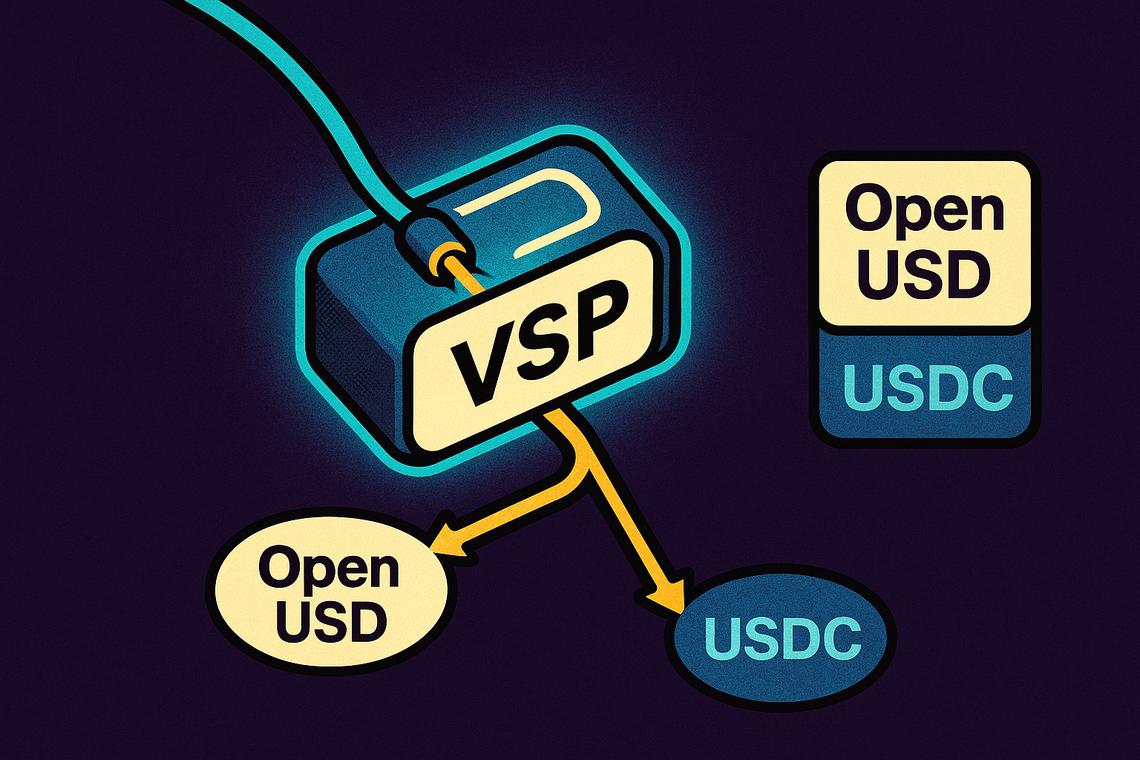
Visa has stepped directly into the institutional stablecoin market, launching a full enterprise platform that puts the payments giant in the middle of a fast-moving competition for digital-dollar dominance. The Visa Stablecoin Platform, known as VSP, arrives with Open USD as its first supported digital asset — and the ripple effects are already reaching Circle, the company behind USDC.
Summary
Key takeaways
- Visa launched the Visa Stablecoin Platform (VSP), supporting Open USD, USDC, and USDG for banks, fintechs, and payment providers.
- VSP enables minting, storing, transferring, and redeeming stablecoins through Visa-managed infrastructure, alongside existing payment networks.
- Open USD offers fee-free minting and redemption with a revenue-sharing model that returns most reserve income to distribution partners.
- More than 140 companies — including Visa, Mastercard, BlackRock, and Coinbase — backed Open USD when it launched on June 30.
- Mizuho downgraded Circle and cut its price target from $85 to $50, citing margin pressure from Open USD’s rival economic model.
Visa launches an enterprise stablecoin platform with Open USD at its center
VSP gives banks, fintech companies, and payment providers a single system to manage digital dollar operations. Through Visa-managed infrastructure, clients can mint, store, transfer, and redeem stablecoins without replacing their existing payment setups — they run alongside them.
The platform also includes Wallet-as-a-Service infrastructure, blockchain connectivity, and Visa’s existing risk and security systems. It is, in effect, a stablecoin operating layer built on top of one of the world’s largest payment networks.
Visa’s Chief Product and Strategy Officer Jack Forestell framed the challenge plainly: “the hard part isn’t the concept, it’s the operational reality.” According to Forestell, VSP gives clients one place to manage stablecoin operations using the controls and network infrastructure Visa already provides — reducing the complexity that has historically kept many institutions on the sidelines.
Multi-stablecoin support from day one
While Open USD is the headline asset, VSP also supports USDC and USDG from launch. That breadth matters: institutions with existing exposure to Circle’s USDC are not forced to switch allegiances to use the platform. Visa is positioning VSP as infrastructure that accommodates the stablecoin market broadly, even as it gives Open USD a significant distribution advantage.
Open USD’s economic model and the coalition behind it
Open USD’s revenue structure is where the story gets interesting for the broader market. Developed by Open Standard, the stablecoin offers fee-free minting and redemption while sharing most of the reserve income generated by the underlying assets with participating distribution partners, after operating costs.
That model is structurally different from how Circle operates USDC, where reserve income has historically flowed primarily to the issuer. Open USD’s approach essentially turns stablecoin distribution into a revenue opportunity for the institutions deploying it — a compelling incentive for banks and fintechs weighing which digital dollar to prioritize.
The coalition backing Open USD is substantial. When the initiative was announced on June 30, more than 140 companies had signed on, including Visa, Mastercard, BlackRock, and Coinbase. The breadth of that group — spanning finance, technology, and crypto — gives Open USD a distribution network that most new stablecoins could never assemble quickly.
What this means for Circle and the USDC market position
Open USD’s challenge to Circle’s USDC is not just about market share — it is about the economics of stablecoin distribution itself. Circle’s model depends on capturing the majority of reserve income. Open USD redirects that income outward, to the partners doing the distributing. That structural difference changes the financial incentive for every bank and fintech choosing which stablecoin to integrate.
Markets have already responded. Circle shares fell after Open USD was announced, as investors assessed the implications of a competing model that shifts reserve income flows. The reaction sharpened further when Mizuho downgraded Circle and cut its price target from $85 to $50, citing the risk that Open USD could compress Circle’s margins by altering how reserve income reaches distribution partners.
That said, Open USD faces real structural challenges. USDC has spent years building liquidity, regulatory reach, and market adoption that no new entrant can replicate overnight. The question is not whether Open USD can exist alongside USDC — it clearly can — but whether Visa’s institutional infrastructure can accelerate adoption fast enough to shift meaningful volume away from Circle’s established position.
Visa as a distribution engine, not just a backer
What separates Visa’s role here from a typical consortium membership is the infrastructure layer. By building VSP around Open USD, Visa is not simply lending its name to a stablecoin coalition — it is providing the operational plumbing that institutions need to actually deploy the token. That distinction could prove decisive. Distribution partnerships lose value quickly without the back-end systems to make them work at scale; VSP is precisely those systems.
For Circle, the competition has moved beyond stablecoin issuance into institutional tooling. Open USD now has both a broad coalition of backers and a Visa-managed platform through which financial companies can access it directly. Whether that combination builds enough scale to meaningfully challenge USDC’s grip on regulated digital-dollar payments is the open question that will define this competition in the months ahead.
FAQ
What is the Visa Stablecoin Platform (VSP)?
VSP is an enterprise platform that allows banks, fintechs, and payment providers to mint, store, transfer, and redeem stablecoins through Visa-managed systems, while operating alongside existing traditional payment infrastructure.
Which stablecoins does Visa’s platform support?
Visa’s platform supports Open USD, USDC, and USDG stablecoins from launch.
How does Open USD’s economic model differ from Circle’s USDC?
Open USD offers fee-free minting and redemption and distributes most reserve income to participating distribution partners after operating costs. Circle’s USDC structure has historically retained more of that reserve income at the issuer level.
Why is Open USD considered a challenge to Circle’s USDC?
Open USD presents a direct competitive challenge because its revenue-sharing model makes it financially attractive for banks and fintechs to distribute it over USDC. Combined with backing from more than 140 companies — including Mastercard, BlackRock, and Coinbase — and Visa’s institutional distribution infrastructure, it represents a structurally different rival that could pressure Circle’s margins and market position.
Article produced with the assistance of artificial intelligence and reviewed by the editorial team.