



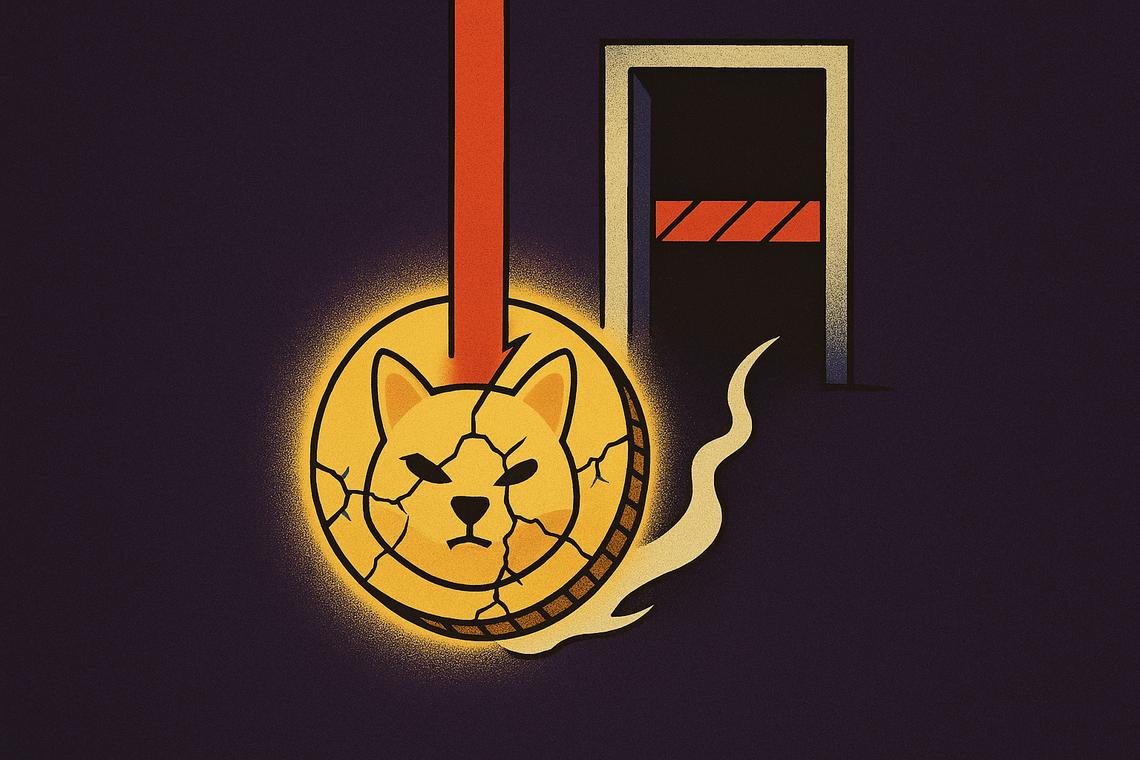
Record token burns were supposed to be good news for Shiba Inu. On July 8, 2026, more than 110 million SHIB tokens were permanently removed from circulation — the largest single-day burn the project had seen in six months. The community celebrated. Then the price fell anyway.
Summary
Key takeaways
- Shiba Inu burned more than 110 million SHIB on July 8, 2026, its biggest daily burn in six months, with weekly burns rising 56% to 152 million tokens.
- Despite the record activity, large investors sold more than one trillion SHIB tokens onto exchanges, erasing the burn’s positive impact.
- SHIB dropped roughly 5% on the day of the burn; monthly losses reached approximately 9%.
- With approximately 585.6 trillion tokens still in circulation, supply reduction at this scale barely moves the needle.
- Weak demand, not excess supply, is now the primary obstacle to any meaningful SHIB price recovery.
Record Shiba Inu Token Burns Reach Six-Month High
The numbers looked strong on paper. Weekly burns climbed to 152 million tokens, representing a rise of nearly 56% from the previous period. A wallet linked to Robinhood contributed the bulk of the July 8 activity, accounting for roughly 109 million of the tokens destroyed that day. Smaller holders added their share on top of that.
For a community that has long championed burn campaigns as a path to higher prices, this felt like a milestone. But the market’s response was immediate and unambiguous.
Massive Burns Fail to Reverse Price Decline Amid Whale Selling
SHIB fell around 5% on the same day the record burn was recorded. Monthly losses have reached roughly 9%, with price action stuck in a narrow range and no visible momentum building. The burn provided no floor.
Record Burn Overshadowed by Large Token Sales
The reason is straightforward, if uncomfortable: while the community was removing hundreds of millions of tokens, large investors moved more than one trillion SHIB onto trading platforms. That kind of selling pressure doesn’t just offset a 110-million-token burn — it buries it.
Whales are not accumulating. They are reducing exposure. That behavioral shift matters more than any single burn event, because it signals where sophisticated money thinks the token is headed.
Price Drops and Market Sentiment Worsen
Sentiment across the broader memecoin sector has continued to weaken alongside SHIB’s price struggles. Trader James Wynn went so far as to describe the token as “dead” — a subjective label, but one that reflects a mood that’s hard to ignore. When prominent voices in the space turn openly bearish, it tends to reinforce the very dynamics they’re describing.
Supply Reduction Alone Cannot Drive SHIB Price Recovery
The deeper problem with relying on burns becomes clear when you look at the full supply picture. Burn campaigns have produced real results in aggregate — but not nearly enough to matter at SHIB’s scale.
Circulating Supply Remains Extremely High
Even after years of community burn efforts, approximately 585.6 trillion SHIB tokens remain in circulation. Removing 152 million in a week, or even 110 million in a single day, represents a rounding error against that figure. The math simply doesn’t favor the burns as a price catalyst on their own.
Historical Burn by Vitalik Buterin Provides Context
The starkest illustration of this dynamic is historical. When Ethereum co-founder Vitalik Buterin received half of the original SHIB supply, he subsequently burned more than 410 trillion tokens in a single transaction. That one event still accounts for the vast majority of every token ever permanently removed from circulation. Everything the community has done since — including every record burn campaign — pales beside it.
Demand, Not Supply, Is the Primary Challenge
This is where the analysis gets critical. The instinct behind burn campaigns is sound in theory: reduce supply, increase scarcity, support price. But that mechanism only works if demand stays constant or grows. Right now, demand is the real problem — and no amount of burning fixes that directly.
Burn campaigns can shrink the available pool of tokens over time, but they cannot manufacture buyers. Until fresh demand returns to SHIB — whether from retail momentum, new utility, or broader crypto market enthusiasm — even the most aggressive supply reduction will struggle to produce durable price gains. The community’s efforts are not wasted, but they are fighting a much larger battle than most burn trackers reveal.
The divergence between what burns can do and what the market actually needs from SHIB has rarely been this visible. Record activity on the supply side, record indifference on the demand side. That gap is the real story — and it won’t be closed by burning more tokens.
FAQ
Why did Shiba Inu’s price drop despite a record token burn?
Large investors sold more than one trillion SHIB tokens onto exchanges on the same day, completely overwhelming the positive effect of the burn. The selling pressure from whales far exceeded what a 110-million-token removal could offset.
Has the increase in token burning successfully improved SHIB’s market sentiment?
No. Despite weekly burns rising 56% and a six-month high in daily burn activity, market sentiment continues to weaken for SHIB and across the broader memecoin sector.
What is the main obstacle to Shiba Inu’s price recovery?
Weak demand is the primary obstacle, not excess supply. Until stronger buying interest returns, burn campaigns alone are unlikely to generate lasting price gains.
How significant are the recent burns compared to historical burns?
The recent activity is minimal by comparison. Vitalik Buterin’s single burn of more than 410 trillion SHIB tokens still accounts for nearly all tokens ever permanently removed, dwarfing every community burn campaign combined.
Article produced with the assistance of artificial intelligence and reviewed by the editorial team.
