



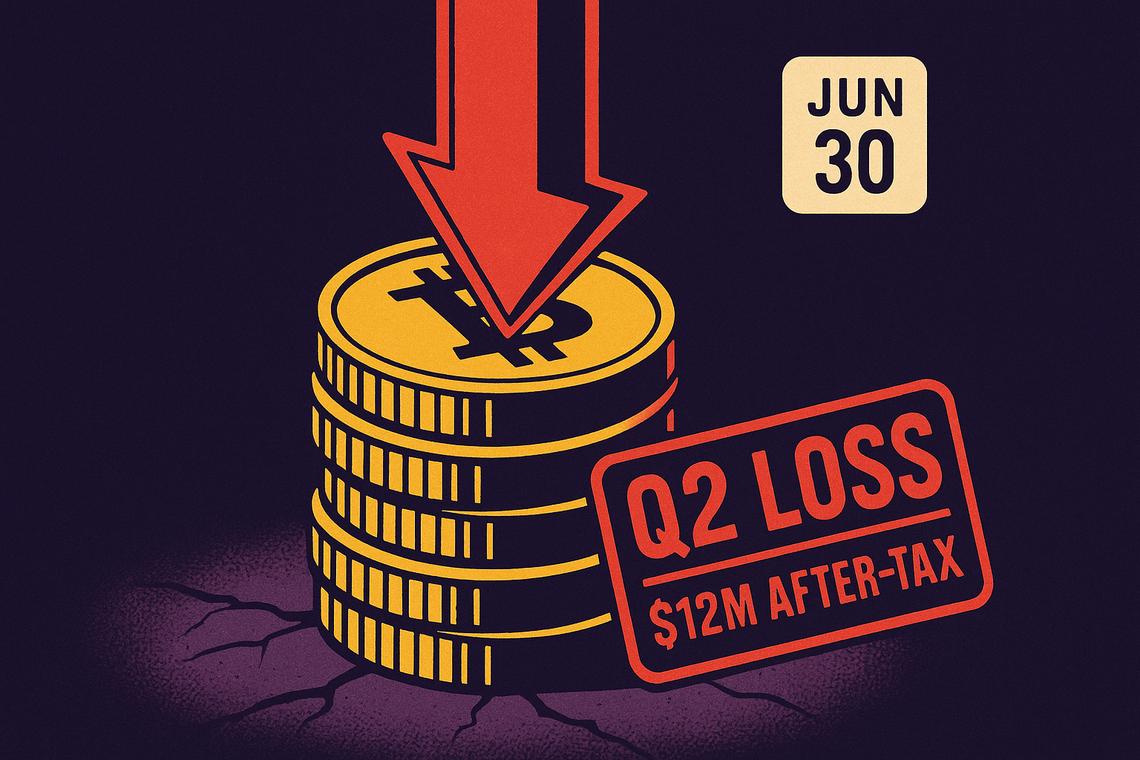
Tesla posted a $112 million after-tax Bitcoin loss in Q2 2026 — without selling a single coin. That contradiction sits at the heart of how modern cryptocurrency accounting works, and it tells a more complicated story than the headline number suggests.
Summary
Key takeaways
- Tesla reported a $112 million after-tax loss on its Bitcoin holdings in Q2 2026, driven entirely by a price decline during the quarter, not by any sale.
- The company holds 11,509 BTC, a position unchanged since 2022, worth approximately $758 million at post-earnings prices.
- Bitcoin fell roughly 14% during Q2 2026, from around $83,000 to $58,000, before rebounding to $65,840 after quarter-end — but accounting rules locked in the lower valuation.
- Tesla follows the 2024 Financial Accounting Standards Board cryptocurrency guidelines, which require fair value adjustments each quarter.
- Q2 2026 automotive revenue hit $28.2 billion, beating Wall Street forecasts, while adjusted EPS of $0.33 missed the $0.55 analyst consensus.
Tesla’s Bitcoin Loss and Holdings in Q2 2026
The Tesla Bitcoin loss this quarter has a specific and somewhat frustrating logic behind it. Tesla didn’t trade any cryptocurrency. It didn’t panic-sell into a downturn. Its 11,509 BTC position sat completely untouched. And yet, under current accounting rules, the company was required to mark those holdings to the Bitcoin price at the end of June — which happened to be near the quarter’s low.
Bitcoin price volatility and the accounting mechanism that locked in the loss
Bitcoin entered Q2 2026 trading around $83,000 before sliding to approximately $58,000 by the end of June, a decline of roughly 14% amid broader macroeconomic uncertainty. That closing price is what matters for the financial statement. By the time Tesla announced earnings, Bitcoin had already recovered to around $65,840 — but that recovery was invisible to the quarterly report.
This is the core mechanic. The 2024 Financial Accounting Standards Board guidelines that Tesla adopted require companies to recognize changes in the fair value of digital assets each reporting period. The result is a $112 million figure that reads like a loss but reflects no actual cash movement. No Bitcoin was bought, none was sold — the number is purely a function of where the price sat on the last day of June.
It also wasn’t a one-off. Tesla recorded a $173 million digital asset loss in Q1 2026 using the identical methodology. Taken together, that’s nearly $285 million in reported crypto-related losses across the first half of 2026, all from a static position.
Stable Bitcoin reserves since 2022
Tesla’s BTC position has remained frozen at 11,509 BTC for nearly four years. The company has neither accumulated more nor reduced its remaining stake since 2022, which makes it a passive holder in a market defined by active institutional players like Strategy, which has continued to aggressively buy Bitcoin throughout this period.
At the post-earnings Bitcoin price of $65,840, Tesla’s holding carries a market value of approximately $758 million — a meaningful asset on the balance sheet, but one generating accounting volatility that complicates the earnings narrative each quarter.
Background on Tesla’s Bitcoin Investment and Strategic Decisions
Tesla’s relationship with Bitcoin has evolved through three distinct phases: enthusiasm, retreat, and now quiet persistence.
Initial purchase and the payments program
The company entered the market in February 2021 with a $1.5 billion Bitcoin acquisition, disclosed through regulatory filings. Shortly after, Tesla briefly enabled Bitcoin as a payment method for vehicle purchases in the United States. That program lasted only a few months before CEO Elon Musk suspended it in May 2021, citing environmental concerns related to the energy consumption of cryptocurrency mining.
The 2022 partial sale and what has stayed since
During Q2 2022, Tesla liquidated approximately 75% of its Bitcoin holdings, generating roughly $936 million in proceeds. Musk described the decision as driven by liquidity needs related to operational challenges in China during COVID-19 — not a fundamental change in the company’s view on cryptocurrency. The remaining stake, those 11,509 BTC, has survived everything since: Bitcoin’s crash below $16,000 in late 2022, subsequent recoveries, and multiple cycles of volatility.
That durability is analytically significant. Tesla has sat through some of the most severe Bitcoin drawdowns in history without blinking. Whether that reflects strategic conviction, institutional inertia, or simply a decision to avoid realizing the position at unfavorable prices is something Tesla’s earnings materials have never clarified.
Tesla’s Broader Q2 2026 Financial Performance
Strip out the Bitcoin accounting noise and Tesla’s Q2 numbers tell a mixed but largely operational story.
Automotive revenue and delivery results
Total revenue came in at $28.2 billion, comfortably ahead of Wall Street’s consensus forecast of $26.4 billion and representing meaningful growth from the $22.5 billion recorded in the same period a year earlier. Vehicle deliveries reached 480,126 units during the quarter, reflecting approximately 25% year-over-year growth — a figure that underscores continued demand strength for Tesla’s core product lineup.
Profit margins and the EPS miss
The profit picture was less clean. Adjusted earnings per share came in at $0.33, falling well short of the $0.55 analyst consensus. GAAP net income totaled $1.11 billion, a slight decline from $1.17 billion in Q2 2025. Automotive gross margin excluding regulatory credits measured 16.3%, an improvement from 15% a year ago but a notable step down from the 19.2% achieved in Q1 2026.
Free cash flow turned negative at $1.1 billion for the quarter, driven by heavy capital deployment into AI computing infrastructure, expanded production capacity, autonomous vehicle development, and the Optimus humanoid robot program. Tesla closed the period with approximately $43.5 billion in cash and marketable securities.
The Bitcoin write-down added reporting complexity, but it was a non-cash item — Tesla’s actual cryptocurrency holdings remain physically intact. The more pointed question for investors is whether the company’s automotive margins can sustain their recovery trajectory while capital expenditures remain elevated across multiple long-horizon bets. Those two pressures, not the BTC accounting adjustment, are what will shape Tesla’s financial narrative into the second half of 2026.
FAQ
Why did Tesla report a Bitcoin loss in Q2 2026 despite not selling any Bitcoin?
Tesla was required to adjust the reported value of its Bitcoin holdings based on the quarter-end price, which had dropped to approximately $58,000 by the end of June. Under the 2024 Financial Accounting Standards Board guidelines, this fair value decline was recorded as a $112 million after-tax loss, even though no coins were sold and no cash changed hands.
How much Bitcoin does Tesla currently hold and since when?
Tesla holds 11,509 BTC, a position that has remained unchanged since 2022, following the company’s partial sale of roughly 75% of its original holdings in Q2 of that year.
What accounting standards does Tesla follow for cryptocurrency reporting?
Tesla follows the updated cryptocurrency accounting guidelines issued by the Financial Accounting Standards Board in 2024. These rules require quarterly fair value adjustments on digital asset holdings, treating price movements as adjustments to earnings rather than traditional impairment write-downs.
How did Tesla’s automotive business perform in Q2 2026?
Tesla’s automotive revenue reached $28.2 billion, beating Wall Street forecasts, while vehicle deliveries grew approximately 25% year-over-year to 480,126 units. Automotive gross margin excluding regulatory credits was 16.3%. However, adjusted EPS of $0.33 missed the $0.55 analyst consensus, and free cash flow was negative at $1.1 billion.
Article produced with the assistance of artificial intelligence and reviewed by the editorial team.
