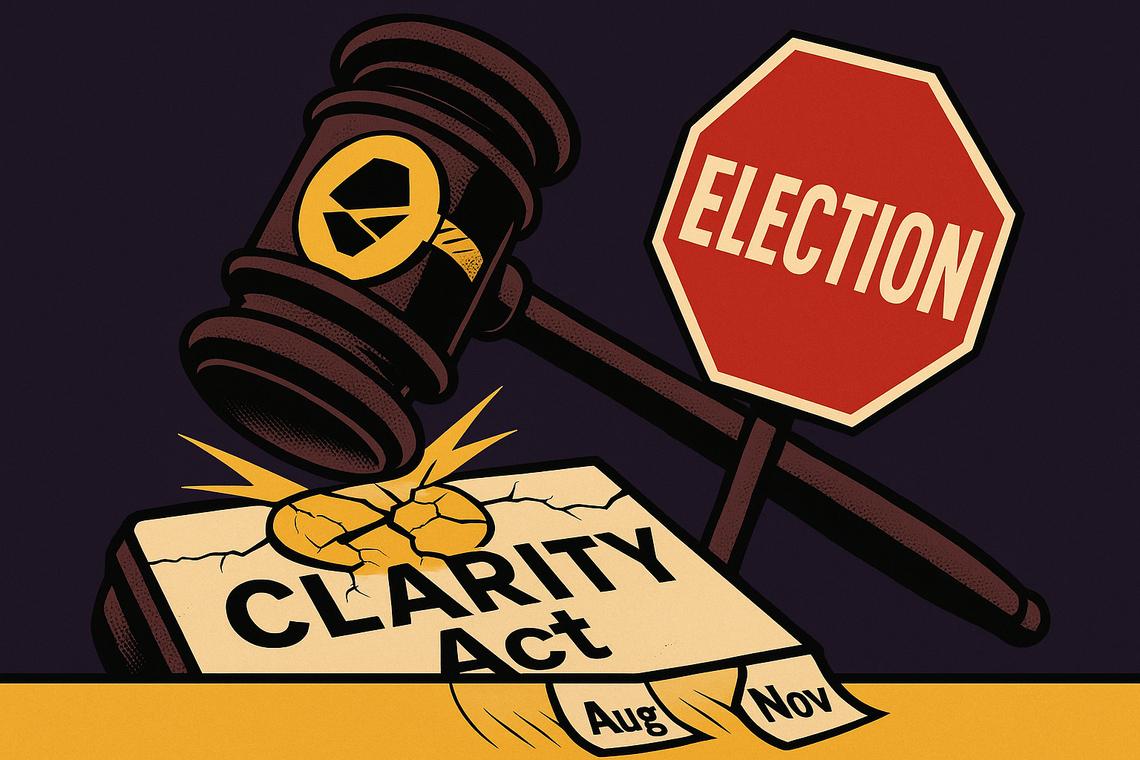
The crypto industry has spent the better part of eighteen months pushing for the CLARITY Act crypto bill, a sweeping piece of legislation designed to give digital assets a permanent, predictable legal foundation in the United States. Now, that effort is running into a wall — and the wall has a name: election season.
Summary
Key takeaways
- Senate Majority Leader John Thune confirmed the CLARITY Act will not pass before the August recess, dealing a significant blow to the crypto industry’s 2026 timeline.
- Prediction markets on Polymarket put the bill’s odds of passing this year at roughly 37%, down sharply from over 80% earlier in 2026.
- Democrats are conditioning support on ethics provisions targeting conflicts of interest tied to Donald Trump‘s crypto dealings, which have generated over $2 billion for his family.
- Republicans proposed a new draft including ethics language, but critics say it contains significant loopholes.
- Policy expert Ron Hammond of Wintermute sees a narrow but real window for passage after the November midterm elections.
What the CLARITY Act was supposed to do
At its core, the CLARITY Act aims to bring blockchain assets and digital tokens firmly within the regulatory perimeter of mainstream finance. The bill would establish clear rules for how crypto projects are classified, traded, and overseen — ending years of legal ambiguity that has left companies, investors, and regulators guessing. For the crypto industry, it represents the single highest policy priority, surpassing even last year’s stablecoin-focused GENIUS Act.
That ambition is exactly why the stakes around its delay feel so high. Without a statutory framework, U.S. crypto activity continues to operate in a gray zone, and every month of inaction is a month of regulatory uncertainty for an industry already navigating a volatile environment.
Senate delays and the August recess problem
The immediate obstacle is a calendrical one. Senate Majority Leader John Thune told reporters he does not expect the Senate to pass the bill before lawmakers scatter for their long summer recess. His exact words signaled a softer door: “I would like to at least get Clarity started. We’ll see where the votes are.” That framing — get the floor process rolling before recess — suggests the bill could technically begin its Senate journey in the first week of August, even if a final vote is off the table.
White House crypto adviser Patrick Witt pushed back on Thune’s pessimism, telling CoinDesk he was “perplexed” by the remarks and remained “slightly more optimistic” about the first week of August. But the math is unforgiving. The Senate needs a 60-vote threshold to advance major legislation, and the CLARITY Act is not currently guaranteed even a simple majority — some Republican senators have raised concerns about its stablecoin yield language and the government ethics provision, according to CoinDesk.
The midterm election shadow
After the August recess, the Senate returns for roughly three weeks in September. That window is tight, and it comes loaded with competing priorities — government funding, defense authorization, and now a bipartisan sanctions bill championed by the late Senator Lindsey Graham. The crypto industry’s flagship bill risks getting squeezed out entirely.
Then there are the November midterm elections. Once campaigns dominate lawmakers’ attention, bipartisan dealmaking on something as contested as crypto regulation becomes exponentially harder. The bill’s fate now hinges not just on whether the votes exist, but on whether political conditions allow those votes to be cast.
Ethical controversies surrounding Trump and the bill’s provisions
The deepest obstacle to the CLARITY Act is not procedural — it’s political. Trump’s crypto activities, including the sale of memecoins and his family’s stake in World Liberty Financial, have generated over $2 billion for the first family. Democrats view this as a direct conflict of interest and have made ethics provisions a condition of their support.
Democrats push for ethics provisions
Senate Minority Leader Chuck Schumer recently directed his caucus to center their midterm messaging on Trump and corruption allegations — a directive that makes Democratic support for a crypto bill seen as benefiting the president politically difficult to sell to voters. As Fortune reported, this has made Democrats reluctant to hand the administration a legislative win on crypto without meaningful guardrails.
Republican stance shifts, but questions remain
Republicans initially resisted any ethics language, reflecting Trump’s own opposition. But in a notable shift within the past week, a new draft of the bill emerged that includes provisions aimed at stopping elected officials from profiting from crypto. The catch: skeptics, including key Democratic lawmakers, say those provisions appear to contain significant loopholes that could render them ineffective. Senator Cynthia Lummis, a lead Republican negotiator on the bill, acknowledged the most contentious sections remain open for revision — which she argued could bring Democrats on board if resolved.
This dynamic illustrates a broader tension at the heart of the legislation: both parties nominally support the bill’s core market structure goals, but neither side is willing to hand the other a political victory without extracting something first. That standoff is precisely what opponents of the bill have been counting on.
Strategic opposition and industry responses
According to Ron Hammond, head of Policy and Advocacy at crypto trading firm Wintermute, the delay Thune announced this week did not happen in a vacuum. It reflects a deliberate strategy by banks and other crypto skeptics to drag out the debate and run out the legislative clock — a tactic that has, at least for now, worked. The combination of institutional resistance and election-year politics has created a convergence of pressure that the bill’s supporters were unable to overcome before the recess.
Still, Hammond stopped short of writing off the bill’s prospects. “The votes are there, but the election politics are louder. The latter will dissipate after November and that’s a narrow but very possible window,” he said. That cautious optimism carries weight from someone with deep experience in Washington crypto policy, but it also underlines just how contingent the bill’s survival has become on forces outside the crypto industry’s control.
What prediction markets are pricing in
The clearest real-time read on sentiment comes from Polymarket, where the implied probability of the CLARITY Act passing in 2026 stood at around 37% as of Friday — a significant drop from highs above 80% earlier in the year and from a brief spike to 43% when unverified reports emerged that Trump had agreed to an ethics deal. The market’s current pricing reflects the accumulated weight of missed deadlines, unresolved ethics disputes, and the looming distraction of midterm campaigns.
That 37% figure is not a death sentence. But it signals that the majority of informed bettors now view failure as the more likely outcome for 2026. For an industry that entered this year expecting a landmark legislative win, that shift in expectations carries its own consequences — for regulatory planning, for investment decisions, and for the broader narrative around U.S. crypto policy leadership.
What happens after November matters enormously. Democrats could potentially retake the House and make Senate gains, reshaping the entire negotiating dynamic for any post-election lame-duck session. A new congressional composition might demand a completely renegotiated bill — one where the ethics provisions look very different, the loopholes are closed or expanded, and the balance of power between crypto advocates and skeptics has shifted. The industry may ultimately get its regulatory framework, but the version that emerges from that process could look quite different from what it has been negotiating for the past year and a half.
FAQ
What is the purpose of the CLARITY Act?
The CLARITY Act aims to provide a predictable regulatory framework for digital assets in the U.S., placing blockchain tokens and crypto projects firmly within the realm of mainstream finance and establishing clear rules for classification and oversight.
Why is the CLARITY Act’s passage delayed?
Delays stem from three converging forces: political tensions driven by the upcoming November midterm elections, ethical controversies tied to Donald Trump’s crypto dealings, and a deliberate strategy by banks and crypto skeptics to drag out the legislative debate and exhaust the available calendar.
How do ethical concerns regarding Donald Trump affect the bill?
Democrats are demanding the bill include ethics provisions to prevent conflicts of interest, given that Trump and his family have reportedly made over $2 billion from memecoins and other crypto activities. Republicans initially resisted such provisions but recently introduced a draft that includes them, though critics say the language contains significant loopholes.
What are the chances of the CLARITY Act passing this year?
Prediction markets on Polymarket currently put the odds at approximately 37% — well below the highs of over 80% seen earlier in 2026, reflecting growing pessimism about the bill clearing Congress before the current congressional term ends in early January.
Article produced with the assistance of artificial intelligence and reviewed by the editorial team.