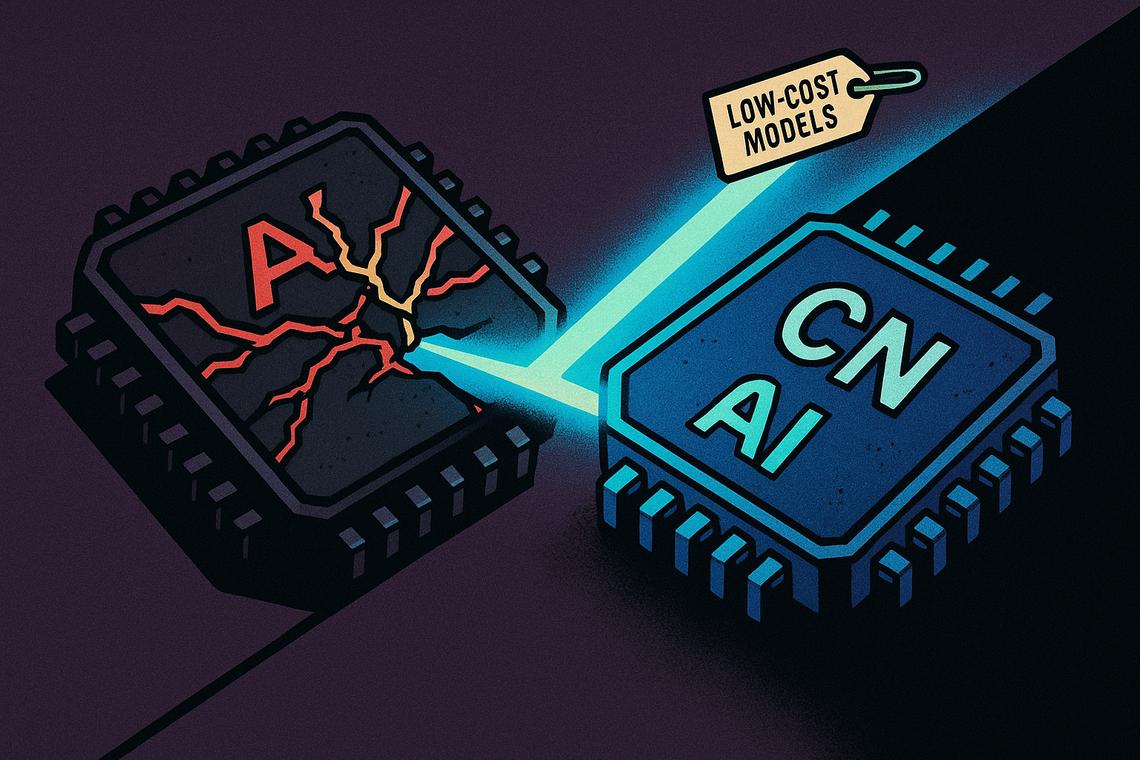
History has a way of rhyming loudest when the stakes are highest. The same industrial logic that built America’s first billionaire class — and eventually exposed it to foreign disruption — is now playing out again, this time not in steel mills but in the race for artificial intelligence dominance. And the parallels are sharper than most people in Silicon Valley would like to admit.
Summary
Key takeaways
- The AI industry mirrors the Gilded Age steel era: both created concentrated billionaire wealth through control of critical infrastructure.
- Chinese AI labs DeepSeek, Kimi, and Qwen are deploying low-cost models globally, applying scale and price pressure reminiscent of China’s steel dumping tactics.
- By spring 2026, Fortune reported the US-China AI gap had nearly vanished despite significantly higher US private investment.
- NYU Stern professor Scott Galloway described China’s approach in a May 2026 interview as “modern-day steel dumping”, warning that margin erosion for US tech firms is the endgame.
- The competition is not just a trade dispute — it is a structural fight over the wealth architecture of the next global economy.
Parallels Between the Steel Industry and the AI Industry
Steel didn’t just build bridges. It built the first modern American billionaire class — and in doing so, it created both a template for industrial dominance and a blueprint for its undoing. Today, artificial intelligence is filling that same role, with striking structural similarity.
The first American billionaire class from steel
In the decades around the turn of the 20th century, a surge in modern industrial capitalism fused financial consolidation with raw physical control. Andrew Carnegie and J.P. Morgan sat at the center of a system where owning the infrastructure — the mines, the mills, the railroads — was the same as owning the economy itself. Their power was double-edged: nation-builders to some, robber barons to others. Both characterizations were accurate. The fortunes they accumulated were Carnegie- and Rockefeller-sized, and they came from controlling chokepoints, which then allowed those men to shape labor markets, pricing, and policy for everyone else.
What made the steel era so durable was also what made it vulnerable: it was built on physical concentration. Control the blast furnace, control the country’s industrial metabolism.
Modern tech billionaires’ control of AI infrastructure
The stack has changed. The logic has not. Today’s tech oligarchs don’t own blast furnaces — they own cloud infrastructure, semiconductor supply chains, AI model layers, and the data pipelines that feed them. Elon Musk, for instance, was flirting with trillionaire status in recent months following the historic SpaceX IPO, a fortune that reflects the same kind of infrastructure lock-in that made Carnegie untouchable in his era.
As Fortune’s analysis notes, the winners in both eras controlled the infrastructure layer — mines, mills and railroads then; chips, clouds, AI models and data now — and converted that control into extraordinary wealth, political influence, and the ability to set the terms for everyone below them in the value chain. AI is now driving capital spending and market valuations in ways that make the current moment feel less like a technology cycle and more like an era-defining consolidation of economic power.
The uncomfortable parallel, as Fortune’s Nick Lichtenberg argues, is this: just as the steel barons thought they were building the future, today’s tech billionaires may be inheriting the vulnerabilities of an earlier age without fully recognizing it.
China’s Strategic Application of the Steel Playbook to AI
China’s approach to AI isn’t improvised. It follows a proven industrial script — one the country used to reshape global steel markets and that analysts say is now being applied with precision to artificial intelligence.
Industrial scale, subsidies, and price pressure
As early as July 2024, commentator Susan Ariel Aaronson warned in Fortune that AI could become the “new steel” if governments overbuilt capacity and created a supply glut that tipped into dumping. By 2026, that warning had effectively materialized. Reporting from Bloomberg, The New York Times, and the Washington Examiner indicated that Beijing was backing industrial-scale AI deployment, favoring broad distribution over prestige, and pushing lower-cost supply into global markets — accepting short-term profit sacrifices in exchange for market share expansion. The Washington Examiner framed it as a “TikTok playbook” for AI: saturate the market, win the users, and worry about margins later.
The U.S.-China Economic and Security Review Commission has described China’s approach as a familiar industrial playbook, now applied to open-source software, embodied AI, and the broader industrial base.
Chinese AI companies driving low-cost global competition
The competitive pressure is no longer theoretical. Chinese labs — DeepSeek, Kimi, and Qwen — are being deployed as low-cost, widely available alternatives to US offerings, designed to win users quickly and compress the margins that US firms depend on to justify their valuations.
DeepSeek had released models in early 2025 that matched the performance of top US counterparts while reportedly using minimal budgets and second-tier hardware. The broader signal from Chinese AI developers: they can continue innovating even under chip export controls, and they are doing it cheaper.
Market Impact and Expert Perspectives on US-China AI Competition
The market consequences are real and measurable, and the expert community is no longer hedging its language about what China is doing.
Nearing closure of the US-China AI gap
Fortune’s own reporting showed that the US-China AI gap had nearly vanished by spring 2026, even as US private investment remained far larger than China’s. That asymmetry — more money in, narrower lead out — maps directly onto the steel era dynamic: America won the first-mover story, but China eventually won on volume. The pattern is repeating.
Expert view: China’s approach as modern-day steel dumping
NYU Stern professor Scott Galloway put it most directly. In a May 2026 appearance on The Diary of a CEO podcast, he described China’s tactic as “modern-day steel dumping” — a deliberate strategy of pushing cheap AI into US and global markets, forcing prices down, consolidating the market, and eventually gaining margin power once competitors have been squeezed out or weakened. He added, pointedly, that America’s billionaire class is already preparing for the possibility of an AI boom collapse.
That framing deserves serious attention. In traditional steel dumping, the goal was never just to sell cheaply — it was to outlast the competition, restructure market power, and capture pricing authority once rivals had exited or scaled back. If China’s AI strategy follows the same arc, the concern isn’t just about today’s model benchmarks. It’s about who controls AI pricing and infrastructure five years from now.
Broader implications for wealth and economic architecture
What makes this moment analytically significant is the scale of what is actually being contested. This is not a standard trade rivalry over commodity margins. The sector being fought over is the one currently minting today’s largest fortunes and, according to Fortune’s analysis, defining the architecture of the next economy. Whoever controls the AI infrastructure layer — as Carnegie controlled steel, as Rockefeller controlled oil — will exert structural influence over capital allocation, labor markets, and policy in ways that compound over decades.
China’s industrial tactics — scale, subsidy, price pressure — are specifically calibrated to test whether US AI dominance is genuinely durable or whether it rests on first-mover advantages that can be eroded the same way steel dominance was. DeepSeek’s suspension of its second fundraising round in late July 2026, reported by Bloomberg, adds a layer of uncertainty to the Chinese side as well: the lab told prospective investors it would not be signing investment agreements as expected, following controversy over comments from founder Liang Wenfeng about US-Chinese AI competition. The fundraising pause does not diminish China’s strategic momentum, but it does introduce a variable into the timeline.
Every dominant infrastructure era creates both extraordinary wealth and a target for the next wave of industrial disruption. Steel made Carnegie. It also made him vulnerable. The men currently building the second American billionaire class on AI infrastructure may be about to learn the same lesson — from the same playbook, just run by a different country.
FAQ
How is the AI industry compared to the historical steel industry in the US?
The AI industry mirrors the steel industry by creating concentrated wealth through control of critical infrastructure. Steel barons like Andrew Carnegie and J.P. Morgan controlled mines, mills, and railroads; today’s tech billionaires control chips, cloud platforms, AI models, and data. In both eras, owning the infrastructure layer translated into extraordinary wealth, political influence, and the power to shape markets for everyone else.
What strategy is China using in the AI market similar to historical steel tactics?
China is leveraging industrial scale, state subsidies, and aggressive price pressure — a strategy analysts compare to steel dumping — to push low-cost AI solutions into global markets. Beijing’s goal, as reported by Bloomberg and The New York Times, is to expand global market share even if profitability is delayed. Chinese labs including DeepSeek, Kimi, and Qwen are central to this deployment strategy.
What impact has China’s AI strategy had on the US-China AI competitive gap?
By spring 2026, Fortune’s reporting showed the US-China AI gap had nearly vanished, despite US private investment remaining significantly larger than China’s. Chinese AI capabilities have caught up rapidly, even under US chip export controls.
What does the term “modern-day steel dumping” refer to in the context of AI?
The term, used by NYU Stern professor Scott Galloway in a May 2026 interview, refers to China aggressively distributing cheap AI products internationally to undercut US competitors, compress their margins, and eventually gain pricing power once rivals have been weakened — mirroring how China’s steel industry used dumping to reshape global markets and erode Western producers’ competitive positions.
Article produced with the assistance of artificial intelligence and reviewed by the editorial team.